BRCGS Global Standard for Packaging Materials
Legal Compliance for Packaging Materials: Building a Legal Compliance Procedure
A documented legal compliance procedure proves your packaging meets the law where it is made, supplied and used. This guide explains what the BRCGS Global Standard for Packaging Materials expects, the four steps to build the procedure, and the records auditors ask to see.
Requirement overview
What the standard requires for legal compliance
The BRCGS Global Standard for Packaging Materials requires sites to make sure all packaging materials comply with the legal and regulatory requirements of the countries where they are made, distributed and used. This covers substances used in manufacturing, food contact safety, labeling and environmental rules.
The standard requires a documented process to make sure that, where legislation applies, materials meet the legal requirements in the country of manufacture and in the countries where the packaging is supplied or used.
Failing to verify and document legal compliance can lead to regulatory penalties, product recalls or customer complaints, especially for food-contact and consumer-facing materials.
Key compliance objectives
✓ Verify that all packaging materials meet legal and safety standards
✓ Keep declarations of compliance from raw material suppliers
✓ Monitor regulatory updates for target markets
✓ Keep evidence of assessments, certifications and approvals
Step by step
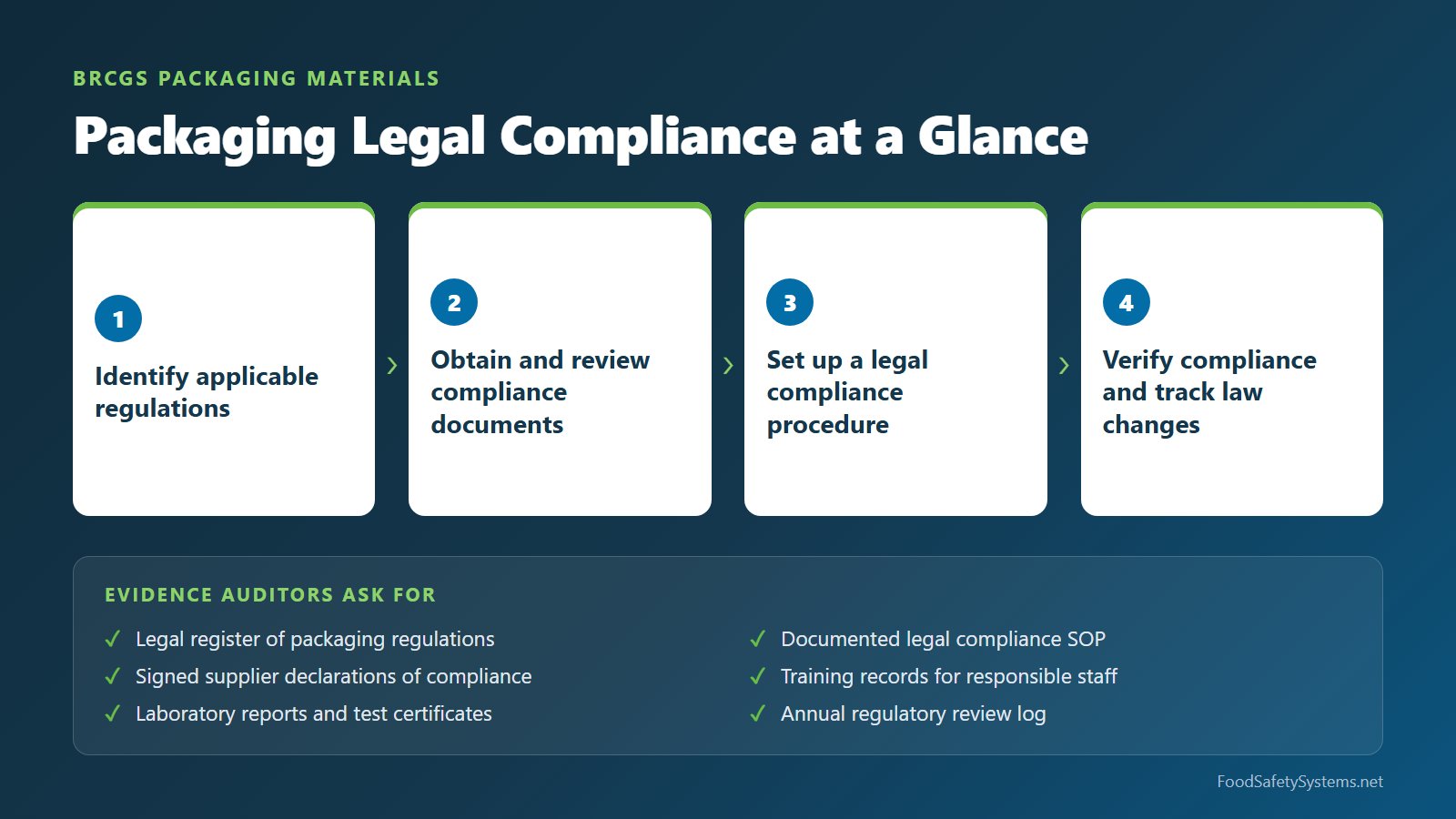
Four steps to a legal compliance procedure
Work through these steps in order. Each one lists what to put in place and the records that prove it works.
Step 1
Identify applicable regulatory requirements
What to put in place
✓ Food contact safety regulations (for example EU Regulation 10/2011, FDA 21 CFR)
✓ Chemical restrictions (for example REACH, Prop 65, SVHC)
✓ Environmental claims or labeling laws
✓ Heavy metal or migration limits for inks, adhesives and plastics
Evidence to maintain
✓ Legal register of applicable packaging regulations
✓ Risk assessments by market or country
✓ Summary of client or product-specific requirements
Step 2
Obtain and review compliance documentation
What to put in place
✓ Declarations of compliance (DoC)
✓ Material safety data sheets (MSDS)
✓ Analytical test reports (for example migration, heavy metal content)
✓ Certificates for recyclability, compostability or sustainability
Evidence to maintain
✓ Signed DoCs from material and component suppliers
✓ Validated laboratory reports and test certificates
✓ Supplier approval files with compliance documentation
Step 3
Establish a legal compliance procedure
What to put in place
✓ How regulatory requirements are identified and updated
✓ How supplier documents are requested, reviewed and approved
✓ Who maintains compliance and updates clients
Evidence to maintain
✓ Documented legal compliance SOP
✓ Compliance approval workflow or checklist
✓ Training records for responsible personnel
Step 4
Verify ongoing compliance and regulatory changes
What to put in place
✓ Review compliance certificates annually or with each change
✓ Monitor regulatory changes in each market of use
✓ Audit suppliers for ongoing conformance
Evidence to maintain
✓ Annual regulatory review log
✓ Supplier re-evaluation or requalification records
✓ Document updates following changes in the law
Avoid nonconformities
Common legal compliance audit findings and how to fix them
Missing or outdated declarations of compliance
Fix: request and archive valid supplier documents every year.
No documented legal compliance procedure
Fix: write and implement an SOP that meets the standard's legal compliance requirements.
No regulatory awareness for export markets
Fix: keep a country-specific regulatory checklist.
Incomplete review of multi-component materials
Fix: get compliance evidence for every subcomponent, such as inks and adhesives.
Audit day
Auditor verification checklist
During a BRCGS audit, expect to present:
✓ Legal compliance procedure and regulatory register
✓ Valid supplier declarations and supporting test results
✓ Records of ongoing verification and change monitoring
✓ Evidence of staff training on the legal compliance process
The benefit
Why legal compliance matters
A working legal compliance procedure does more than pass the audit:
✓ Keeps your packaging legally safe and fit for purpose
✓ Helps prevent costly recalls and regulatory action
✓ Strengthens buyer trust and certification performance
✓ Shows leadership in product stewardship and responsibility
Implementation roadmap
From legal register to continuous improvement
Phase 1
Build your compliance system
✓ Identify applicable laws for all target markets
✓ Write a legal compliance SOP for packaging materials
Phase 2
Verify and maintain
✓ Collect and validate declarations and test data from suppliers
✓ Keep a compliance file for each packaging component
Phase 3
Monitor and audit
✓ Review documents annually or when components change
✓ Audit supplier compliance and update regulatory reviews
Phase 4
Improve continuously
✓ Track changing regulations (for example PFAS, microplastics bans)
✓ Update procedures and staff training to match
FAQ
Legal compliance procedure questions
What does BRCGS Packaging Materials require for legal compliance?
A documented process to make sure that, where legislation applies, materials meet the legal requirements of the country of manufacture and of the countries where the packaging is supplied or used.
Which documents should we get from suppliers?
Declarations of compliance, material safety data sheets, analytical test reports such as migration or heavy metal results, and, where relevant, certificates for recyclability, compostability or sustainability.
How often should compliance documents be reviewed?
Review compliance certificates annually or whenever a component changes, and keep monitoring regulatory changes in each market where the packaging is used.
Related guides
More BRCGS Packaging Materials guides
Packaging Design Control
Control packaging design, reviews, approvals and changes.
Read the guide →
Material Hazard Management
Risk-assess raw materials and build it into supplier approval.
Read the guide →
Specifications for Materials & Packaging
Keep raw material, packaging and finished product specifications current.
Read the guide →
Get your legal compliance procedure audit-ready
We provide legal compliance SOP templates for packaging materials, country-specific packaging compliance checklists, supplier document request forms and training guides for QA and purchasing teams.
Food Safety Systems is an independent consulting provider and is not affiliated with, endorsed by or certified by BRCGS or the British Retail Consortium. BRCGS® is a registered trademark of the British Retail Consortium Trading Ltd. For official requirements, visit www.brcgs.com. Read our disclaimer.