
BRCGS Food Safety Issue 9 · Section 6.4
BRCGS Calibration and Verification Procedure: Section 6.4 Guide
A documented calibration and verification procedure keeps the equipment you use to monitor food safety, legality and quality accurate and reliable. This guide explains what BRCGS Section 6.4 expects, the four steps to set it up, and the evidence auditors ask to see.
Requirement overview
What BRCGS Section 6.4 requires
BRCGS Food Safety Issue 9, Section 6.4 requires the site to make sure that all measuring and monitoring equipment critical to food safety, legality or quality is calibrated and verified at scheduled intervals.
The site must identify and control the measuring equipment used to monitor critical control points, product safety, legality and quality, and have a documented calibration and verification procedure in place.
Proper calibration keeps the equipment that controls or verifies food safety processes accurate, and helps prevent false readings that could lead to unsafe or non-compliant products.
Key compliance objectives
✓ Identify all equipment used for food safety and quality monitoring
✓ Use trained personnel or approved vendors for calibration
✓ Verify measuring equipment accuracy regularly
✓ Keep calibration records and non-conformance procedures
Step by step
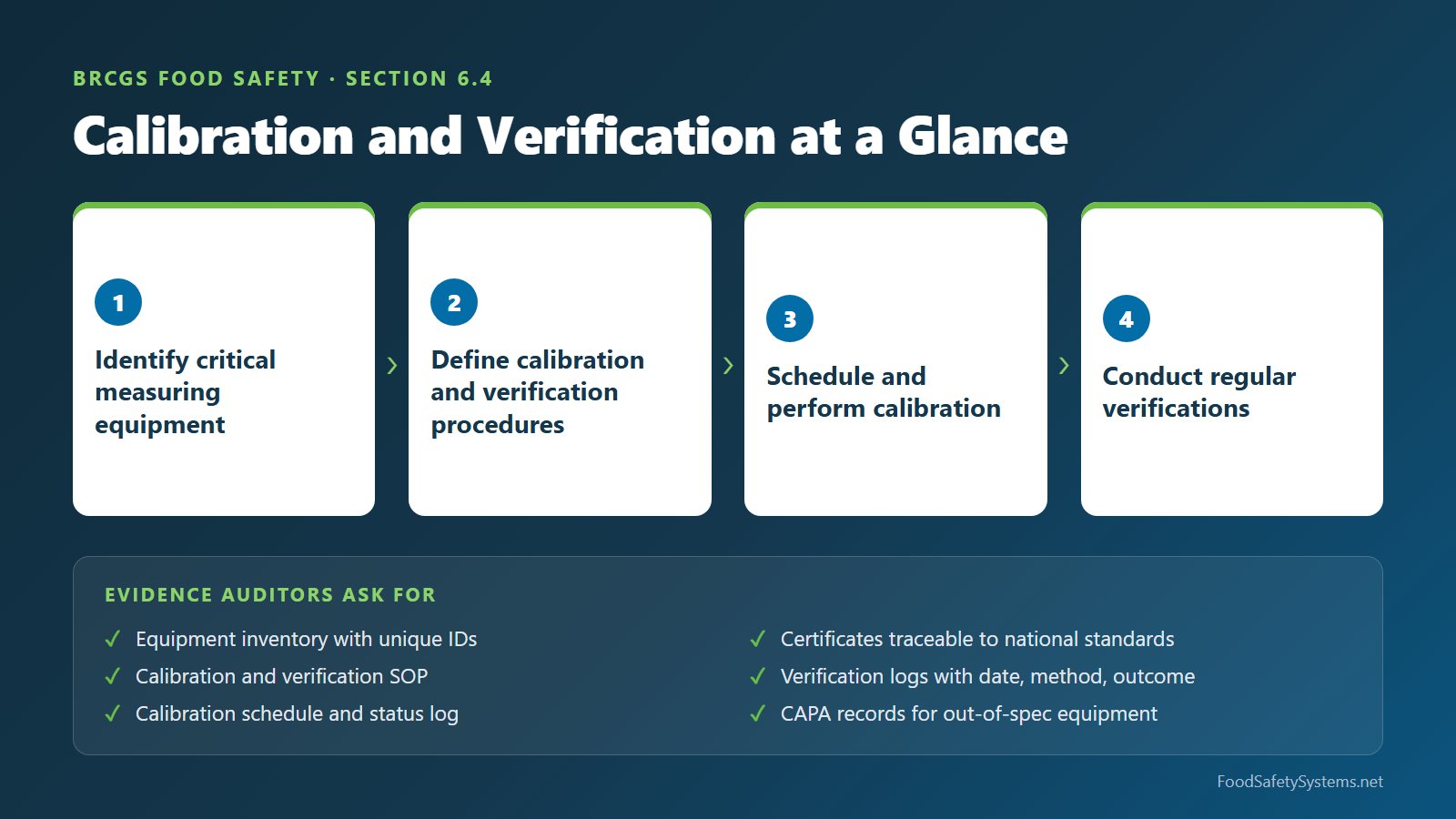
Four steps to a compliant calibration and verification procedure
Work through these steps in order. Each one lists what to put in place and the records that prove it works.
Step 1
Identify critical measuring equipment
What to put in place
✓ Thermometers, scales, metal detectors, pH meters and checkweighers
✓ Any device used to monitor CCPs or legal compliance
Evidence to maintain
✓ Equipment inventory list with unique ID numbers
✓ Documentation linking equipment to CCPs or quality checks
✓ Equipment specification sheets
Step 2
Define calibration and verification procedures
What to put in place
✓ Calibration frequency and acceptable tolerance limits
✓ Methods of calibration, internal or third-party
✓ Required certifications or traceability to national standards
Evidence to maintain
✓ Calibration SOPs
✓ Service provider certifications or traceability certificates
✓ Internal verification logs and methods
Step 3
Schedule and perform calibration
What to put in place
✓ Frequency based on equipment risk and usage
✓ Calibration performed only by trained or qualified personnel
✓ Out-of-tolerance equipment clearly tagged and removed from use
Evidence to maintain
✓ Calibration schedule and status log
✓ Tagged or quarantined non-compliant equipment
✓ Completed calibration reports with pass/fail status
Step 4
Conduct regular verifications
What to put in place
✓ Ice-point or boiling-point checks for thermometers
✓ Certified test weights for scales
✓ Internal performance checks for metal detectors
Evidence to maintain
✓ Verification logs with date, method and outcome
✓ Signed and dated calibration and verification certificates
✓ CAPA logs if equipment is found out of spec
Avoid nonconformities
Common calibration audit findings and how to fix them
No calibration procedure in place
Fix: develop and document a formal calibration and verification SOP.
Inadequate calibration frequency
Fix: adjust schedules based on risk and manufacturer recommendations.
Missing or expired calibration certificates
Fix: keep a central log with updated records and supplier credentials.
Equipment used despite failed calibration
Fix: set up quarantine tagging and alternative equipment protocols.
Audit day
Auditor verification checklist
During a BRCGS audit, expect to provide:
✓ A documented calibration and verification SOP
✓ An up-to-date calibration schedule
✓ Calibration and verification records for all critical equipment
✓ Certificates of calibration traceable to national standards
✓ Evidence of corrective actions for any out-of-spec results
The benefit
Why calibration and verification matter
Accurate equipment does more than pass the audit:
✓ Keeps critical food safety and quality measurements reliable
✓ Prevents production of unsafe or non-compliant products
✓ Reduces audit and regulatory risk
✓ Shows operational control and technical competency
Implementation roadmap
From equipment inventory to continuous improvement
Phase 1
Build your program
✓ Create an equipment inventory and risk categories
✓ Develop a calibration and verification SOP
Phase 2
Train and execute
✓ Assign trained personnel or approved service providers
✓ Calibrate equipment on schedule and document results
Phase 3
Monitor and record
✓ Track verification results and trends
✓ Immediately remove or tag out-of-tolerance equipment
Phase 4
Improve continuously
✓ Review non-conformance trends
✓ Update calibration procedures as operations change
FAQ
Calibration and verification procedure questions
Which equipment needs calibration under BRCGS Section 6.4?
Measuring and monitoring equipment critical to food safety, legality or quality, such as thermometers, scales, metal detectors, pH meters, checkweighers and any device used to monitor CCPs or legal compliance.
What is the difference between calibration and verification?
Calibration is carried out at a defined frequency, internally or by a third party, against set tolerance limits. Verification is a regular check in between, such as ice-point checks on thermometers, certified test weights on scales or performance checks on metal detectors.
What happens if equipment fails calibration?
Tag it clearly and remove it from use, quarantine it, and record corrective actions in your CAPA log. Have alternative equipment protocols ready so production does not rely on a failed device.
Related guides
More BRCGS process control guides
Process Monitoring & Control
Use calibrated instruments to monitor critical process parameters.
Read the guide →
Documented Processing Procedures
Write the process specifications and work instructions your checks support.
Read the guide →
Process Validation
Prove that key process steps deliver the intended food safety outcome.
Read the guide →
Get your calibration and verification procedure audit-ready
We provide calibration and verification SOP templates, equipment inventory and scheduling spreadsheets, training guides for internal verification procedures, and audit-ready logs and non-conformance forms.
Food Safety Systems is an independent consulting provider and is not affiliated with, endorsed by or certified by BRCGS or the British Retail Consortium. BRCGS® is a registered trademark of the British Retail Consortium Trading Ltd. For official requirements, visit www.brcgs.com. Read our disclaimer.