BRCGS Food Safety Issue 9 · Section 4.9
Chemical and Physical Contamination Controls: BRCGS Section 4.9 Guide
Chemical and physical contamination, from cleaning chemicals to glass, metal and hard plastic, puts products and consumers at risk. This guide shows what BRCGS Section 4.9 expects, the four steps to control it, and the evidence auditors ask to see.
Requirement overview
What BRCGS Section 4.9 requires
BRCGS Food Safety Section 4.9 requires controls that prevent contamination of food products by foreign materials, including chemicals, metal, glass, hard plastic and other physical hazards.
Sites need processes that manage the risk of chemical and physical contamination of raw materials, intermediate products and finished products. Controls must be tailored to the site's operations, clearly documented, verified and reviewed regularly.
Managing these risks well protects product integrity, consumer safety and regulatory compliance.
Key compliance objectives
✓ Identify potential sources of chemical and physical contamination
✓ Implement site-wide contamination prevention measures
✓ Validate and verify control effectiveness (detection, removal, segregation)
✓ Keep detailed records for traceability and audit readiness
Step by step
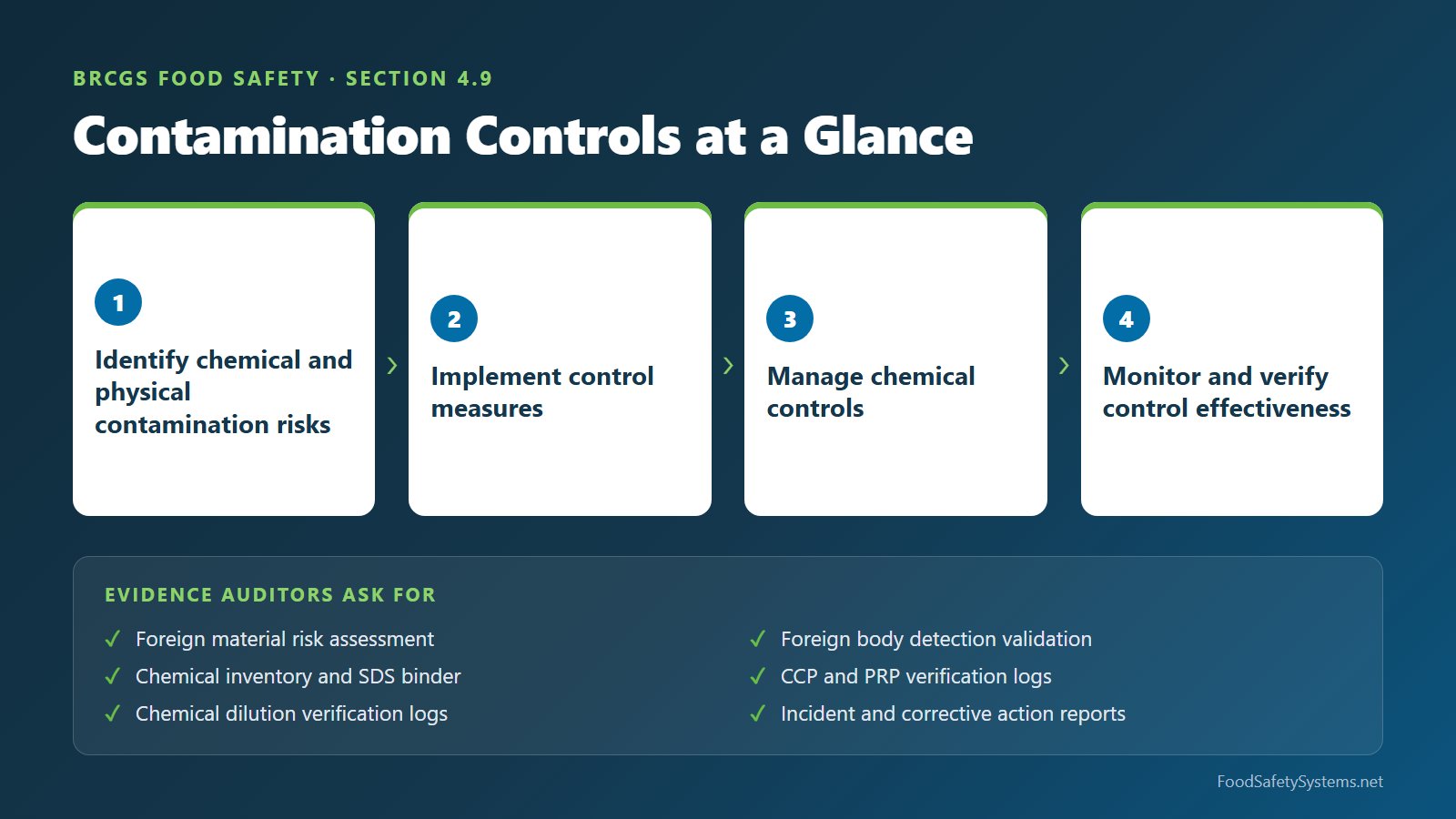
Four steps to control chemical and physical contamination
Work through these steps in order. Each one lists what to put in place and the records that prove it works.
Step 1
Identify contamination risks
What to put in place
✓ Cleaning chemicals, lubricants and pest control substances
✓ Glass, metal, wood and hard plastic from equipment or packaging
✓ Foreign materials from raw materials or poorly maintained infrastructure
Evidence to maintain
✓ Site-specific risk assessments
✓ Foreign material hazard analysis within the HACCP plan
✓ Equipment and area inspections
Step 2
Implement control measures
What to put in place
✓ Color-coded cleaning tools and segregated chemical storage
✓ Preventive maintenance of equipment and utensils
✓ Physical barriers such as light covers, mesh sieves and filters
✓ Foreign body detection such as metal detectors, X-ray and magnets
Evidence to maintain
✓ Cleaning and chemical usage SOPs
✓ Equipment maintenance logs
✓ CCP or PRP validation for foreign material detection systems
Step 3
Manage chemical controls
What to put in place
✓ Approved chemical list with Safety Data Sheets (SDS)
✓ Chemical use logs and concentration verification
✓ Segregated, labeled storage cabinets
✓ Trained staff handling food-safe and non-food-safe chemicals
Evidence to maintain
✓ Chemical inventory and SDS binder
✓ Chemical dilution verification logs
✓ Staff training records on safe handling
Step 4
Monitor and verify control effectiveness
What to put in place
✓ Regular audits of high-risk zones
✓ CCP monitoring, such as metal detector test wands
✓ Foreign material incident investigations
✓ Swab tests or product inspections where applicable
Evidence to maintain
✓ CCP and PRP verification logs
✓ Non-conformance and corrective action reports
✓ Internal inspection reports
Avoid nonconformities
Common contamination control audit findings and how to fix them
Unlabeled or improperly stored chemicals
Fix: implement chemical storage control procedures and signage.
Broken or damaged site infrastructure
Fix: add infrastructure condition to your site inspections.
Missing foreign body detection checks
Fix: document and verify CCP functionality routinely.
No foreign material risk assessment
Fix: build foreign object analysis into your HACCP plan and site assessments.
Audit day
Auditor verification checklist
During a BRCGS audit, be prepared to show:
✓ A risk assessment for foreign material contamination
✓ SOPs for chemical use, equipment maintenance and detection systems
✓ Validated procedures for metal detection or foreign body screening
✓ Records of equipment checks, chemical usage and incident investigations
The benefit
Why contamination controls matter
Strong controls do more than pass the audit:
✓ Prevent costly recalls and consumer harm
✓ Support compliance with BRCGS and regulatory requirements
✓ Protect brand reputation and product trust
✓ Demonstrate due diligence and robust site management
Implementation roadmap
From hazard analysis to continuous improvement
Phase 1
Build a contamination control plan
✓ Run a site-specific hazard analysis
✓ Identify high-risk materials and vulnerable steps
Phase 2
Train and equip teams
✓ Implement SOPs for chemical use and detection systems
✓ Train staff on contamination risk and prevention
Phase 3
Monitor and verify
✓ Check and test detection systems routinely
✓ Audit equipment, storage areas and production zones
Phase 4
Improve continuously
✓ Investigate and track all foreign body complaints and findings
✓ Review control measures and update SOPs based on results
FAQ
Chemical and physical contamination questions
What does BRCGS Section 4.9 cover?
Controls that prevent contamination of raw materials, intermediate products and finished products by chemicals and foreign materials such as metal, glass, wood and hard plastic.
How should cleaning chemicals be controlled?
Keep an approved chemical list with Safety Data Sheets, store chemicals in segregated and labeled cabinets, log use and verify concentrations, and train the staff who handle them.
How do we show foreign body detection works?
Validate detection systems such as metal detectors as a CCP or PRP, check them routinely (for example with test wands) and keep the verification logs and any corrective action reports.
Related guides
More BRCGS site standards guides
Cleaning & Sanitation
Documented cleaning procedures and chemical control for hygienic premises.
Read the guide →
Equipment Suitability & Calibration
Keep equipment fit for purpose, maintained and accurately calibrated.
Read the guide →
Maintenance & Repair
Planned and reactive maintenance that does not put product at risk.
Read the guide →
Get your chemical and physical contamination controls audit-ready
We provide chemical and physical hazard control templates, foreign body detection validation checklists, SOPs for chemical storage, tool maintenance and zone inspections, and contamination control training guides for production teams.
Food Safety Systems is an independent consulting provider and is not affiliated with, endorsed by or certified by BRCGS or the British Retail Consortium. BRCGS® is a registered trademark of the British Retail Consortium Trading Ltd. For official requirements, visit www.brcgs.com. Read our disclaimer.