BRCGS Food Safety Issue 9
BRCGS Food Safety Compliance Checklist: System Requirements
Use this BRCGS Food Safety Compliance Checklist to review the 12 requirement areas a food manufacturer's system must cover, from senior management commitment and HACCP to traded products, food defense and internal audits.
Requirement overview
What the BRCGS Food Safety Standard expects
Food manufacturers must implement a comprehensive food safety management system to meet the requirements of the BRCGS Global Standard for Food Safety Issue 9.
The framework helps you stay compliant with regulations, protect consumers and demonstrate due diligence to customers worldwide.
The checklist below groups the system into 12 requirement areas, each with the key controls and records to have in place before certification.
What a compliant system shows
✓ Regulatory compliance across all operations
✓ Protection of consumers
✓ Due diligence that customers worldwide can see
✓ Records that prove each control is working
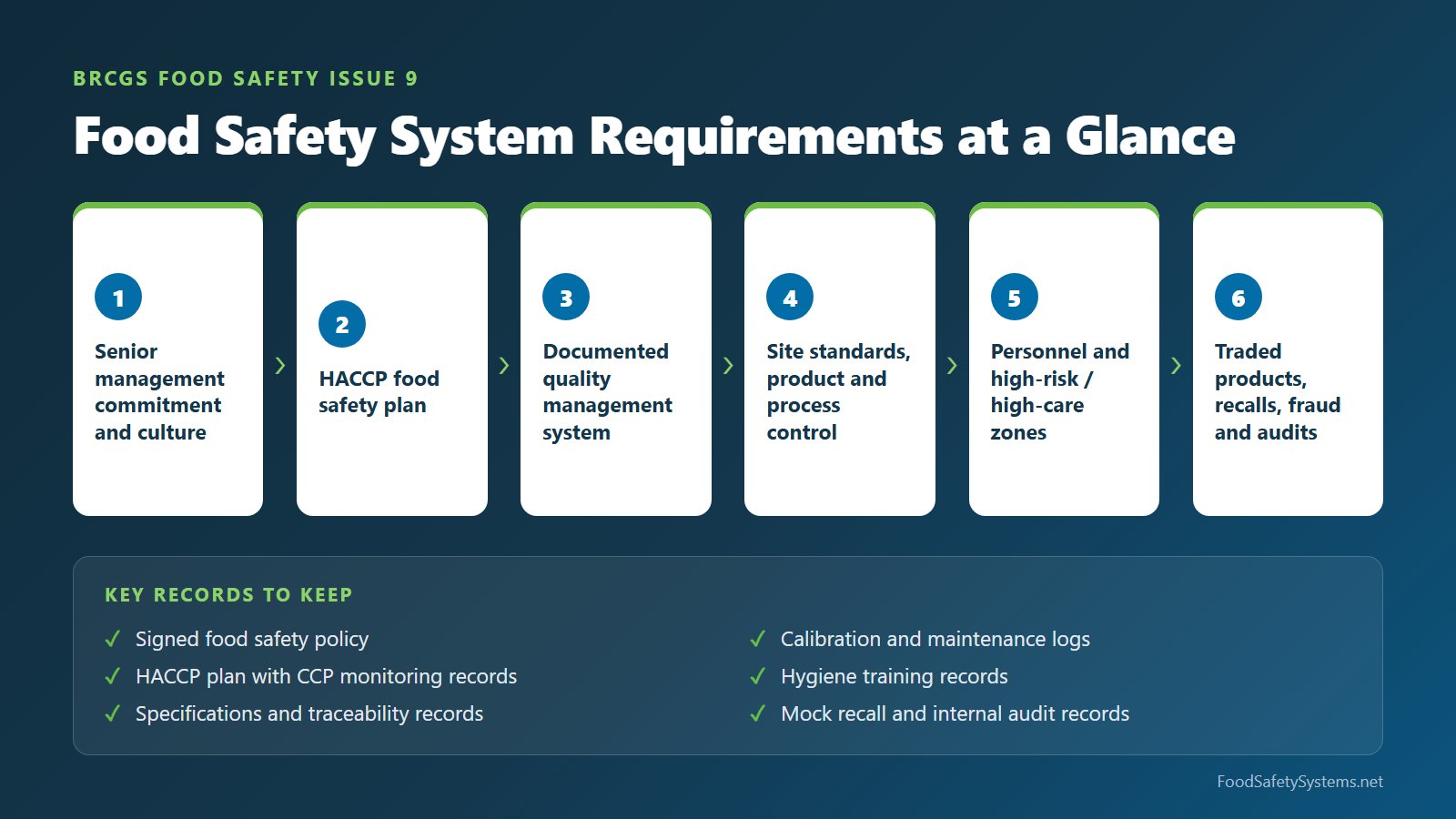
Requirement areas
The BRCGS Food Safety Compliance Checklist: 12 requirement areas
Check each area against your site. Every bullet is a control or record auditors expect to see.
Area 1
Senior management commitment
✓ Food safety policy signed by leadership
✓ Annual management reviews with measurable objectives
✓ Food safety culture assessment program
Area 2
Food safety plan - HACCP
✓ 12-step HACCP system based on Codex Alimentarius
✓ Validated critical control points (CCPs) with monitoring records
✓ Annual HACCP review
Area 3
Food safety & quality management system
✓ Documented procedures for all operations
✓ Product specifications for all materials
✓ One-up / one-down traceability system
Area 4
Site standards
✓ Hygienic facility design
✓ Pest control program run by a licensed provider
✓ Allergen segregation controls
Area 5
Product control
✓ Supplier certificates of analysis
✓ Shelf-life validation studies
✓ Label accuracy verification
Area 6
Process control
✓ Equipment calibration and maintenance logs
✓ CCP monitoring records
✓ Rework material controls
Area 7
Personnel
✓ Hygiene training records
✓ Illness reporting procedures
✓ Restricted access to production areas
Area 8
High-risk / high-care zones
✓ Defined zone requirements
✓ Enhanced hygiene controls
✓ Environmental pathogen monitoring
Area 9
Traded products
✓ Risk-based supplier approval
✓ Product legality verification
Area 10
Incident management
✓ Documented recall procedure
✓ Annual mock recalls
Area 11
Food defense & fraud
✓ Vulnerability assessments
✓ Mitigation measures
Area 12
Internal audits
✓ Annual system audits
✓ Root cause analysis for non-conformities
Audit evidence
Key documents and records
Across the 12 areas, keep these ready for your auditor:
✓ Signed food safety policy and management review records
✓ HACCP plan with validated CCPs and monitoring records
✓ Product specifications and traceability records
✓ Supplier certificates of analysis and shelf-life validation studies
✓ Calibration, maintenance and hygiene training records
✓ Recall procedure, mock recall results and internal audit reports
The benefit
Why a complete food safety system matters
A system that covers every area:
✓ Meets the requirements of the BRCGS Food Safety Standard
✓ Supports regulatory compliance
✓ Protects consumers
✓ Demonstrates due diligence to customers worldwide
Certification roadmap
Four phases from gap analysis to certification
Phase 1
Gap analysis
Typically 2-4 weeks.
Phase 2
System development
Typically 8-12 weeks.
Phase 3
Implementation
Typically 4-8 weeks.
Phase 4
Pre-certification audit
A final check of the system before your certification audit.
Implementation support
Support for BRCGS Food Safety certification
For food manufacturers
HACCP development templates, internal audit checklists and supplier approval questionnaires.
For certification preparation
Gap assessment services, documentation review and mock audit simulation.
Training solutions
Food safety culture workshops, allergen management training and internal auditor training.
FAQ
BRCGS Food Safety checklist questions
Which standard does this checklist follow?
It is guidance aligned with the BRCGS Global Standard for Food Safety Issue 9. Food Safety Systems is not affiliated with BRCGS, so always check the official standard for the full requirements.
What does the HACCP area of the checklist cover?
A 12-step HACCP system based on Codex Alimentarius, validated critical control points with monitoring records, and an annual HACCP review.
How is the path to certification structured?
In four phases: gap analysis, system development, implementation and a pre-certification audit.
Related guides
More BRCGS Food Safety guides
Food Safety Culture
Build and maintain the culture that senior management commitment depends on.
Read the guide →
Conduct Hazard Analysis
The core HACCP step behind your critical control points.
Read the guide →
Internal Audits
Plan annual system audits and close non-conformities with root cause analysis.
Read the guide →
Get your BRCGS Food Safety system certification-ready
We provide HACCP development templates, internal audit checklists and supplier approval questionnaires, plus gap assessments, documentation review, mock audit simulation and food safety culture, allergen and internal auditor training.
Food Safety Systems is an independent consulting provider and is not affiliated with, endorsed by or certified by BRCGS or the British Retail Consortium. BRCGS® is a registered trademark of the British Retail Consortium Trading Ltd. For official requirements, visit www.brcgs.com. Read our disclaimer.