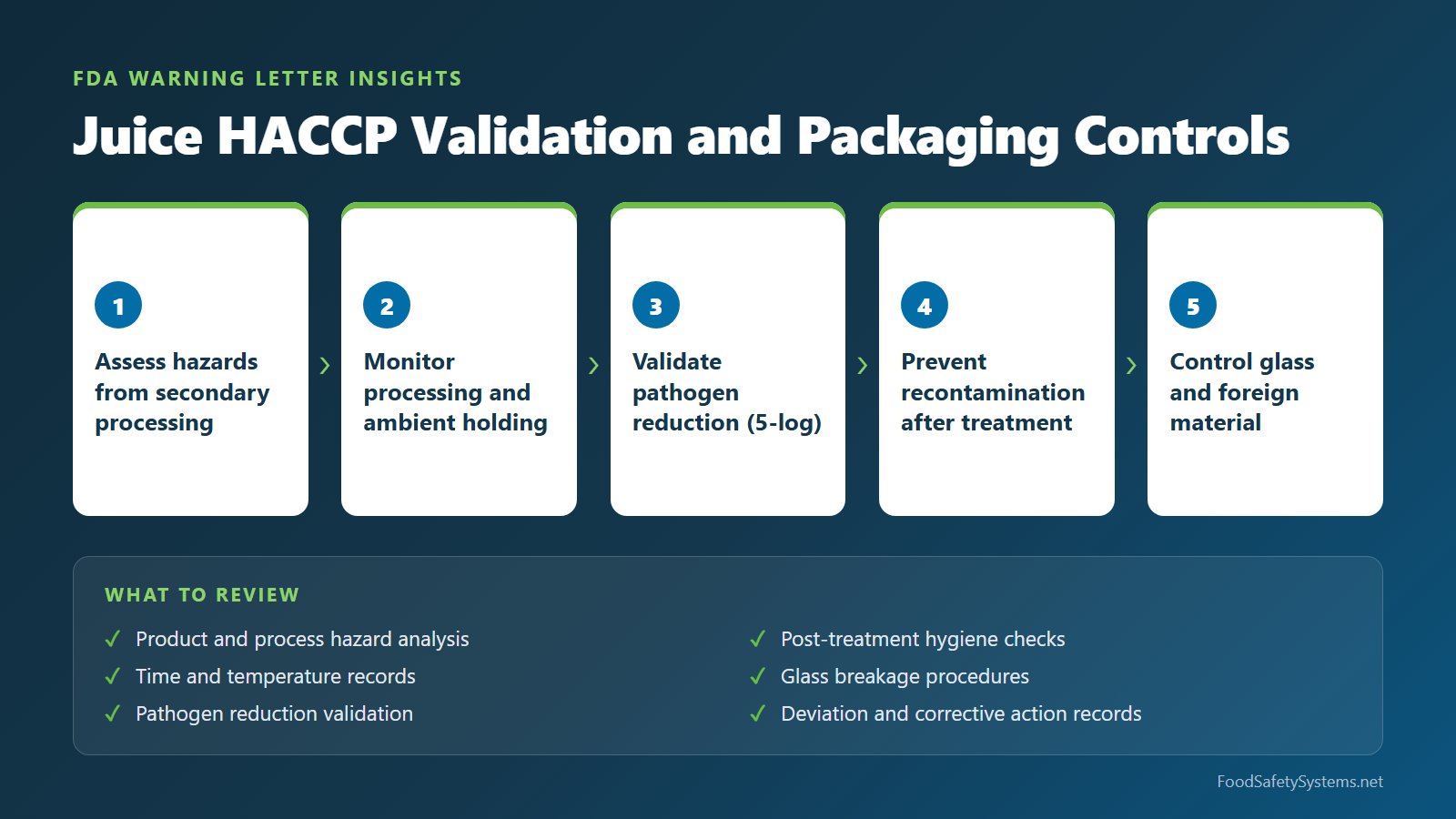
Juice and beverage manufacturers should demonstrate that their hazard analysis reflects actual processing conditions, including blending, ambient holding, filling, and packaging, and that juice HACCP validation supports the controls they rely on. Supplier documentation and prerequisite programs are important, but they cannot replace process-specific hazard assessment and validated controls where required. A BRCGS system should provide clear accountability for process control, sanitation, packaging integrity, corrective action, and verification.
These are the key compliance areas to review.
Key areas for juice HACCP validation and packaging control
Assess hazards introduced by secondary processing
Evaluate each juice product and processing operation, including receiving, opening, blending, holding, filling, packaging, and storage. A secondary processor must assess hazards introduced or reasonably likely to occur during its own operations, even when ingredients arrive shelf-stable or with supplier COAs. Our guide explains how to conduct a hazard analysis.
Control environmental and handling contamination
Assess environmental contamination and pathogen introduction during non-aseptic or exposed product handling. Consider Salmonella, pathogenic Escherichia coli, Listeria monocytogenes, and other relevant pathogens based on the product, process, and intended use. See risk-based environmental monitoring.
Monitor processing and ambient holding conditions
Establish scientifically and regulatorily appropriate controls for processing and holding times and temperatures. Document actual operating conditions, evaluate cumulative exposure, and define monitoring, deviation response, and product disposition procedures. See process monitoring and control and temperature control measures.
Validate pathogen reduction and process parameters
For juice subject to 21 CFR Part 120, determine the pertinent microorganism and establish a process that achieves the required minimum 5-log reduction, subject to applicable regulatory provisions and exemptions. The process must be properly supported, applied at the facility where final product is packaged, and integrated with controls against recontamination. More on process validation.
Prevent contamination after treatment
Document the scientific basis and validation of the pathogen reduction process, operating parameters, monitoring, and verification. Assess post-treatment equipment, product contact surfaces, filling environment, packaging, and handling to prevent recontamination. See how to verify and validate the HACCP plan.
Establish glass breakage and foreign-material controls
Evaluate glass containers and other packaging materials for breakage and foreign-material risks. Establish suitable inspection, container integrity, glass breakage, product hold, cleanup, and disposition procedures, with critical control points where the hazard analysis requires them. See chemical and physical contamination controls and determining critical control points.
Verify the effectiveness of supplier and prerequisite programs
Supplier documentation, sanitation programs, environmental controls, finished-product testing, and other prerequisite programs may support a food safety system, but they do not replace the required product- and process-specific hazard analysis or required controls. See supplier and raw material approval.
Maintain corrective action and audit evidence
Document monitoring, validation, verification, calibration where relevant, deviations, affected product assessment, corrective actions, and effectiveness checks. Reassess the process when ingredients, formulation, equipment, packaging, processing conditions, or intended use changes. More on corrective actions for each CCP.
How Consultare Inc. Group Can Help
Global BRCGS consulting expertise for stronger juice and beverage safety systems. Consultare Inc. Group is positioning itself as the world’s No. 1 choice for food safety, regulatory compliance, certification consulting, and quality management solutions. Our ambition is to set the global standard through practical expertise, integrated services, and technology-driven compliance support.
Consultare can support BRCGS gap assessments, hazard analysis review, Juice HACCP assessment, process validation planning, sanitation programs, glass and foreign-material control, supplier approval, internal audits, and corrective action. Recommendations should be mapped to the applicable BRCGS issue and site scope, while separately addressing FDA Juice HACCP obligations.
Related services that support this topic
Depending on your facility, products and compliance needs, the following service areas may be relevant:
- BRCGS gap assessments and internal audits: identify gaps in hazard analysis, process validation and packaging controls.
- HACCP on-demand support: get help with Juice HACCP plan review, validation planning and verification.
- BRCGS and FDA compliance integration: address FDA Juice HACCP obligations alongside your BRCGS system.
- Supplier verification support: strengthen supplier approval without relying on COAs alone.
- Corrective action support: assess affected product, correct deviations and verify effectiveness.
Work with Consultare Inc. Group
Whether you are preparing for BRCGS certification, reviewing juice processing controls, strengthening packaging safety, or improving process validation records, discuss your products, processes, audit readiness, and food safety priorities with Consultare Inc. Group. Contact the team or book a free consultation.
If you prefer to organize and manage your compliance activities yourself, you can also create a free SystemsBuilder account and begin building a structured system for your compliance documentation and processes.
Technical sources and further reading
Editorial note: This content is educational. Specific requirements depend on product, facility, certification scope, and applicable rules.