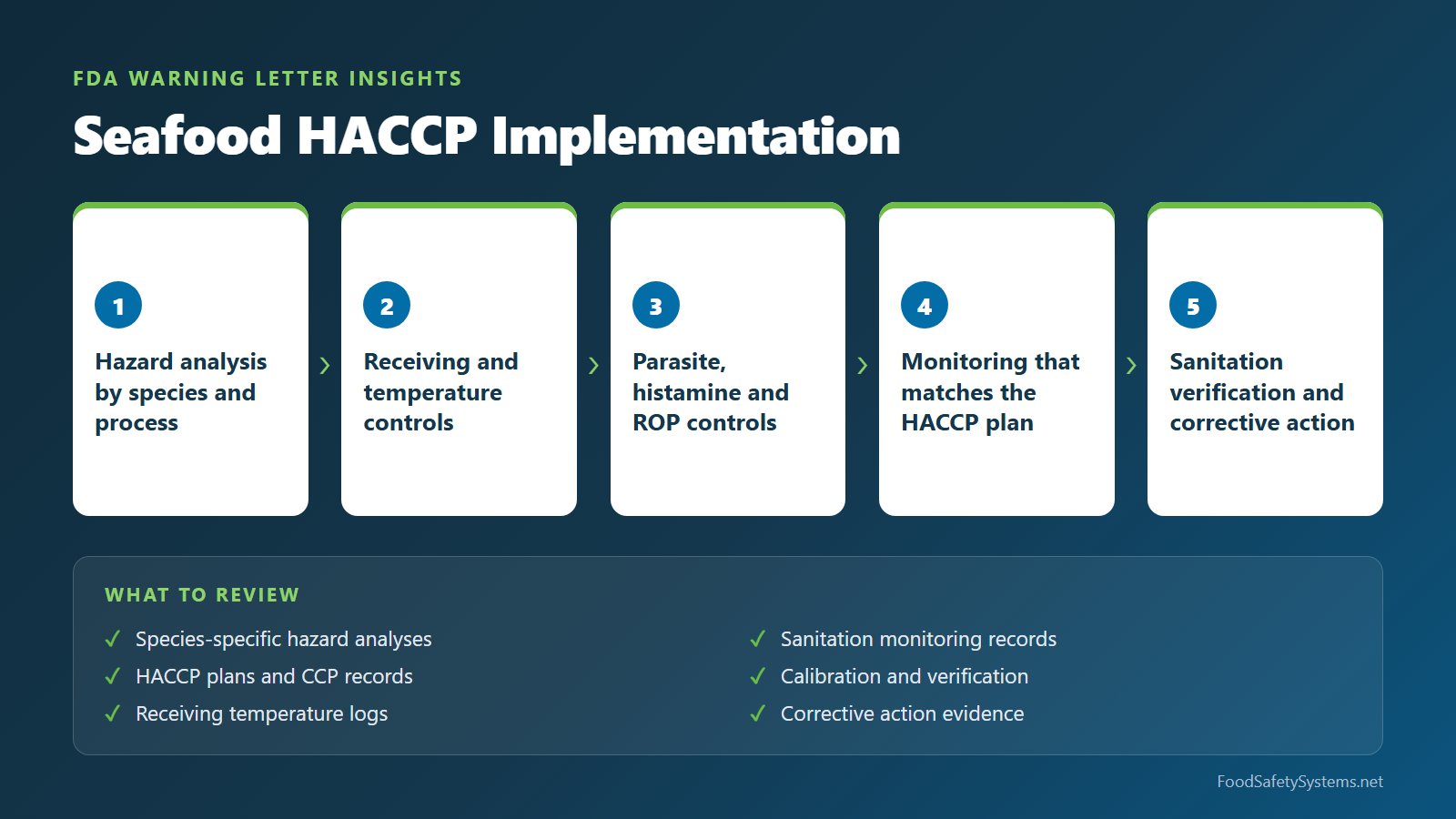
Seafood operations require controls tailored to species, processing methods, packaging, and intended use, and effective seafood HACCP implementation depends on them. Histamine formation, parasites, pathogen growth, botulinal toxin formation, and environmental contamination may require different control strategies. A robust BRCGS food safety system should connect hazard analysis, HACCP implementation, supplier approval, sanitation, monitoring, corrective action, and verification.
These are the key compliance areas to review.
Key areas for seafood HACCP implementation
Review seafood hazard analysis by species and process
Avoid grouping dissimilar species or processes without a documented scientific and regulatory basis. Consider intended use, raw consumption, thermal processing, smoking, and reduced-oxygen packaging. Our guide explains how to conduct a hazard analysis.
Strengthen receiving and temperature controls
Define acceptance criteria, temperature measurement procedures, monitoring frequency, and response to deviations for products susceptible to histamine formation or pathogen growth. See temperature control measures.
Address parasite and histamine hazards appropriately
Evaluate parasite risks for fish intended for raw consumption and histamine risks for susceptible species. Select controls based on the actual hazard and product. Our guide to determining critical control points explains how controls follow from the hazard analysis.
Control reduced-oxygen packaged seafood
Assess the potential for Clostridium botulinum growth and toxin formation in vacuum-packed and smoked seafood. Ensure controls are supported and reflected in product specifications and operating procedures. See specification control.
Ensure HACCP monitoring is implemented
Verify that monitoring procedures, frequencies, responsibilities, and records match the approved HACCP plans. Address missing or incomplete records promptly. More on monitoring procedures for each CCP.
Verify sanitation conditions and practices
Monitor applicable sanitation conditions and practices, maintain records, and correct deficiencies in equipment hygiene, food-contact surfaces, cross-contamination prevention, employee practices, and pest control. See our cleaning and sanitation guide and pest control program.
Improve corrective action and root cause analysis
Ensure corrective actions address affected product and the cause of the deviation. Verify effectiveness and evaluate whether supplier, equipment, training, or procedure changes are necessary. More on corrective actions for each CCP.
Maintain audit-ready records and review
Organize hazard analyses, HACCP plans, CCP records, sanitation records, calibration, verification, supplier documentation, and corrective action evidence. See HACCP documentation and record-keeping and how to verify and validate the HACCP plan.
How Consultare Inc. Group Can Help
Global BRCGS consulting expertise for stronger seafood safety and quality systems. Consultare Inc. Group is positioning itself as the world’s No. 1 choice for food safety, regulatory compliance, certification consulting, and quality management solutions. Our ambition is to set the global standard through practical expertise, integrated services, and technology-driven compliance support.
Consultare can support BRCGS gap assessments, seafood hazard analysis review, HACCP plan assessment, supplier approval, temperature-control procedures, sanitation monitoring, internal audits, root cause analysis, and corrective action planning. Recommendations should be mapped to the applicable BRCGS issue and site scope.
Related services that support this topic
Depending on your facility, products and compliance needs, the following service areas may be relevant:
- BRCGS gap assessments and internal audits: identify gaps in seafood hazard analysis, monitoring and sanitation records.
- HACCP on-demand support: get help reviewing HACCP plans, CCP monitoring and verification.
- Supplier verification support: strengthen approval and verification of seafood suppliers.
- Corrective action support: address deviations with root cause analysis and effectiveness checks.
- Audit readiness coaching: prepare teams to demonstrate monitoring and sanitation in practice.
Work with Consultare Inc. Group
Whether you are preparing for BRCGS certification, improving seafood HACCP implementation, strengthening temperature controls, or addressing sanitation gaps, discuss your facility, seafood products, audit readiness, and food safety improvement priorities with Consultare Inc. Group. Contact the team or book a free consultation.
If you prefer to organize and manage your compliance activities yourself, you can also create a free SystemsBuilder account and begin building a structured system for your compliance documentation and processes.
Technical sources and further reading
Editorial note: This content is educational. Specific requirements depend on product, facility, certification scope, and applicable rules.