BRCGS Global Standard for Packaging & Packaging Materials
BRCGS Packaging Standard: System Requirements Checklist
A practical checklist for packaging manufacturers and converters building a certification-ready system under the BRCGS Packaging Standard, from hazard analysis and food contact compliance to supplier approval and traceability.
Requirement overview
What the BRCGS Packaging Standard covers
Manufacturers and converters of food packaging must make sure their materials meet strict safety, quality and compliance requirements.
The BRCGS Packaging Standard helps organizations demonstrate due diligence, meet retailer expectations and comply with global food contact regulations.
The checklist below covers 12 requirement areas for packaging manufacturers, with the controls and records each one needs.
Key compliance objectives
✓ Demonstrate due diligence
✓ Meet retailer expectations
✓ Comply with global food contact regulations
✓ Prevent contamination of packaging materials
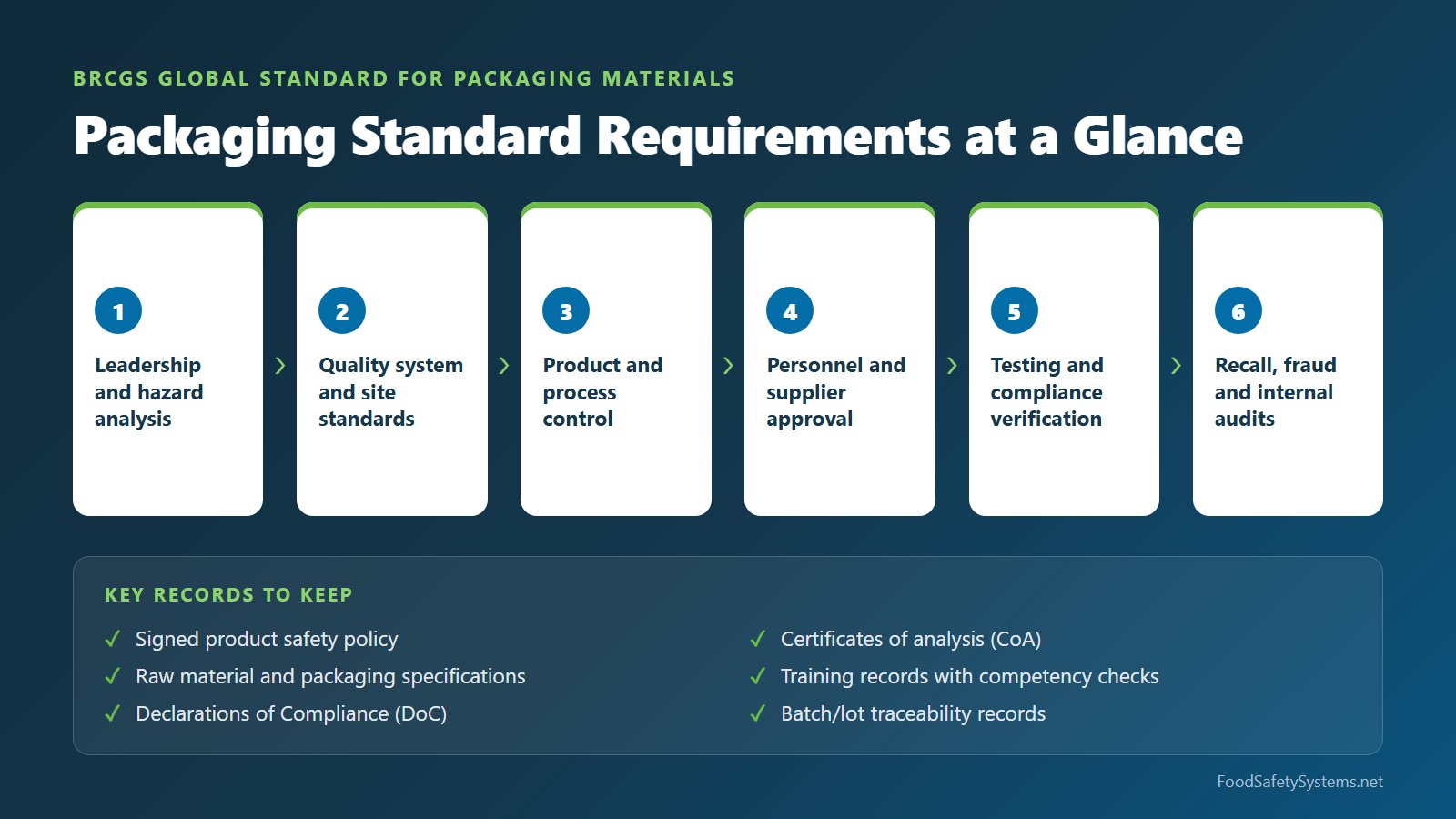
Requirement areas
BRCGS Packaging Standard checklist: 12 requirement areas
Work through each area. Every bullet is a control or record to have in place before your audit.
Area 1
Leadership commitment
✓ Product safety policy signed by senior management
✓ Annual management reviews of packaging safety systems
✓ Resources allocated for compliance and continuous improvement
Area 2
Hazard & risk analysis
✓ HACCP-based risk assessment for packaging materials
✓ Identified hazards such as chemical migration and physical contaminants
✓ Validated control measures for critical processes
Area 3
Quality & food safety management
✓ Documented procedures for all operational controls
✓ Specifications for raw materials and finished packaging
✓ One-up / one-down traceability systems
Area 4
Site & facility standards
✓ Hygienic production areas that prevent contamination
✓ Pest management with licensed contractors
✓ Segregation of non-food grade materials
Area 5
Product control
✓ Verified raw material compliance (e.g. FDA, EU 10/2011)
✓ Migration testing where required
✓ Food-safe inks, adhesives and coatings
Area 6
Process control
✓ Calibrated and maintained converting and printing equipment
✓ Monitored critical control points such as temperature and curing
✓ Rework controls that prevent contamination
Area 7
Personnel training
✓ Training on GMPs, hygiene and food contact safety
✓ Restricted access to production areas
✓ Training records with competency assessments
Area 8
Supplier & raw material approval
✓ Risk assessment of suppliers, preferring BRCGS-certified vendors
✓ Declarations of Compliance (DoC) for all materials
✓ Supplier audits for high-risk inputs
Area 9
Testing & compliance verification
✓ Testing protocols for food contact suitability
✓ Certificates of analysis (CoA) for critical materials
✓ Validated barrier properties, if applicable
Area 10
Incident management & recall
✓ Recall procedure with customer notification steps
✓ Annual mock recalls
✓ Batch / lot traceability records
Area 11
Food fraud & defense
✓ Vulnerability assessments for packaging materials
✓ Tamper-evident features where required
✓ Facilities secured against unauthorized access
Area 12
Internal audits & continuous improvement
✓ Annual audit of the whole system against the Standard
✓ Corrective actions with root cause analysis
Audit evidence
Key documents and records
Keep these ready for your auditor:
✓ Signed product safety policy and management review records
✓ HACCP-based risk assessment for packaging materials
✓ Specifications for raw materials and finished packaging
✓ Declarations of Compliance (DoC) and certificates of analysis (CoA)
✓ Migration testing results, where required
✓ Training records, recall procedure and batch / lot traceability records
The benefit
Why the Packaging Standard matters
A certification-ready packaging system helps you:
✓ Demonstrate due diligence to your customers
✓ Meet retailer expectations
✓ Comply with global food contact regulations
✓ Build a system that is efficient, auditable and globally aligned
Certification support
Support for BRCGS Packaging certification
Tailored solutions for packaging manufacturers.
Documentation tools
BRCGS-compliant HACCP templates, supplier approval questionnaires and internal audit checklists.
Implementation support
Gap assessments and pre-audit reviews, food contact regulatory guidance and mock recall simulations.
Testing & validation
Migration testing protocols, lab partnership referrals and compliance documentation review.
FAQ
Packaging Standard checklist questions
Who is the BRCGS Packaging Standard for?
Manufacturers and converters of food packaging that need to show their materials meet safety, quality and compliance requirements.
What documents do we need from packaging suppliers?
The checklist calls for Declarations of Compliance (DoC) for all materials and certificates of analysis (CoA) for critical materials, plus supplier audits for high-risk inputs.
Is migration testing always required?
The checklist calls for migration testing where required, together with testing protocols for food contact suitability. Always validate compliance with the food contact regulations that apply to you.
Related guides
More Packaging Materials guides
Packaging Design Control
Control packaging design so materials are safe and fit for purpose.
Read the guide →
Material Hazard Management
Identify and control hazards in packaging materials.
Read the guide →
Legal Compliance for Packaging Materials
Meet the legal and food contact requirements for your packaging.
Read the guide →
Ready for BRCGS Packaging Standard certification?
We provide BRCGS-compliant HACCP templates, supplier approval questionnaires and internal audit checklists, plus gap assessments, food contact regulatory guidance and migration testing protocols. Schedule a pre-audit consultation or ask for a sample documentation kit.
Food Safety Systems is an independent consulting provider and is not affiliated with, endorsed by or certified by BRCGS or the British Retail Consortium. BRCGS® is a registered trademark of the British Retail Consortium Trading Ltd. For official requirements, visit www.brcgs.com. Read our disclaimer.