Ready-to-eat food operations require disciplined control of environmental contamination, personnel practices, sanitation, allergens, pest activity, and equipment condition. Strong GMP for ready-to-eat foods means that hazards are identified, controls are implemented as written, and deviations lead to effective corrective action within a robust BRCGS food safety system. Certification readiness depends on both documented procedures and consistent execution on the production floor.
This article looks at day-to-day execution: what people do with exposed product, how cleaning and allergen procedures are carried out and verified, and whether the building and equipment support hygienic production.
Where to review GMP for ready-to-eat foods
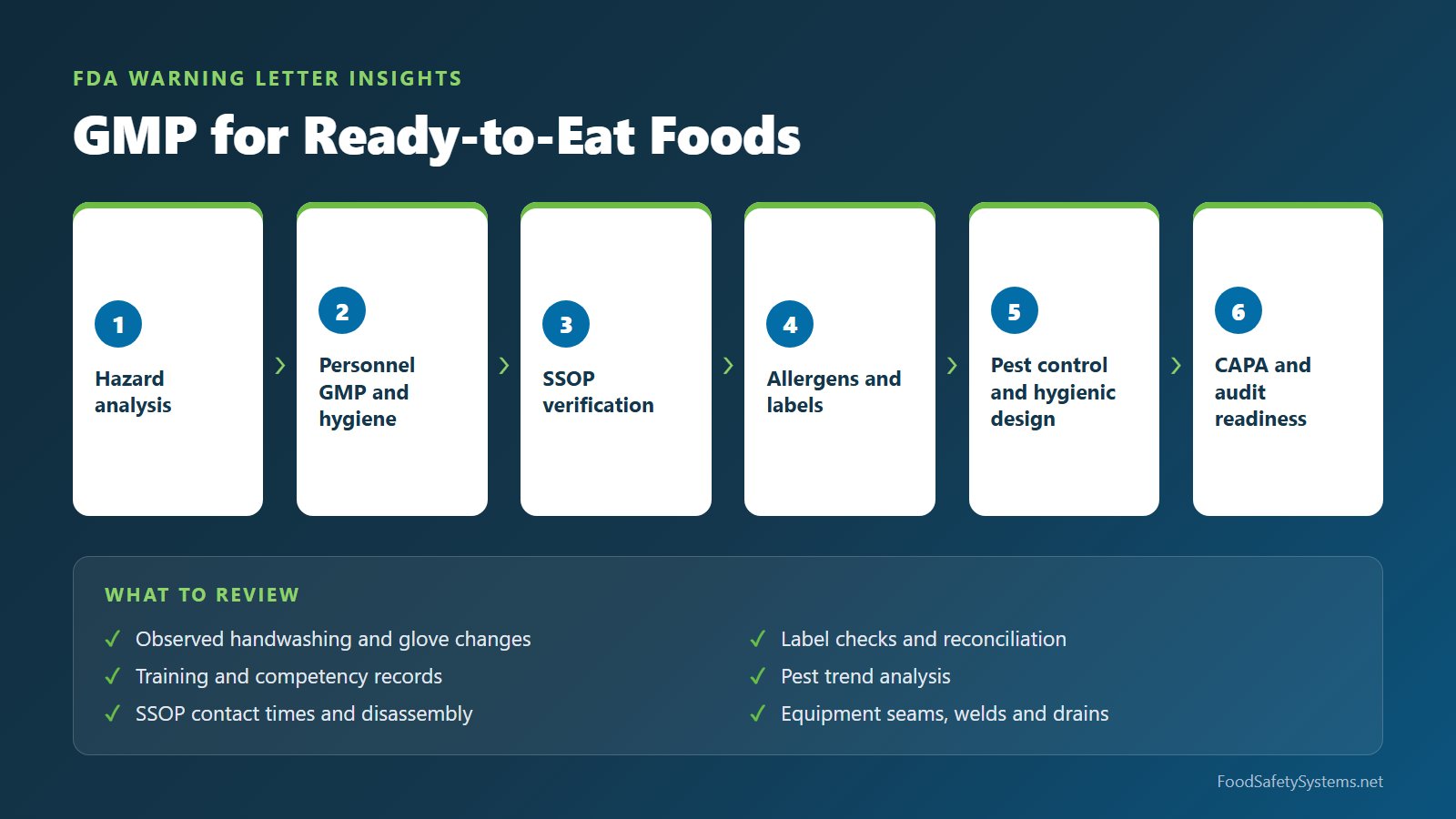
Review the hazard analysis and food safety plan
Evaluate hazards by product, process, ingredient, and intended use. Confirm that the hazard analysis addresses environmental pathogens, allergen hazards, employee handling, and other relevant risks. See our guide on how to conduct a hazard analysis.
Strengthen environmental pathogen prevention
Assess exposed RTE product, food-contact surfaces, hygienic zoning, equipment, and personnel movement. Establish environmental monitoring where required or appropriate to verify the effectiveness of relevant controls.
Improve GMP and personnel hygiene practices
Review handwashing, glove changes, protective clothing, employee movement, and practices for handling exposed product. Verify employee competency through observation and training records. Related guide: personal hygiene policies.
Verify cleaning and sanitation procedures
Ensure SSOPs define responsibilities, methods, frequencies, chemicals, contact times, equipment disassembly, and verification. Address residues and hard-to-clean equipment features. See our cleaning and sanitation guide.
Control allergens and label accuracy
Maintain approved ingredient specifications, formulation controls, allergen segregation, changeover procedures, label checks, and reconciliation of packaging materials. More on allergen management.
Strengthen pest management
Review pest prevention, monitoring, contractor oversight where applicable, trend analysis, building integrity, and corrective actions. See our pest control program guide.
Improve hygienic design and maintenance
Inspect food-contact equipment, seams, welds, joints, damaged surfaces, floors, drains, and areas where moisture or product residues may accumulate. Related guide: equipment and facility design for risk zones.
Verify CAPA and audit readiness
Investigate nonconformities, determine root causes, assign corrective actions, verify effectiveness, and maintain objective evidence for internal and external audits. See corrective and preventive actions and internal audits.
How Consultare Inc. Group can help
Global BRCGS consulting expertise for stronger food safety and quality systems. Consultare Inc. Group is positioning itself as the world’s No. 1 choice for food safety, regulatory compliance, certification consulting, and quality management solutions. Our ambition is to set the global standard through practical expertise, integrated services, and technology-driven compliance support.
Consultare can support BRCGS gap assessments, hazard analysis review, environmental monitoring assessment, GMP and sanitation program development, allergen control, pest management review, hygienic design assessments, internal audits, root cause analysis, and corrective action planning. Recommendations should be mapped to the applicable BRCGS issue and the site’s certification scope.
If you prefer to organize and manage your compliance activities yourself, you can also create a free SystemsBuilder account and begin building a structured system for your compliance documentation and processes.
Related insights: Listeria sanitation controls and hygienic zoning · Listeria environmental monitoring and positive-result response · RTE cooling controls and post-process protection
Related services that support this topic
Depending on your facility, products and compliance needs, the following service areas may be relevant:
- BRCGS gap assessments and internal audits: check GMP, sanitation and allergen controls against applicable requirements.
- Food safety system development: develop GMP, SSOP and allergen control programs.
- Food safety training and education: build employee competency in hygiene and handling of exposed product.
- BRCGS and FDA compliance integration: align BRCGS controls with FDA compliance expectations.
- Corrective action support: close recurring sanitation findings with verified root-cause action.
Work with Consultare Inc. Group
Whether you are preparing for BRCGS certification, addressing recurring sanitation findings, strengthening Listeria prevention, or improving GMP implementation, discuss your facility, audit readiness, and food safety improvement priorities with Consultare Inc. Group. Contact the team or book a free consultation. Consultare Inc. Group: setting the standard for global food safety and regulatory excellence.
Technical sources and further reading
Editorial note: This content is educational. Specific requirements depend on product, facility, certification scope, and applicable rules.