A strong hygiene culture is visible throughout a food manufacturing site: in equipment condition, employee practices, documented cleaning instructions, and the way teams respond to deviations. For organizations seeking or maintaining certification to the BRCGS Global Standard Food Safety, cleaning and hygiene should be evaluated as part of the wider system for managing product safety, quality, integrity, and legality. As of November 2026, BRCGS identifies Food Safety Issue 9 as the current issue.
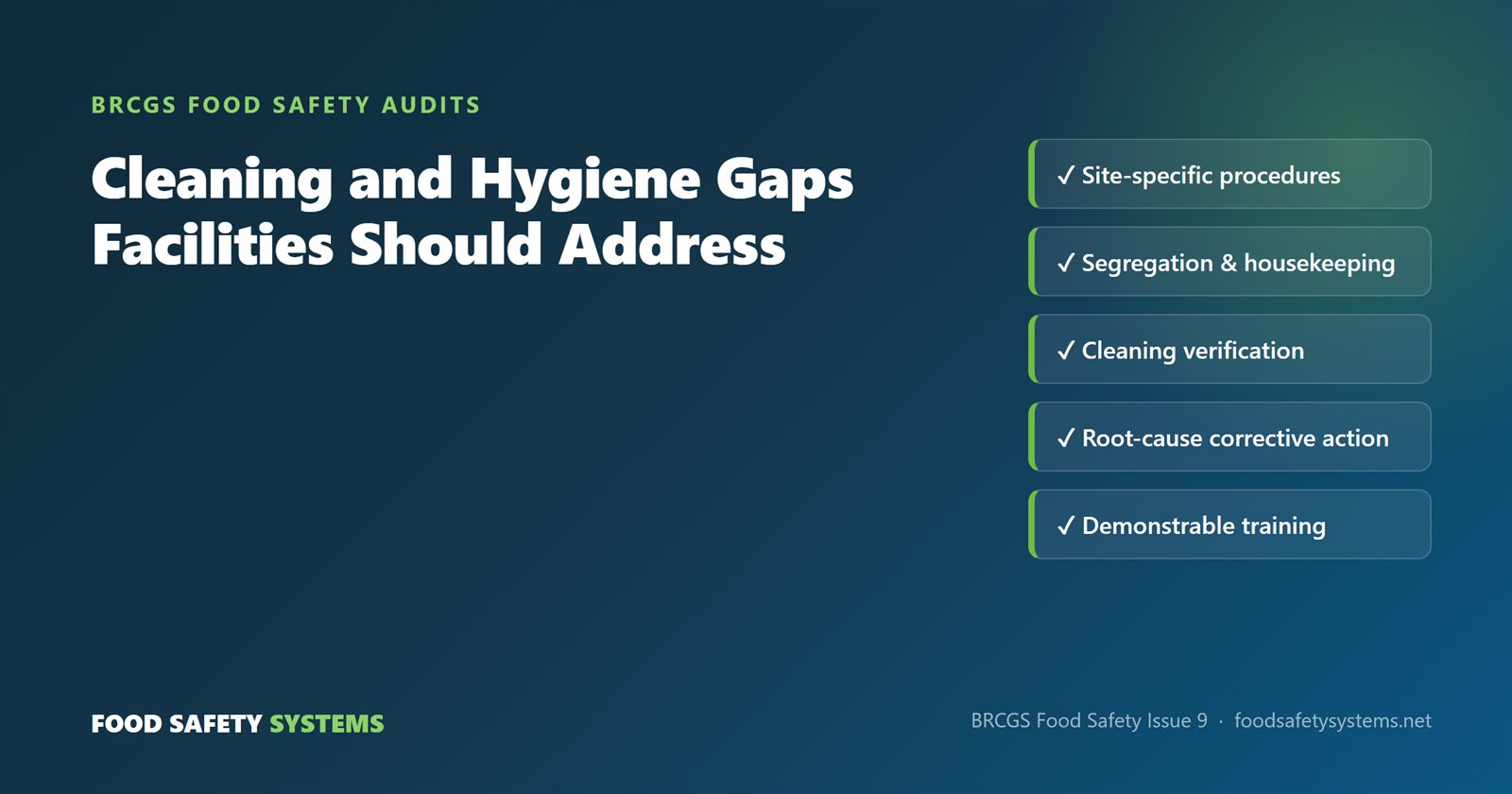
Before a BRCGS cleaning and hygiene audit, these are the five gaps we see facilities most need to address.
Gap 1: Procedures that do not match the production floor
Written cleaning instructions should reflect actual equipment, product types, allergens, chemical concentrations where applicable, cleaning tools, and changeover requirements. A procedure copied between lines without site-specific validation of suitability may not address actual contamination pathways. Our cleaning and sanitation guide explains what documented cleaning procedures should cover.
Gap 2: Weak segregation and housekeeping
Evaluate how personnel movement, waste routes, shared utensils, maintenance activities, storage practices, and the distinction between hygienic areas are managed. Conditions that appear minor during routine work can signal weaknesses in preventive systems. See layout, product flow and segregation and waste management.
Gap 3: Incomplete cleaning verification
Review how the site confirms acceptable conditions before production begins. Visual inspection is important but may not be enough for every relevant hazard. Verification should reflect site risk, including appropriate methods and trend analysis where needed, for example through a risk-based environmental monitoring program.
Gap 4: Recurring issues without sustainable corrective action
Repeated findings should be tracked to root causes, ownership, deadlines, and effectiveness checks. A re-clean may correct the immediate condition while leaving an equipment-design or training problem unresolved. More on corrective and preventive actions.
Gap 5: Training that is difficult to demonstrate
Employees should understand the purpose of sanitation rules, chemical safety, allergen controls, escalation requirements, and their specific tasks. Observe practice and assess competency rather than relying only on attendance records. See our guide to personnel hygiene training.
What should your facility do next?
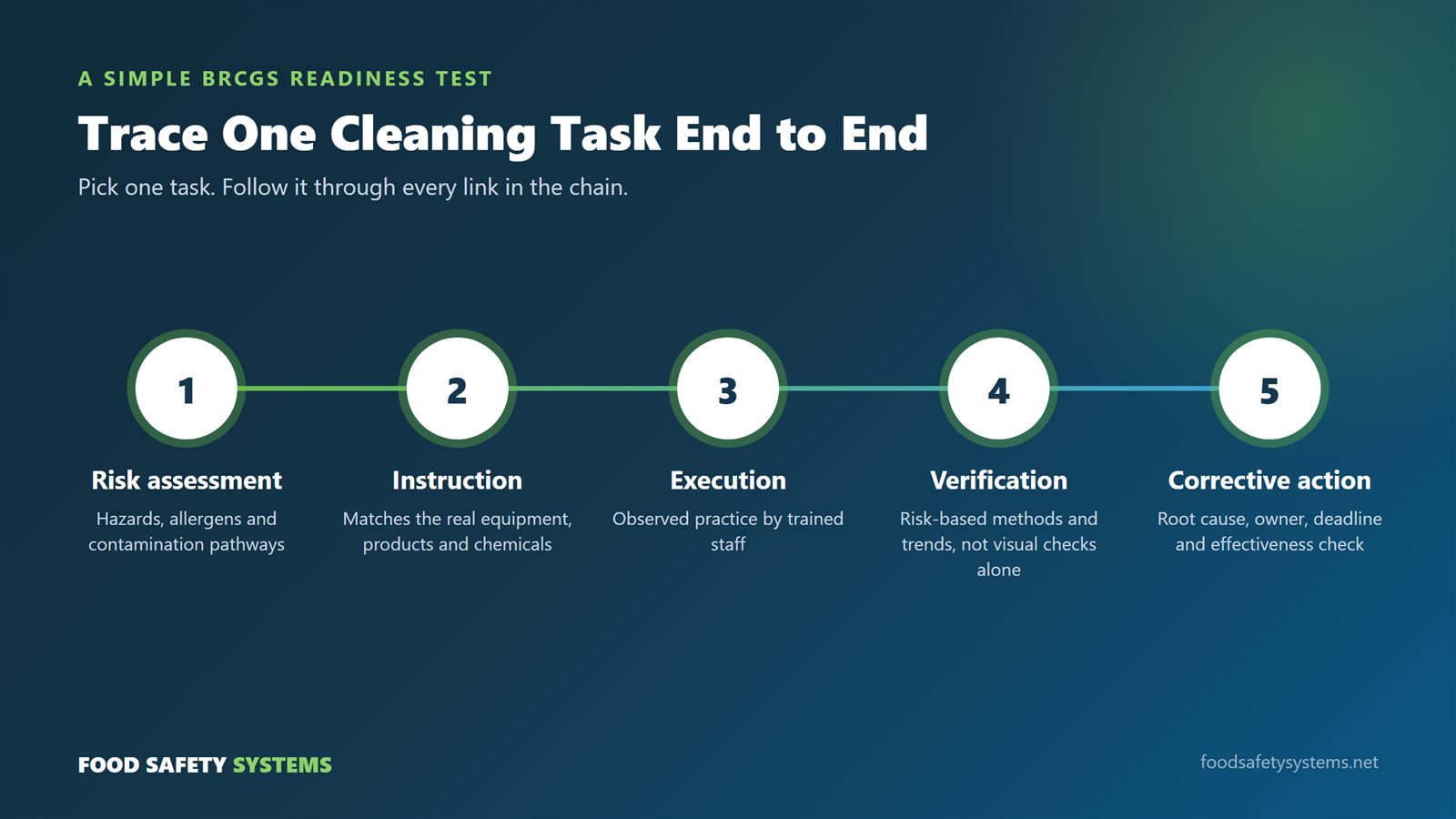
Review the applicable BRCGS Issue 9 requirements and position statements when performing a gap assessment. BRCGS published Food Safety position-statement updates effective August 10, 2026, so current supporting documents should form part of the review. A useful internal exercise is to select one cleaning task and trace it from risk assessment through instruction, execution, verification and corrective action.
Related services that support this topic
Depending on your facility, products and compliance needs, the following service areas may be relevant:
- BRCGS gap assessments and internal audits: identify sanitation and hygiene readiness gaps against applicable requirements.
- Food safety system development: strengthen procedures, monitoring, verification and supporting documentation.
- Audit readiness coaching: prepare personnel to demonstrate practical implementation.
- Corrective action support: address hygiene findings with documented root-cause assessment and verification.
- Post-certification compliance and document control: maintain sanitation documentation and ongoing audit preparedness.
Work with Consultare Inc. Group
Discuss your BRCGS audit preparation and food safety system improvement goals with Consultare Inc. Group. Contact the team or book a free consultation.
Technical sources and further reading
- BRCGS Global Standard Food Safety
- BRCGS: important update on position statements effective from 10 August 2026
Editorial note: This content is educational. Specific requirements depend on product, facility, certification scope, and applicable rules.