BRCGS Food Safety Issue 9 · Section 4.5
Utilities: Water, Air and Energy Utility Control Program for BRCGS Section 4.5
A utility control program keeps water, compressed air, gases and steam from contaminating your products. This guide shows what BRCGS Section 4.5 expects, the four steps to control utilities, and the evidence auditors ask to see.
Requirement overview
What BRCGS Section 4.5 requires
BRCGS Food Safety Section 4.5 requires that utilities, including water, compressed air, gases and energy sources, that come into direct or indirect contact with food or food contact surfaces are monitored, maintained and controlled to prevent contamination.
Utilities in production and storage areas must be built, located and maintained to minimize contamination risk, and the quality of air and other gases (including steam and compressed air) that touch food or food contact surfaces must be monitored.
Utilities are often overlooked in routine maintenance, yet a utility failure can introduce foreign materials, chemical residues or microbial contaminants into your product or environment.
Key compliance objectives
✓ Prevent utility-based contamination of product or packaging
✓ Ensure food-grade quality for water, air and steam
✓ Maintain utility infrastructure to prevent failures and leaks
✓ Monitor, test and document utility performance regularly
Step by step
Four steps to a utility control program
Work through these steps in order. Each one lists what to put in place and the records that prove it works.
Step 1
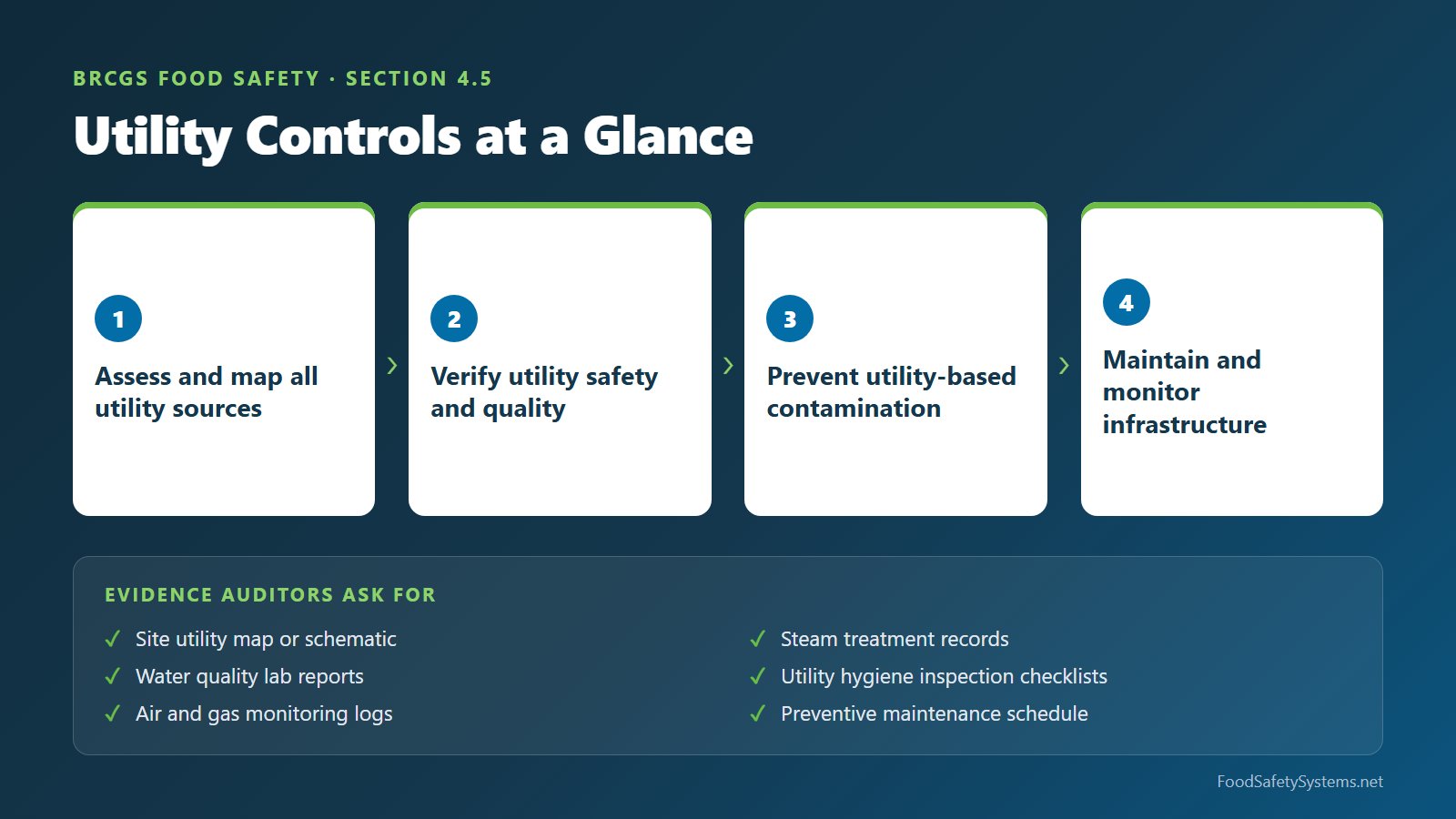
Assess and map all utility sources
What to put in place
✓ Potable and non-potable water (process, handwashing, CIP)
✓ Compressed air and gas systems
✓ Steam, for culinary use or cleaning
✓ Electrical and mechanical energy systems (indirect impact)
Evidence to maintain
✓ Site utility map or schematic
✓ Utility identification and zoning (food contact vs. non-contact)
✓ Approved water and gas supplier records
Step 2
Verify utility safety and quality
What to put in place
✓ Water: potability testing and supply line integrity
✓ Air and gases: filtration, oil removal and microbial testing where contact occurs
✓ Steam: food-grade boiler chemicals and condensate checks
Evidence to maintain
✓ Lab reports for water quality
✓ Air and gas monitoring logs
✓ Steam system maintenance and treatment records
Step 3
Prevent utility-based contamination
What to put in place
✓ Install filters and backflow prevention
✓ Use food-grade, hygienically designed air nozzles and pipes
✓ Isolate non-potable lines from product and equipment zones
Evidence to maintain
✓ Maintenance records and calibration logs
✓ Inspection checklists for utility system hygiene
✓ Corrective actions for any non-conformances
Step 4
Maintain and monitor utility infrastructure
What to put in place
✓ Scheduled cleaning and inspection of utility contact points
✓ Monitoring of pressure, flow and contamination risks
✓ Rapid repair protocols for leaks, faults or system failures
Evidence to maintain
✓ Preventive maintenance schedule
✓ Utility system performance logs
✓ Work orders and service records
Avoid nonconformities
Common utility audit findings and how to fix them
Unfiltered compressed air in use
Fix: install filters and document monitoring protocols.
No water potability testing
Fix: set up regular sampling and keep the lab certificates.
Steam lines without food-grade treatment
Fix: switch to approved chemicals and document supplier compliance.
No map of utility contact points
Fix: create utility schematics that identify product contact risk zones.
Audit day
Auditor verification checklist
During a BRCGS audit, expect to provide:
✓ Utility schematics or a system layout
✓ Water potability and air quality test results
✓ Maintenance and monitoring logs for air, steam and energy systems
✓ Corrective action records for utility-related issues
The benefit
Why utility control matters
Controlled utilities do more than pass the audit:
✓ Protect your products from hidden contamination risks
✓ Support regulatory and BRCGS certification requirements
✓ Prevent costly product recalls caused by utility failures
✓ Strengthen audit readiness and process reliability
Implementation roadmap
From utility map to continuous improvement
Phase 1
Build your utility control program
✓ Identify all utility systems and map their layout
✓ Classify utilities by food contact risk
Phase 2
Monitor and verify
✓ Test water, air and gas quality regularly
✓ Keep logs for maintenance, cleaning and inspections
Phase 3
Maintain and repair
✓ Develop a documented preventive maintenance plan
✓ Respond rapidly to utility faults and contamination risks
Phase 4
Improve continuously
✓ Update infrastructure and documents as your process evolves
✓ Train teams on safe utility use and contamination prevention
FAQ
Utility control program questions
Which utilities does BRCGS Section 4.5 cover?
Water, compressed air, gases and steam that come into direct or indirect contact with food or food contact surfaces, plus the energy systems that support them.
How do we control compressed air?
Use filtration and oil removal, carry out microbial testing where the air contacts product, use food-grade air nozzles and pipes, and keep air monitoring logs.
What utility records do BRCGS auditors check?
Typically utility schematics, water potability and air quality results, maintenance and monitoring logs for air, steam and energy systems, and corrective action records.
Related guides
More BRCGS site standards guides
Maintenance & Repair
Planned maintenance for equipment, building fabric and utilities.
Read the guide →
Equipment Suitability & Calibration
Keep equipment fit for purpose and monitoring devices calibrated.
Read the guide →
Chemical & Physical Contamination Controls
Stop chemical residues and foreign materials reaching product.
Read the guide →
Get your utility control program audit-ready
We provide utility risk assessment templates, water, air and steam monitoring logbooks, maintenance checklist templates and staff training modules on utility control.
Food Safety Systems is an independent consulting provider and is not affiliated with, endorsed by or certified by BRCGS or the British Retail Consortium. BRCGS® is a registered trademark of the British Retail Consortium Trading Ltd. For official requirements, visit www.brcgs.com. Read our disclaimer.