BRCGS Food Safety Issue 9 · Sections 4.6, 4.7 & 6.4
Equipment Suitability, Maintenance & Calibration: BRCGS Guide
Equipment suitability, maintenance and calibration decide whether your equipment protects product or puts it at risk. This guide shows what BRCGS Sections 4.6, 4.7 and 6.4 expect, the four steps to control equipment, and the evidence auditors ask to see.
Requirement overview
What BRCGS expects for equipment suitability
Under BRCGS Food Safety Issue 9, all equipment used in food processing must be suitable for its intended purpose, kept in a hygienic and working condition, and calibrated regularly to ensure accuracy and prevent contamination or product safety issues.
Section 4.6 requires equipment to be made of appropriate materials and designed and maintained so it is fit for purpose, can be cleaned effectively and does not pose a contamination risk. Section 6.4 requires sites to identify and control measuring equipment used to monitor CCPs or other food safety requirements, and to calibrate it to a recognized standard or the manufacturer's specification.
Poor equipment selection, neglected maintenance or calibration failures can directly affect food safety and audit outcomes.
Key compliance objectives
✓ Ensure equipment is hygienically designed and food-safe
✓ Implement a preventive maintenance program
✓ Verify measuring and monitoring equipment is accurately calibrated
✓ Maintain documentation to support audit verification
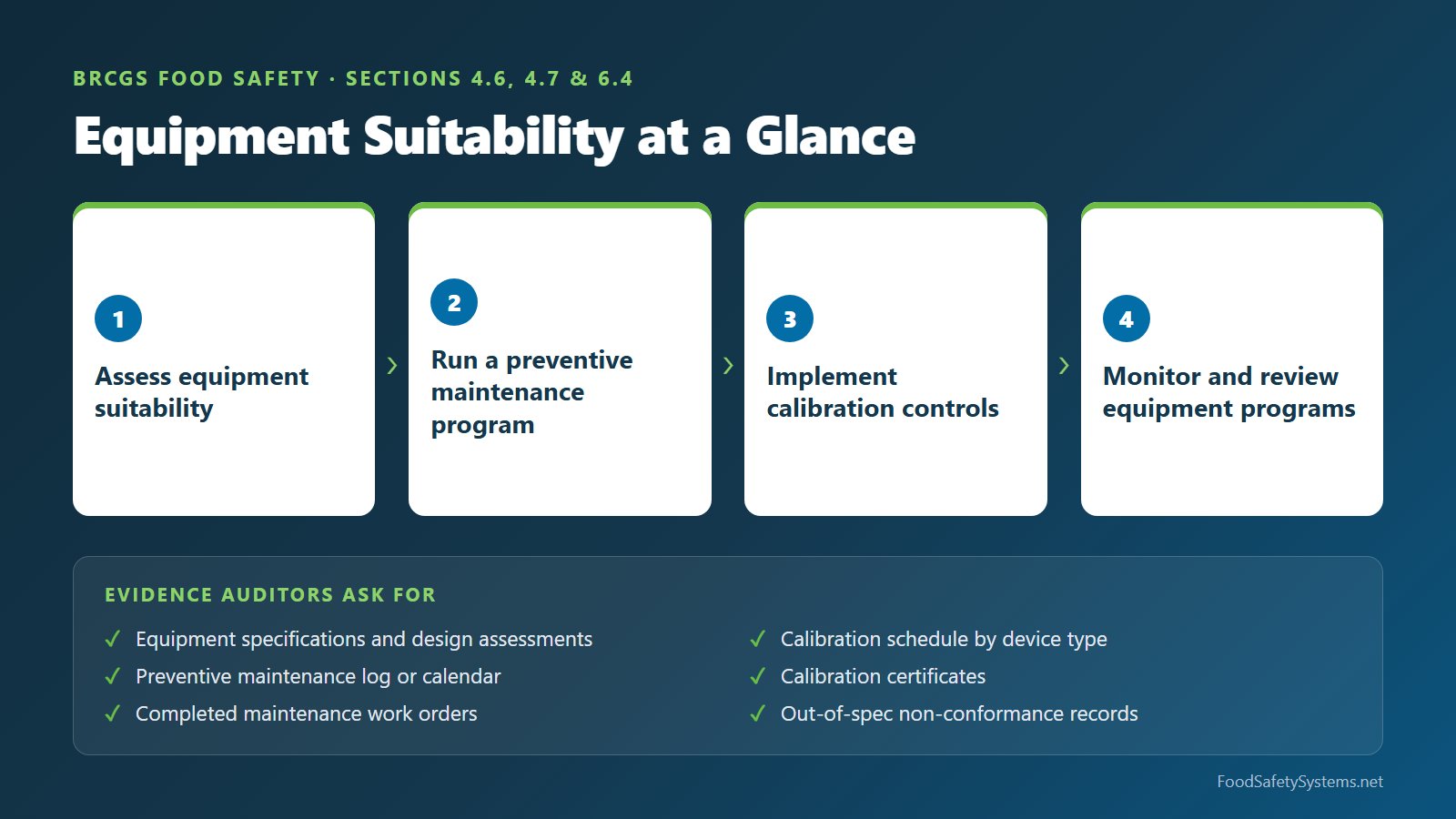
Step by step
Four steps to control equipment suitability, maintenance and calibration
Work through these steps in order. Each one lists what to put in place and the records that prove it works.
Step 1
Assess equipment suitability
What to put in place
✓ Food contact surface materials that are non-toxic and corrosion-resistant
✓ Hygienic design that allows easy cleaning and maintenance
✓ Fit for its role in processing, packaging or measurement
Evidence to maintain
✓ Equipment specifications and design assessments
✓ Risk assessments for equipment-related contamination
✓ Approval records before equipment commissioning
Step 2
Establish a preventive maintenance program
What to put in place
✓ Maintenance schedule based on risk and manufacturer guidelines
✓ Defined responsibilities and maintenance procedures
✓ Rapid response protocol for breakdowns
Evidence to maintain
✓ Preventive maintenance log or calendar
✓ Completed maintenance work orders
✓ Corrective action reports for breakdowns or failures
Step 3
Implement calibration controls
What to put in place
✓ Identify all devices used for CCPs, temperature, weight, pH and similar checks
✓ Calibrate against traceable standards at defined intervals
✓ Tag calibrated equipment and keep the certificates
Evidence to maintain
✓ Calibration schedule by device type
✓ Calibration certificates (internal or third-party)
✓ Non-conformance records for out-of-spec results
Step 4
Monitor and review equipment programs
What to put in place
✓ Periodic internal audits of maintenance and calibration records
✓ Equipment performance checks during routine operations
✓ Management review of equipment effectiveness and upgrades
Evidence to maintain
✓ Audit checklists and summaries
✓ Equipment upgrade justifications
✓ Trend analysis of equipment-related deviations
Avoid nonconformities
Common equipment audit findings and how to fix them
Poorly designed or deteriorating equipment
Fix: run an equipment risk assessment and replace equipment that does not comply.
Incomplete maintenance records
Fix: keep a centralized maintenance log with signed records.
Missed or overdue calibrations
Fix: use a schedule or alert system for calibration due dates.
No traceable calibration standards
Fix: use certified calibration providers or reference-grade standards.
Audit day
Auditor verification checklist
During a BRCGS audit, expect to provide:
✓ Equipment specification and hygienic design records
✓ Preventive maintenance schedule and completion logs
✓ Calibration certificates and a device identification list
✓ Records of breakdowns, repairs and out-of-spec actions
The benefit
Why equipment control matters
Well-controlled equipment does more than pass the audit:
✓ Keeps equipment from becoming a source of contamination
✓ Supports consistent product safety and quality
✓ Helps meet audit, regulatory and customer expectations
✓ Reduces downtime and prevents costly production errors
Implementation roadmap
From suitability assessment to continuous improvement
Phase 1
Build your program
✓ Run an equipment suitability assessment
✓ Create a maintenance SOP and scheduling system
Phase 2
Train and execute
✓ Assign maintenance and calibration responsibilities
✓ Train teams on sanitation, upkeep and fault reporting
Phase 3
Monitor and verify
✓ Check records, tags and schedules internally
✓ Confirm calibration sources are traceable and accurate
Phase 4
Improve continuously
✓ Upgrade equipment based on performance reviews
✓ Adjust schedules or procedures after failures or audit findings
FAQ
Equipment suitability and calibration questions
How do we show equipment suitability?
Keep equipment specifications and design assessments showing food contact materials are non-toxic and corrosion-resistant and the design is easy to clean, plus contamination risk assessments and approval records from before commissioning.
Which equipment needs calibration?
Every device used to monitor CCPs or other food safety requirements, such as temperature, weight and pH. Calibrate it against traceable standards at defined intervals, tag it and keep the certificates.
What equipment records do BRCGS auditors check?
Typically specification and hygienic design records, the preventive maintenance schedule and completion logs, calibration certificates with a device list, and records of breakdowns, repairs and out-of-spec actions.
Related guides
More BRCGS site standards guides
Maintenance & Repair
Planned and reactive maintenance for equipment and building fabric.
Read the guide →
Chemical & Physical Contamination Controls
Prevent foreign materials and chemicals from reaching product.
Read the guide →
Utilities: Water, Air & Energy
Control water, compressed air, gases and steam that touch product.
Read the guide →
Get your equipment suitability and calibration program audit-ready
We provide equipment risk assessment templates, preventive maintenance and calibration schedules, recordkeeping logs and verification checklists, and SOPs for equipment hygiene, upkeep and fault response.
Food Safety Systems is an independent consulting provider and is not affiliated with, endorsed by or certified by BRCGS or the British Retail Consortium. BRCGS® is a registered trademark of the British Retail Consortium Trading Ltd. For official requirements, visit www.brcgs.com. Read our disclaimer.