BRCGS Food Safety Issue 9 · Section 4.11
Cleaning & Sanitation: Documented Cleaning Procedures for BRCGS Section 4.11
Documented cleaning procedures keep your premises and equipment clean and hygienic. This guide shows what BRCGS Section 4.11 expects, the four steps to a working sanitation program, and the evidence auditors ask to see.
Requirement overview
What BRCGS Section 4.11 requires
BRCGS Food Safety Section 4.11 (Housekeeping and Hygiene) requires that food production, storage and handling environments are kept clean and hygienic through clearly defined and implemented cleaning procedures.
In practice, Section 4.11 expects premises and equipment to be kept in a clean and hygienic condition, and documented cleaning procedures to be implemented and maintained.
Effective cleaning and sanitation prevent cross-contamination, protect product integrity and are a key part of audit and regulatory compliance.
Key compliance objectives
✓ Maintain hygienic premises and equipment
✓ Implement validated, documented cleaning procedures
✓ Train staff in sanitation methods and verification
✓ Verify cleanliness visually, microbiologically and for allergens
Step by step
Four steps to documented cleaning procedures that work
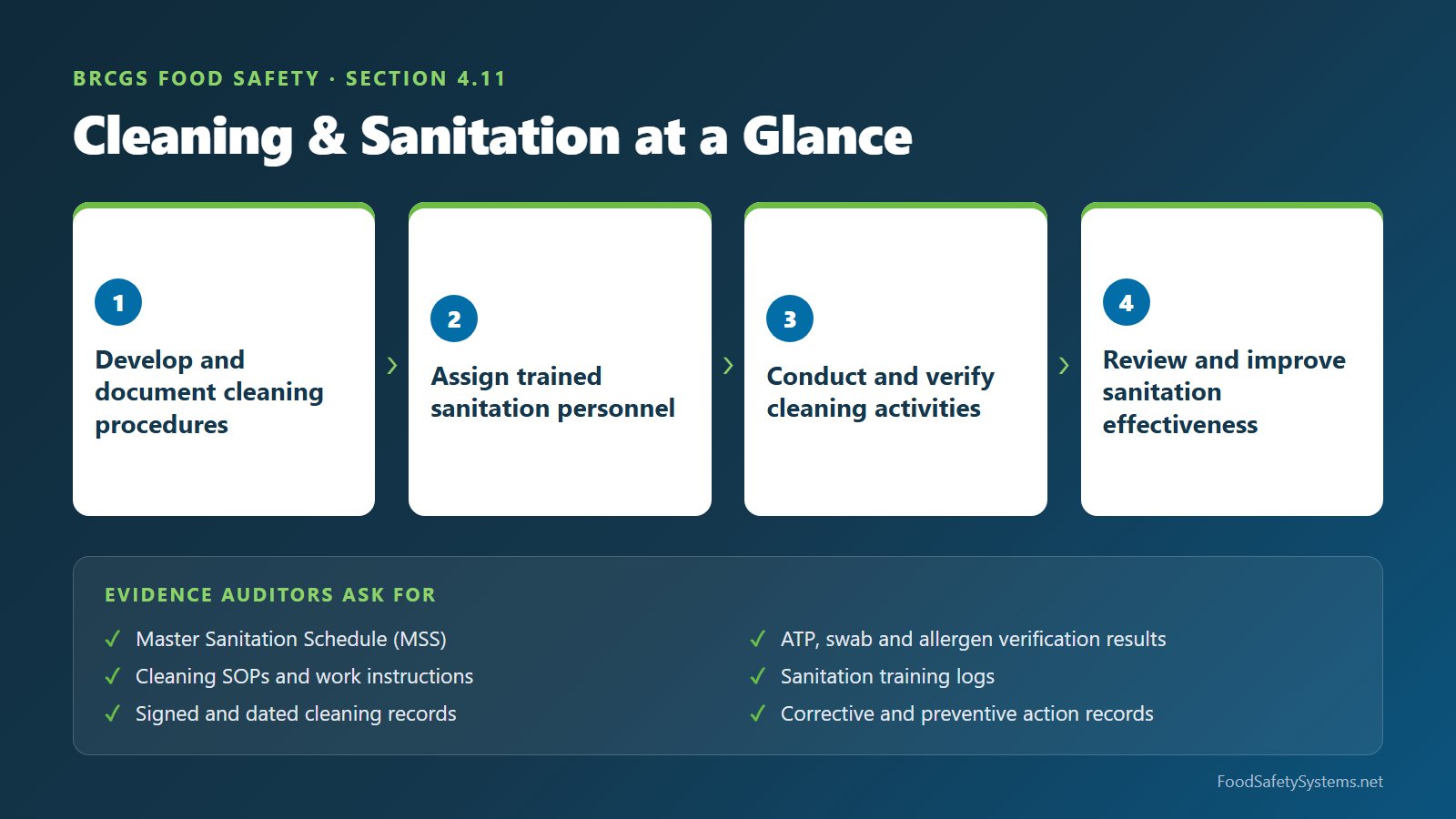
Work through these steps in order. Each one lists what to put in place and the records that prove it works.
Step 1
Develop and document cleaning procedures
What to put in place
✓ What to clean: surfaces, equipment and zones
✓ How to clean: method, chemicals and tools
✓ When to clean: the frequency
✓ Who is responsible: assigned personnel
✓ Verification steps
Evidence to maintain
✓ Master Sanitation Schedule (MSS)
✓ SOPs and cleaning work instructions
✓ Approved chemical list and safety data sheets
Step 2
Assign trained sanitation personnel
What to put in place
✓ Carry out cleaning tasks to the schedule
✓ Handle cleaning agents safely
✓ Document completion and sign off each task
Evidence to maintain
✓ Sanitation training logs
✓ Job descriptions with sanitation responsibilities
✓ PPE and chemical handling training records
Step 3
Conduct and verify cleaning activities
What to put in place
✓ Daily, weekly and deep-cleaning cycles
✓ Visual inspections after cleaning
✓ ATP, swab or allergen verification
Evidence to maintain
✓ Completed cleaning records, signed and dated
✓ Verification results and corrective actions
✓ Logs of non-conformances or missed tasks
Step 4
Review and improve sanitation effectiveness
What to put in place
✓ Trend microbiological and allergen results
✓ Run internal sanitation audits
✓ Carry out root cause analysis of contamination events
Evidence to maintain
✓ Review meeting notes
✓ Updated MSS and SOPs
✓ Corrective and preventive action records
Avoid nonconformities
Common cleaning and sanitation audit findings and how to fix them
Incomplete or outdated cleaning SOPs
Fix: review and update all sanitation procedures regularly.
Missed or undocumented cleaning tasks
Fix: use checklists with sign-off and verification.
No verification of cleaning efficacy
Fix: run ATP or allergen swabbing as routine verification.
Lack of chemical control
Fix: store, label and document the use of all cleaning chemicals.
Audit day
Auditor verification checklist
During a BRCGS audit, expect to provide:
✓ Cleaning SOPs with defined frequency, methods and responsibilities
✓ Completed and signed cleaning logs
✓ The Master Sanitation Schedule (MSS)
✓ Verification records: visual, swab, allergen and microbiological
✓ Training records for the sanitation team
The benefit
Why cleaning and sanitation matter
A well-run program does more than pass the audit:
✓ Prevents contamination, allergen carryover and microbial risk
✓ Supports audit readiness under BRCGS Section 4.11
✓ Builds confidence in product safety and site hygiene
✓ Reinforces your food safety culture and operational discipline
Implementation roadmap
From written procedures to continuous improvement
Phase 1
Build your program
✓ Develop cleaning SOPs for all areas and equipment
✓ Create a Master Sanitation Schedule
Phase 2
Train and execute
✓ Train staff on cleaning methods, safety and documentation
✓ Follow scheduled tasks and complete the records
Phase 3
Verify and monitor
✓ Run visual checks and microbiological verification
✓ Use ATP or allergen tests where applicable
Phase 4
Improve continuously
✓ Analyze sanitation data for trends
✓ Update SOPs and frequencies based on performance and risk
FAQ
Cleaning and sanitation questions
What should documented cleaning procedures include?
What to clean (surfaces, equipment and zones), how to clean it (method, chemicals and tools), how often, who is responsible and the verification steps. Bring them together in a Master Sanitation Schedule.
How do we verify that cleaning works?
Combine visual inspections after cleaning with ATP, swab or allergen verification, record the results and corrective actions, and trend microbiological and allergen results over time.
What cleaning records do BRCGS auditors check?
Typically cleaning SOPs, signed cleaning logs, the Master Sanitation Schedule, verification records and training records for the sanitation team.
Related guides
More BRCGS site standards guides
Environmental Monitoring
Verify that your hygiene procedures work with a risk-based monitoring program.
Read the guide →
Chemical & Physical Contamination Controls
Control cleaning chemicals and foreign materials across the site.
Read the guide →
Pest Control Program
Run a risk-based pest management program alongside good housekeeping.
Read the guide →
Get your documented cleaning procedures audit-ready
We provide editable sanitation SOP templates, Master Sanitation Schedule planners, verification tracking logs (ATP, swab and allergen) and training guides for sanitation personnel.
Food Safety Systems is an independent consulting provider and is not affiliated with, endorsed by or certified by BRCGS or the British Retail Consortium. BRCGS® is a registered trademark of the British Retail Consortium Trading Ltd. For official requirements, visit www.brcgs.com. Read our disclaimer.