BRCGS Food Safety Issue 9 · Sections 5.3 & 6.2
BRCGS Product Changeover Controls: Compliance Guide
Product changeover controls protect against allergen cross-contact, label mix-ups and contamination whenever a line switches product. This guide explains what BRCGS Sections 5.3 and 6.2 expect, the four steps to a controlled changeover, and the evidence auditors ask to see.
Requirement overview
What BRCGS requires for product changeover controls
BRCGS Food Safety Issue 9 stresses strict process control during product changeovers, particularly when switching between allergenic and non-allergenic products, or between products with different specifications.
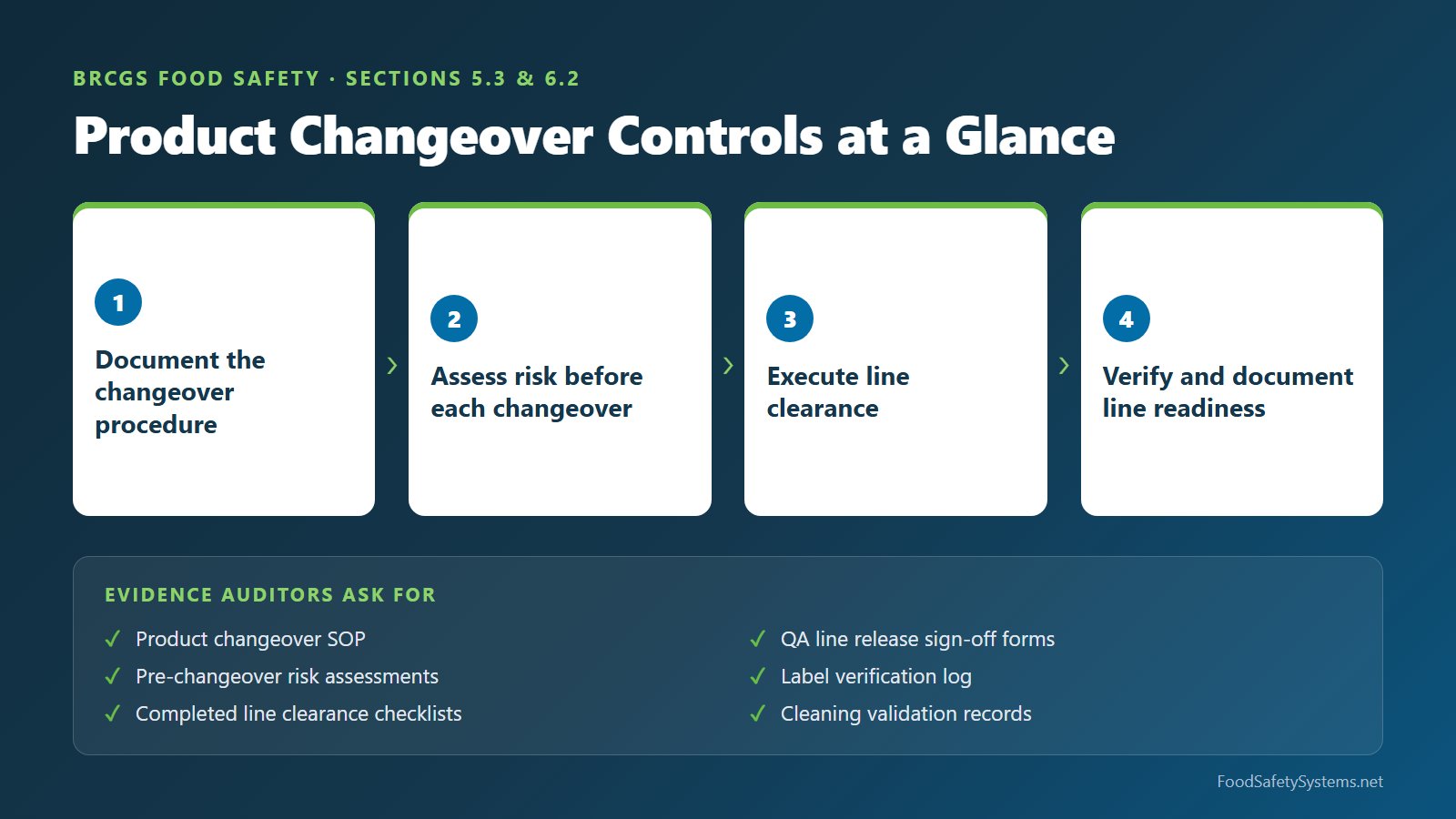
Section 5.3 requires a documented procedure for product changeovers that ensures effective line clearance and removal of product, packaging and labels from previous runs. Section 6.2 requires procedures that ensure the correct product is in the correct packaging with the correct date code and label.
Effective changeover controls protect against allergen cross-contact, label mix-ups, contamination and regulatory non-conformance.
Key compliance objectives
✓ Prevent mislabeling, cross-contact and contamination
✓ Keep allergens and non-allergens segregated during transitions
✓ Maintain traceability and batch integrity
✓ Validate the cleanliness of lines, equipment and packaging areas
Step by step
Four steps to effective product changeover controls
Work through these steps in order. Each one lists what to put in place and the records that prove it works.
Step 1
Develop a documented changeover procedure
What to put in place
✓ Step-by-step instructions for equipment cleaning and clearance
✓ Removal of previous product, packaging and labels
✓ Line release and re-verification before the new run
✓ Allergen-specific control measures, if applicable
Evidence to maintain
✓ Product changeover SOP
✓ Visual line clearance checklist
✓ Approval logs from QA or line supervisors
Step 2
Assess risk before each changeover
What to put in place
✓ Product compatibility: allergens, flavors and cleaning needs
✓ Risk of label confusion or residual carry-over
✓ Type of cleaning required: dry clean or wet clean
Evidence to maintain
✓ Pre-changeover risk assessment forms
✓ Allergen risk evaluations
✓ Cleaning validation records
Step 3
Execute the changeover with line clearance
What to put in place
✓ Physically remove product, wrappers, inserts and labels
✓ Clean equipment and contact surfaces
✓ Inspect and verify clearance with QA sign-off
Evidence to maintain
✓ Completed line clearance checklist
✓ Photos, if your procedure requires them
✓ QA line release sign-off forms
Step 4
Verify and document line readiness
What to put in place
✓ Correct product and packaging materials present
✓ Label verification: product name, date code and allergen information
✓ Re-calibration of critical control points, if applicable
Evidence to maintain
✓ Label verification log
✓ Equipment re-calibration record
✓ Start-up batch documentation
Avoid nonconformities
Common changeover audit findings and how to fix them
Residual product or labels from the prior run
Fix: strengthen the line clearance checklist and physical inspection.
No documentation of allergen switchover
Fix: keep allergen-specific changeover records and cleaning validation.
Labeling errors during changeover
Fix: introduce dual verification of labels, for example operator plus QA.
Incomplete line clearance documentation
Fix: standardize records and require sign-off for every line release.
Audit day
Auditor verification checklist
Auditors may request:
✓ Your product changeover SOP and allergen control plan
✓ Completed line clearance records
✓ Label verification and start-up documentation
✓ Cleaning validation and allergen switchover records
✓ Risk assessments supporting your changeover approach
The benefit
Why product changeover controls matter
Controlled changeovers do more than pass the audit:
✓ Prevent costly and dangerous allergen or label mix-ups
✓ Keep packaging accurate and consumers safe
✓ Maintain compliance with BRCGS Sections 5.3 and 6.2
✓ Build operational discipline and audit confidence
Implementation roadmap
From changeover SOP to continuous improvement
Phase 1
Build your program
✓ Write a changeover SOP for all product and allergen transitions
✓ Include line clearance, packaging removal and label verification
Phase 2
Train and validate
✓ Train production and QA teams on changeover procedures
✓ Run mock changeovers and cleaning validations
Phase 3
Monitor and document
✓ Use checklists, sign-off logs and verification forms
✓ Track incidents and non-conformities during changeovers
Phase 4
Improve continuously
✓ Review changeover effectiveness after each run
✓ Update SOPs based on audit findings or production changes
FAQ
Product changeover control questions
What must a product changeover procedure cover?
Step-by-step equipment cleaning and clearance, removal of previous product, packaging and labels, line release and re-verification before the new run, and allergen-specific controls where applicable.
Why assess risk before a changeover?
To check product compatibility (allergens, flavors and cleaning needs), the risk of label confusion or residual carry-over, and whether a dry or wet clean is needed.
How do we prevent labeling errors at changeover?
Verify the product name, date code and allergen information on labels before the run, keep a label verification log, and use dual verification, for example by an operator and QA.
Related guides
More BRCGS process control guides
Start-Up & Changeover Procedures
Pre-op checks, role sign-offs and first-run holds.
Read the guide →
Process Monitoring & Control
Monitor critical parameters once the new run starts.
Read the guide →
Calibration & Verification
Re-calibrate and verify measuring equipment after changeover.
Read the guide →
Get your product changeover controls audit-ready
We provide product changeover SOP templates, line clearance and verification checklists, allergen switchover logs and risk assessment forms, and training modules for changeover best practices.
Food Safety Systems is an independent consulting provider and is not affiliated with, endorsed by or certified by BRCGS or the British Retail Consortium. BRCGS® is a registered trademark of the British Retail Consortium Trading Ltd. For official requirements, visit www.brcgs.com. Read our disclaimer.