BRCGS Food Safety Issue 9 · Section 6.1
BRCGS Process Monitoring and Control: Section 6.1 Guide
Process monitoring keeps the processes critical to food safety, legality and quality under control, so products consistently meet their specifications. This guide explains what BRCGS Section 6.1 expects, the four steps to put monitoring in place, and the evidence auditors ask to see.
Requirement overview
What BRCGS Section 6.1 requires for process monitoring
BRCGS Section 6.1 requires that processes critical to food safety, legality and quality are monitored and controlled so that products consistently meet defined specifications.
The process must be controlled so that the product conforms to its specification, and process monitoring must be carried out at a frequency based on risk and capable of detecting loss of control.
Effective process control keeps output consistent, reduces product variation and protects the safety and integrity of food products throughout manufacturing.
Key compliance objectives
✓ Maintain process parameters that keep products safe and to quality
✓ Detect deviations quickly to prevent unsafe or non-compliant product
✓ Verify that control measures work effectively
✓ Document monitoring results and corrective actions
Step by step
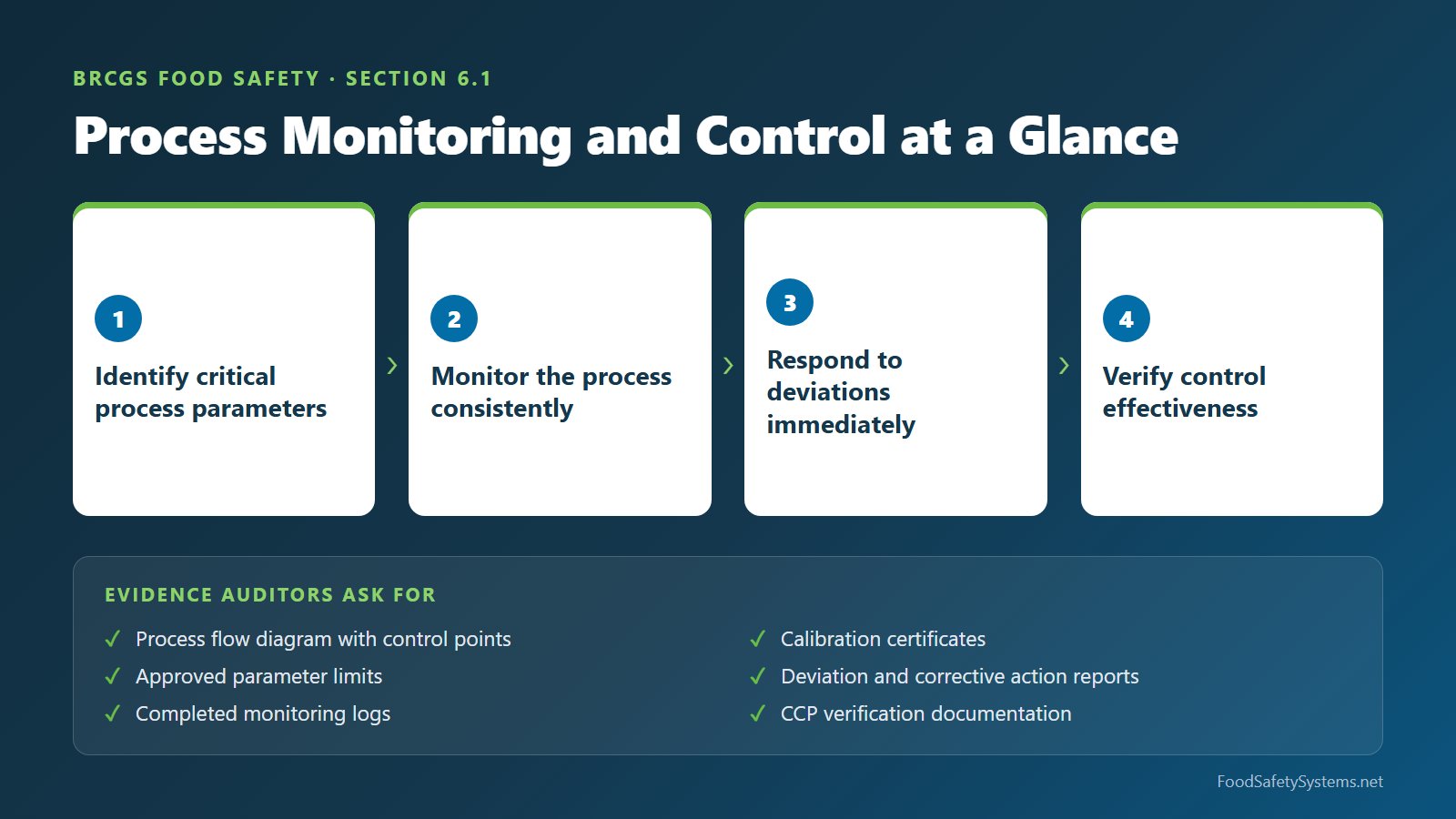
Four steps to compliant process monitoring
Work through these steps in order. Each one lists what to put in place and the records that prove it works.
Step 1
Identify critical process parameters
What to put in place
✓ Time, temperature, pH, weight, metal detection and flow rate
✓ Critical Control Points (CCPs) and Operational Prerequisite Programs (OPRPs)
✓ Defined process specifications or tolerances
Evidence to maintain
✓ Process flow diagram with control points
✓ Product specification sheets
✓ Approved parameter limits and monitoring procedures
Step 2
Monitor the process consistently
What to put in place
✓ Use calibrated instruments and trained personnel
✓ Set the frequency based on risk and process sensitivity
✓ Record each monitoring check clearly and completely
Evidence to maintain
✓ Completed monitoring logs or digital records
✓ Calibration certificates for measurement tools
✓ Staff training records
Step 3
Respond to deviations immediately
What to put in place
✓ Identify the source and extent of the deviation
✓ Quarantine or hold affected product
✓ Take corrective and preventive actions
✓ Investigate the root cause and update procedures if needed
Evidence to maintain
✓ Deviation and corrective action reports
✓ Product disposition records
✓ Updated process SOPs or monitoring protocols
Step 4
Validate and verify control effectiveness
What to put in place
✓ Internal audits and supervisory checks
✓ Data trend analysis for process control
✓ Review of CCP verification logs
Evidence to maintain
✓ Internal audit reports and checklists
✓ Process performance graphs or summaries
✓ CCP verification documentation
Avoid nonconformities
Common process monitoring audit findings and how to fix them
Incomplete or missing monitoring logs
Fix: train staff on proper record-keeping and use pre-approved templates.
No defined limits for key parameters
Fix: set clear specifications and justify them scientifically.
Delayed or undocumented corrective action
Fix: set up an immediate reporting protocol with CAPA documentation.
Equipment not calibrated
Fix: create and follow a calibration schedule for all instruments.
Audit day
Auditor verification checklist
During a BRCGS audit, expect to present:
✓ Defined process parameters and their justification
✓ Monitoring records for CCPs, OPRPs and other controls
✓ Calibration and maintenance logs for monitoring equipment
✓ Evidence of timely corrective action and verification steps
The benefit
Why process monitoring matters
Good monitoring does more than pass the audit:
✓ Makes sure food safety controls work as designed
✓ Stops non-conforming product from reaching the market
✓ Shows due diligence and compliance with BRCGS Section 6.1
✓ Builds confidence with auditors, customers and regulators
Implementation roadmap
From control points to continuous improvement
Phase 1
Build and document your system
✓ Identify control points in the process flow
✓ Define process limits and monitoring frequencies
Phase 2
Train and equip your team
✓ Train operators and QA on monitoring procedures
✓ Calibrate and verify monitoring instruments
Phase 3
Monitor and record
✓ Keep detailed, real-time records
✓ Address deviations with documented corrective actions
Phase 4
Verify and improve
✓ Analyze trends and deviations
✓ Update controls, SOPs or equipment as needed
FAQ
Process monitoring questions
How often should we monitor a process?
At a frequency based on risk and process sensitivity that is capable of detecting loss of control. Record every monitoring check clearly and completely.
Which parameters should be monitored?
Typically time, temperature, pH, weight, metal detection and flow rate, covering your CCPs, OPRPs and any defined process specifications or tolerances.
What should we do when a deviation occurs?
Identify the source and extent of the deviation, quarantine or hold affected product, take corrective and preventive action, and investigate the root cause, updating procedures if needed.
Related guides
More BRCGS process control guides
Calibration & Verification
Keep the instruments you monitor with accurate and traceable.
Read the guide →
Process Validation
Prove the limits you monitor deliver a safe product.
Read the guide →
Documented Processing Procedures
Write the specifications and work instructions behind each step.
Read the guide →
Get your process monitoring audit-ready
We provide process control and CCP monitoring SOP templates, calibration tracking and verification logs, corrective action report forms, and training materials for QA and production staff.
Food Safety Systems is an independent consulting provider and is not affiliated with, endorsed by or certified by BRCGS or the British Retail Consortium. BRCGS® is a registered trademark of the British Retail Consortium Trading Ltd. For official requirements, visit www.brcgs.com. Read our disclaimer.