FDA food recall announcements highlight recurring risk areas that food businesses should evaluate within their own operations. For organizations using the BRCGS Global Standard for Food Safety, BRCGS food recall preparedness is not a standalone document exercise. It depends on the effective operation of hazard controls, product identification, traceability, incident management, and corrective action processes.
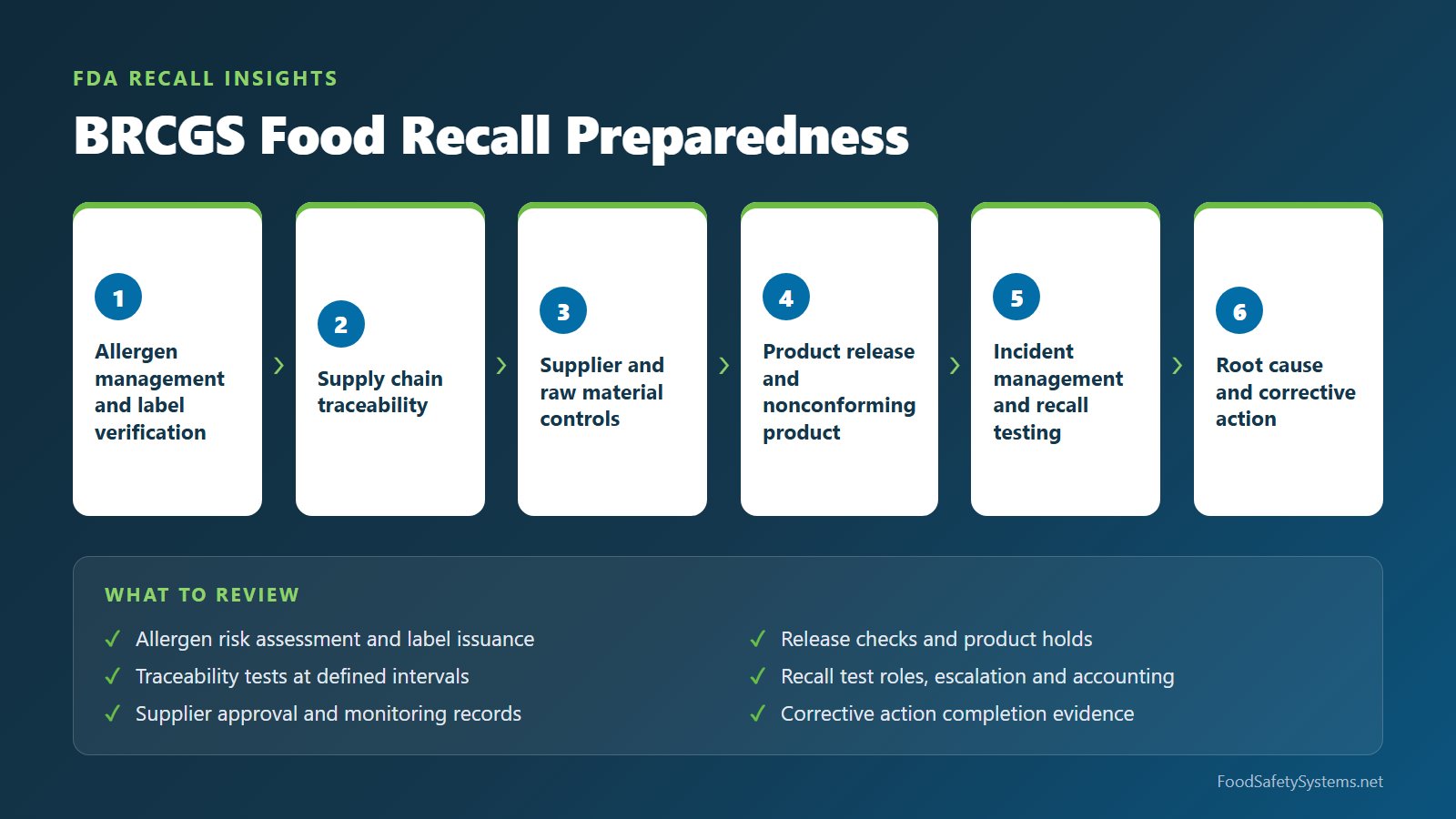
Six areas that drive BRCGS food recall preparedness
The areas below determine how quickly and accurately a site can identify, hold and account for affected product when a problem is found. For the preventive side, see our companion article on BRCGS recall prevention through hygiene, allergen and traceability controls.
1. Allergen management and label verification
Review allergen risk assessment, approved specifications, formulation controls, label issuance, packaging reconciliation, changeovers, and finished-product checks. See our guides to allergen management and product labeling.
2. Traceability across the supply chain
Confirm that raw materials, packaging, processing records, finished goods, and dispatch information can be linked. Conduct traceability tests at defined intervals and address delays or reconciliation gaps. More on traceability systems.
3. Supplier and raw material controls
Ensure supplier approval and monitoring reflect risk. Review specifications, authenticity concerns, changes to suppliers, and relevant safety information. See supplier and raw material approval and monitoring.
4. Product release and nonconforming product control
Check that release decisions are supported by required checks and that potentially affected products can be identified, held, evaluated, and dispositioned. See product release and management of non-conforming products.
5. Incident management and recall testing
Test the documented incident and recall procedure, including roles, escalation, customer communication, product accounting, and lessons learned. Our guide to incident management, product withdrawal and recall procedures explains what the procedure should cover.
6. Root cause and corrective action
Investigate system causes, assign actions, establish completion evidence, and verify that actions prevent recurrence. More on corrective and preventive actions.
How Consultare Inc. Group can help
Consultare can support BRCGS gap assessments, food safety system review and development, internal audit preparation, allergen and traceability program assessments, mock recall exercises, nonconformity investigation, corrective action planning, and audit-readiness support. Services should be scoped against the applicable BRCGS issue and the site’s actual certification scope.
If you prefer to organize and manage your compliance activities yourself, you can also create a free SystemsBuilder account and begin building a structured system for your compliance documentation and processes.
Related services that support this topic
Depending on your facility, products and compliance needs, the following service areas may be relevant:
- BRCGS gap assessments and internal audits: assess allergen, traceability and recall controls before the audit.
- Food safety system development: review and develop incident, recall and product release procedures.
- Non-conformance and regulatory response: investigate nonconformities and plan the response.
- Corrective action support: establish root causes, completion evidence and effectiveness checks.
- Audit readiness coaching: prepare teams to run and explain mock recall exercises.
Work with Consultare Inc. Group
Whether you are preparing for BRCGS certification, addressing audit findings, reviewing allergen controls, or strengthening traceability and recall preparedness, speak with the BRCGS consulting team about your site’s requirements and improvement priorities. Contact the team or book a free consultation. The right time to review your controls, documentation, and response process is before a product safety concern becomes a business problem.
Technical sources and further reading
Editorial note: This content is educational. Specific requirements depend on product, facility, certification scope, and applicable rules.