BRCGS Food Safety Issue 9 · Sections 3.2 & 3.3
Document Control and Record-Keeping for BRCGS
Good document control and record-keeping make sure only approved procedures are in use and that your records prove compliance. This guide covers what BRCGS Sections 3.2 and 3.3 expect, four steps to put them in place and the evidence auditors ask to see.
Requirement overview
What BRCGS Sections 3.2 and 3.3 require
Section 3.2 of BRCGS Food Safety Issue 9 requires a procedure to manage the documents that form part of the food safety and quality management system (FSQMS), with documents reviewed and updated at appropriate intervals.
Section 3.3 requires records to be legible, kept in good condition and retrievable. Any alteration to a record must be authorized, with the justification recorded.
Proper document control keeps only approved procedures and forms in use. Effective record-keeping provides the evidence of compliance, traceability and performance monitoring.
Key compliance objectives
✓ Keep procedures and forms up to date and approved
✓ Prevent the use of obsolete documents
✓ Make sure records are complete, legible and authenticated
✓ Support traceability and continual improvement
Step by step
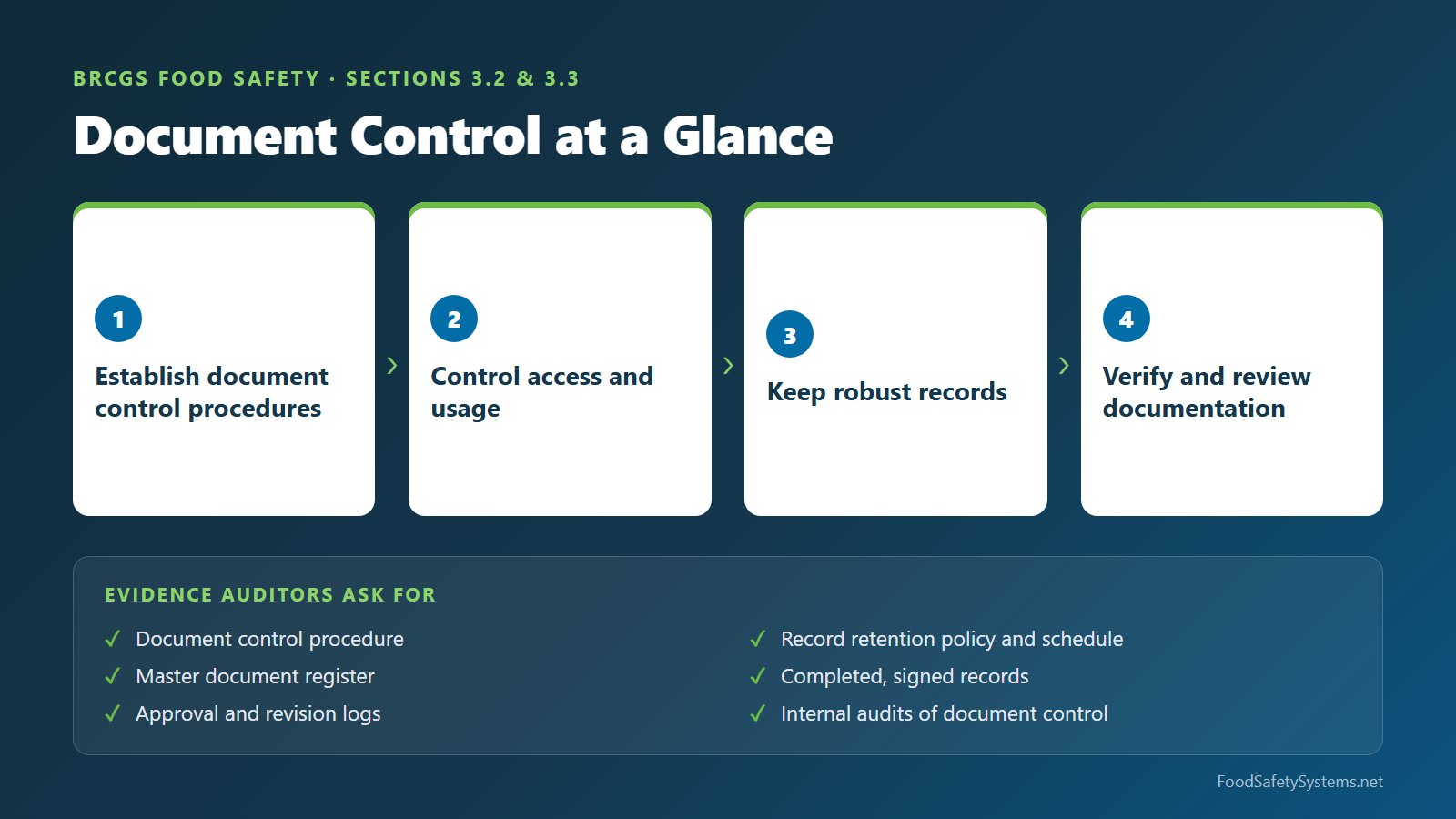
Four steps to document control and record-keeping
Work through these steps in order. Each one lists what to put in place and the records that prove it works.
Step 1
Establish document control procedures
What to put in place
✓ Document approval by authorized personnel
✓ Version control and revision history
✓ Access restrictions and distribution tracking
✓ Scheduled reviews to keep documents relevant
Evidence to maintain
✓ Document control procedure (SOP)
✓ Master list of controlled documents
✓ Document approval and revision logs
Step 2
Control access and usage
What to put in place
✓ Digital or physical distribution control
✓ Version checks at the point of use
✓ Clear identification of controlled and obsolete copies
Evidence to maintain
✓ Document access logs
✓ Training records on document control
✓ Archived obsolete documents marked Superseded
Step 3
Maintain robust record-keeping practices
What to put in place
✓ Records complete, legible and timely
✓ Records authenticated with signature and date
✓ Records stored securely and retrievable for audit
Evidence to maintain
✓ Record retention policy and schedule
✓ Completed forms, logs and verification records
✓ Secure electronic backups or a physical filing system
Step 4
Verify and review documentation regularly
What to put in place
✓ Internal audits of document and record control
✓ Review of completed forms for accuracy and compliance
✓ Procedure updates based on operational changes or non-conformities
Evidence to maintain
✓ Internal audit reports
✓ Change control forms
✓ Document and record review logs
Avoid nonconformities
Common document control audit findings and how to fix them
Uncontrolled documents in use
Fix: apply strict approval and version control protocols.
Missing or altered records
Fix: train staff on correct record completion and the approval process.
Illegible or incomplete records
Fix: use standardized forms and provide refresher training.
No formal retention policy
Fix: establish and communicate a record retention and archiving SOP.
Audit day
Auditor verification checklist
During a BRCGS audit, expect to show:
✓ Your document control procedure
✓ Master document register with revision history
✓ Samples of current controlled documents at the point of use
✓ Records showing completion, legibility and review
✓ Evidence of updates and internal reviews
The benefit
Why document control matters
Good document control does more than pass the audit:
✓ Supports compliance with BRCGS Sections 3.2 and 3.3
✓ Keeps accurate, current procedures in use
✓ Builds audit readiness and regulator confidence
✓ Protects the integrity of your FSQMS and food safety culture
Implementation roadmap
From a written SOP to controlled, reliable records
Phase 1
Build your foundation
✓ Create a document control and record-keeping SOP
✓ Assign responsibility for approvals, revisions and retention
Phase 2
Train and enforce
✓ Train all departments on documentation protocols
✓ Remove obsolete copies or mark them clearly
Phase 3
Monitor and audit
✓ Audit document use and record integrity internally
✓ Check records for legibility, completeness and authentication
Phase 4
Improve continuously
✓ Update procedures after non-conformities or changes
✓ Archive records according to the retention schedule
FAQ
Document control and record-keeping questions
What do BRCGS Sections 3.2 and 3.3 require?
Section 3.2 requires a procedure to manage FSQMS documents, with reviews and updates at appropriate intervals. Section 3.3 requires records to be legible, in good condition and retrievable, with any alteration authorized and justified.
How do we stop obsolete documents being used?
Control distribution, check versions at the point of use, clearly identify controlled and obsolete copies, and archive obsolete documents marked Superseded.
What makes a record audit-ready?
It is complete, legible and timely, authenticated with a signature and date, stored securely and retrievable, and kept according to your record retention policy.
Related guides
More food safety and quality management system guides
Get your document control and record-keeping audit-ready
We provide document control and retention SOP templates, master document and record tracking tools, internal audit checklists for documentation, and training guides on proper record completion.
Food Safety Systems is an independent consulting provider and is not affiliated with, endorsed by or certified by BRCGS or the British Retail Consortium. BRCGS® is a registered trademark of the British Retail Consortium Trading Ltd. For official requirements, visit www.brcgs.com. Read our disclaimer.