BRCGS Food Safety Issue 9 · Section 3.4
Internal Audits: Build a Risk-Based Internal Audit Program
A risk-based internal audit program checks your whole food safety and quality system and finds gaps before external audits or incidents do. This guide covers what BRCGS Section 3.4 expects, five steps to run your program and the evidence auditors ask to see.
Requirement overview
What BRCGS Section 3.4 requires for internal audits
Section 3.4 of BRCGS Food Safety Issue 9 requires a scheduled programme of internal audits throughout the year. Its scope must cover the implementation of the food safety and quality management system, including all processes and activities, at a frequency based on risk.
Internal audits verify ongoing compliance with BRCGS requirements, legal obligations and internal procedures. They find gaps, confirm procedures are followed and drive continual improvement before external audits or incidents occur.
Key compliance objectives
✓ Verify the implementation and effectiveness of the FSQMS
✓ Identify non-conformities, gaps or process deviations
✓ Document corrective actions and follow-ups
✓ Stay ready for BRCGS and regulatory audits
Step by step
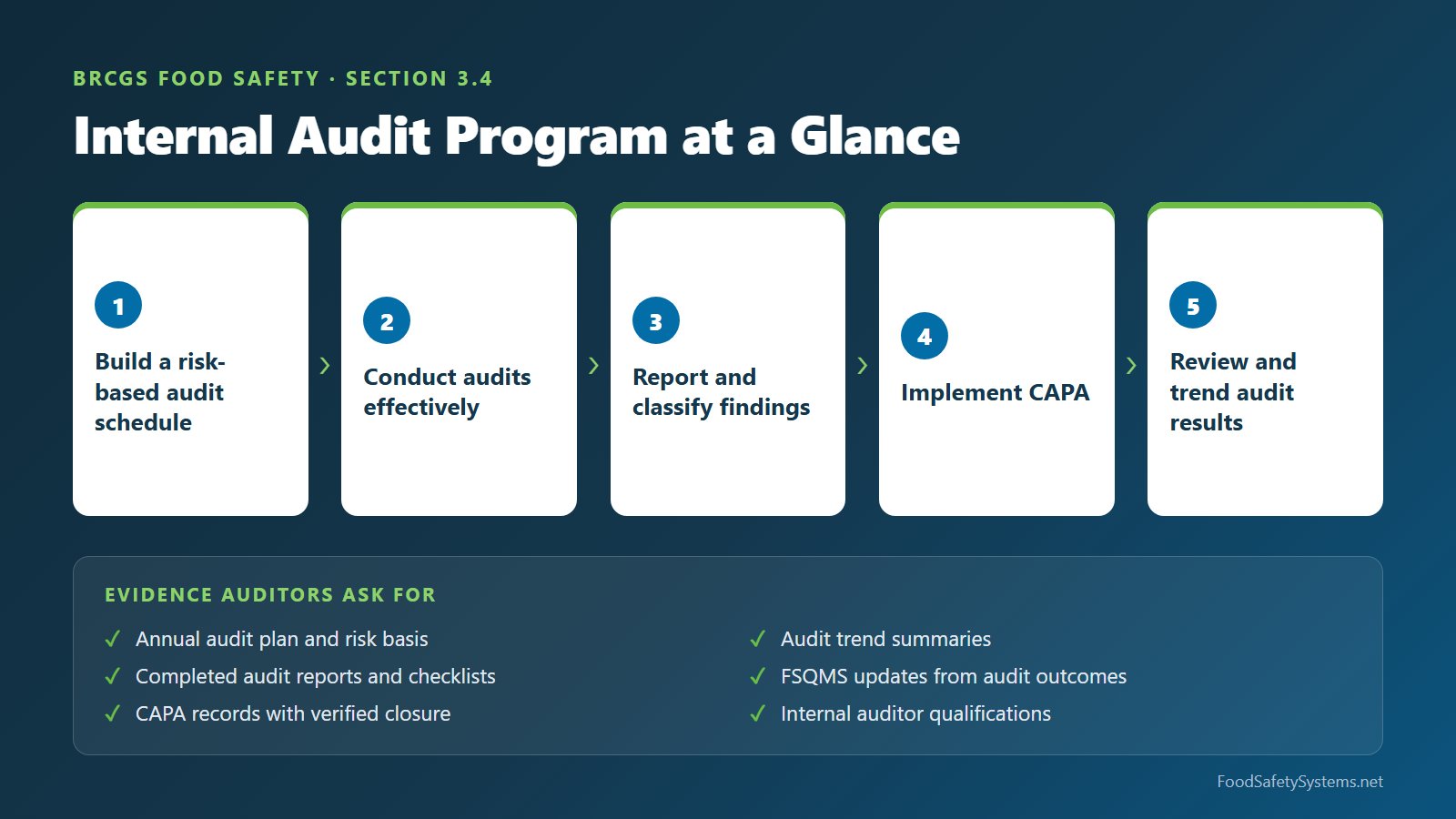
Five steps to a risk-based internal audit program
Work through these steps in order. Each one lists what to put in place and the records that prove it works.
Step 1
Develop a risk-based audit schedule
What to put in place
✓ Annual internal audit schedule covering all areas of the FSQMS
✓ Risk-based frequency and scope, with high-risk areas audited more often
✓ Designated audit leads and checklists aligned with BRCGS requirements
Evidence to maintain
✓ Annual audit plan or calendar
✓ Risk assessment rationale for audit frequency
✓ Assigned audit roles and responsibilities
Step 2
Conduct internal audits effectively
What to put in place
✓ Use approved checklists and audit tools
✓ Interview staff and review procedures
✓ Verify implementation, not just documentation
✓ Gather objective evidence and stay impartial
Evidence to maintain
✓ Completed audit checklists and notes
✓ Photos, observations and collected records
✓ Auditor qualifications and training records
Step 3
Report findings and classify non-conformities
What to put in place
✓ Minor: a procedural deviation with limited risk
✓ Major: failure to meet a critical requirement
✓ Critical: likely to result in a product safety failure or regulatory breach
Evidence to maintain
✓ Audit reports with classification and evidence
✓ Summary of audit results with findings logged
✓ Notification and approval trail
Step 4
Implement corrective and preventive actions (CAPA)
What to put in place
✓ Root cause analysis (RCA)
✓ Corrective action planning and assignment
✓ Completion timelines and verification of effectiveness
Evidence to maintain
✓ CAPA forms with the root cause documented
✓ Action closure dates and verification signatures
✓ Revised procedures, training records or updated logs
Step 5
Review and trend audit performance
What to put in place
✓ Track recurring non-conformities
✓ Identify systemic issues and recurring weak points
✓ Adjust audit frequency or scope as needed
Evidence to maintain
✓ Internal audit summary reports (monthly, quarterly or yearly)
✓ Non-conformance trend charts
✓ FSQMS updates based on audit outcomes
Avoid nonconformities
Common internal audit findings and how to fix them
Incomplete or missing audit schedule
Fix: develop and approve a documented annual audit plan.
The same non-conformities keep recurring
Fix: carry out root cause analysis and verify CAPA effectiveness.
No evidence that audits took place
Fix: keep completed checklists, notes and supporting records.
No follow-up on non-conformities
Fix: track CAPA status and verify closure before marking complete.
Audit day
Auditor verification checklist
During a BRCGS audit, be ready to present:
✓ Annual internal audit plan and its risk basis
✓ Completed audit reports with dates and findings
✓ CAPA records with verification of completion
✓ Audit trend summaries and FSQMS updates
✓ Qualifications of internal auditors
The benefit
Why internal audits matter
A strong internal audit program does more than pass the audit:
✓ Finds risks before external audits or incidents
✓ Supports compliance with BRCGS and legal requirements
✓ Strengthens documentation, traceability and process control
✓ Builds a culture of accountability and improvement
Implementation roadmap
From audit schedule to continual improvement
Phase 1
Build your audit program
✓ Create a risk-based schedule covering all system areas
✓ Assign trained auditors and standardize your tools
Phase 2
Train and execute
✓ Audit regularly with BRCGS-aligned checklists
✓ Interview, observe and document objectively
Phase 3
Track and follow up
✓ Record findings and classify non-conformities
✓ Assign and complete CAPAs with verification
Phase 4
Review and improve
✓ Monitor trends in audit findings
✓ Revise the audit plan and procedures based on results
FAQ
Internal audit program questions
What does BRCGS Section 3.4 require for internal audits?
A scheduled programme of internal audits throughout the year, covering the implementation of the whole food safety and quality management system, including all processes and activities, at a frequency based on risk.
How should we decide audit frequency?
Base it on risk: audit high-risk areas more often, record the rationale in your risk assessment, and adjust frequency or scope as audit trends show recurring weak points.
How do we classify internal audit findings?
A common approach is Minor for a procedural deviation with limited risk, Major for failure to meet a critical requirement, and Critical for findings likely to cause a product safety failure or regulatory breach.
Related guides
More food safety and quality management system guides
Corrective & Preventive Actions (CAPA)
Close internal audit findings with root cause analysis and verified actions.
Read the guide →
Document Control & Record-Keeping
Keep audit reports, checklists and records controlled and retrievable.
Read the guide →
Management of Non-Conforming Products
Control product affected by the issues your audits uncover.
Read the guide →
Build a risk-based internal audit program
We provide internal audit SOP templates, annual audit schedule planners, audit checklists mapped to BRCGS requirements, and CAPA and root cause analysis tools.
Food Safety Systems is an independent consulting provider and is not affiliated with, endorsed by or certified by BRCGS or the British Retail Consortium. BRCGS® is a registered trademark of the British Retail Consortium Trading Ltd. For official requirements, visit www.brcgs.com. Read our disclaimer.