BRCGS Food Safety Issue 9 · Section 1.2
Organizational Structure and Responsibility: Build a Clear Organizational Structure
A clear organizational structure shows who is accountable for food safety and quality at every level. This guide covers what BRCGS Section 1.2 expects, four steps to define and communicate your structure and the evidence auditors ask for.
Requirement overview
What BRCGS Section 1.2 requires
Section 1.2 of BRCGS Food Safety Issue 9 requires senior management to make sure the company has a clear organizational structure that is communicated to all relevant staff, alongside clear objectives to maintain and improve product safety, legality and quality.
This section sets the foundation for accountability and oversight. Senior management must lead with a clear, well-communicated structure that supports food safety and quality compliance across the business.
Key compliance objectives
✓ Define and document the food safety and quality management structure
✓ Assign clear roles, responsibilities and reporting lines
✓ Communicate the structure to relevant employees
✓ Show leadership accountability and commitment
Step by step
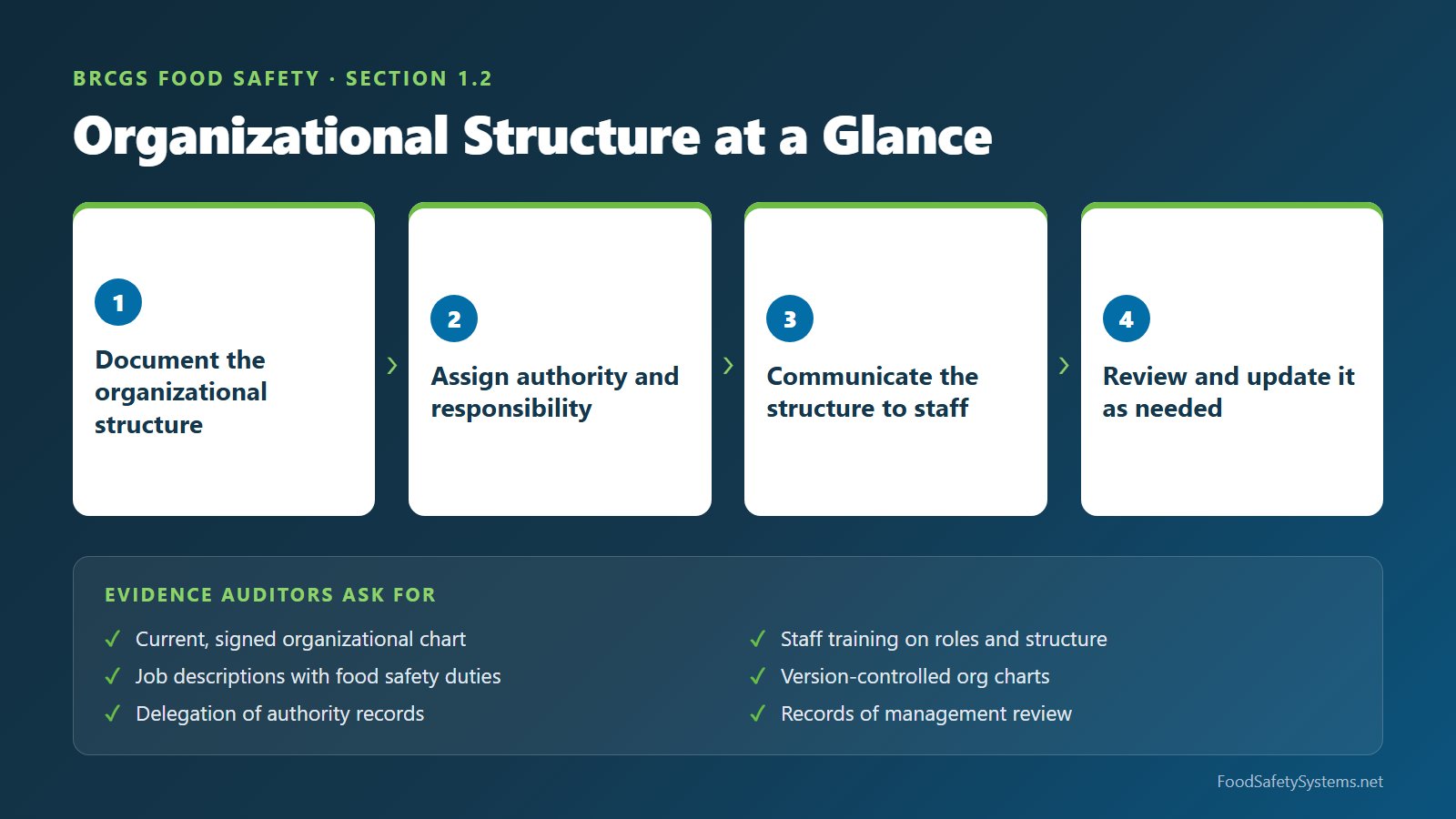
Four steps to a clear organizational structure
Work through these steps in order. Each one lists what to put in place and the records that prove it works.
Step 1
Develop a documented organizational structure
What to put in place
✓ Reporting lines from top management to frontline staff
✓ Designated food safety, quality and regulatory roles
✓ Role titles, responsibilities and cross-functional communication paths
Evidence to maintain
✓ Organizational chart, signed and dated by senior leadership
✓ Job descriptions with food safety and quality responsibilities
✓ Role assignment memos or HR records
Step 2
Assign authority and responsibility clearly
What to put in place
✓ Food Safety Team Leader
✓ Technical or Quality Assurance Manager
✓ Production Manager
✓ Regulatory or Compliance Officer
Evidence to maintain
✓ Written role descriptions defining accountability
✓ Delegation of authority documentation
✓ Training records confirming role understanding
Step 3
Communicate the structure across the organization
What to put in place
✓ Staff onboarding and orientation
✓ Team briefings and internal communications
✓ Posting the organizational chart in key areas
Evidence to maintain
✓ Orientation agendas and training logs
✓ Internal emails, team meeting notes and briefing slides
✓ Photos of posted organizational charts (if applicable)
Step 4
Review and update the structure as needed
What to put in place
✓ During management review or internal audits
✓ After changes in leadership or operations
✓ After a non-conformance related to roles or responsibilities
Evidence to maintain
✓ Dated, version-controlled organizational charts
✓ Change logs or approval history
✓ Updated job descriptions and SOPs
Avoid nonconformities
Common organizational structure audit findings and how to fix them
Outdated or missing organizational chart
Fix: keep a current chart and review it quarterly.
Undefined food safety roles
Fix: assign and document clear responsibility for food safety oversight.
Staff unaware of reporting lines
Fix: include the structure in onboarding and regular training sessions.
No evidence of senior management review
Fix: document leadership review of the structure during management meetings.
Audit day
Auditor verification checklist
Auditors may ask for:
✓ A current, signed organizational chart
✓ Job descriptions showing accountability for food safety and quality
✓ Records of staff training on roles and structure
✓ Evidence of management review and updates to the structure
The benefit
Why organizational structure matters
A clear structure does more than pass the audit:
✓ Builds accountability across all levels
✓ Makes clear who is responsible for food safety actions
✓ Builds a culture of leadership-led compliance
✓ Strengthens audit preparedness and regulatory trust
Implementation roadmap
From a documented chart to continual improvement
Phase 1
Build your structure
✓ Define the chain of command for food safety and quality
✓ Assign and document authority and responsibility
Phase 2
Communicate and train
✓ Share the organizational chart and responsibilities with staff
✓ Run regular training and refreshers
Phase 3
Monitor and review
✓ Verify the structure during internal audits and management reviews
✓ Update it as your organization changes
Phase 4
Improve continuously
✓ Align all roles with food safety priorities
✓ Close gaps revealed by audits or incidents
FAQ
Organizational structure questions
What does BRCGS Section 1.2 require?
It requires a clear organizational structure that is communicated to all relevant staff, with senior management accountable for food safety and quality across the business.
Which roles should the structure define?
Reporting lines from top management to frontline staff, plus designated food safety, quality and regulatory roles such as the Food Safety Team Leader, Technical or QA Manager, Production Manager and Regulatory or Compliance Officer.
When should we update the organizational chart?
During management review or internal audits, after changes in leadership or operations, and after any non-conformance related to roles or responsibilities. Keep charts dated and version-controlled.
Related guides
More senior management commitment guides
Create a clear organizational structure for your site
We provide organizational chart templates with food safety role indicators, job description samples aligned with BRCGS expectations, internal communication templates for structure rollouts, and training aids for onboarding and role reinforcement.
Food Safety Systems is an independent consulting provider and is not affiliated with, endorsed by or certified by BRCGS or the British Retail Consortium. BRCGS® is a registered trademark of the British Retail Consortium Trading Ltd. For official requirements, visit www.brcgs.com. Read our disclaimer.