
BRCGS Food Safety Issue 9 · Section 7.1
Training and Competence: Your Documented Training Procedure
A documented training procedure shows that everyone whose work affects product safety, legality and quality is trained and competent. This guide covers what BRCGS Clause 7.1 expects, four steps to put it in place and the evidence auditors ask to see.
Requirement overview
What BRCGS Clause 7.1 requires
BRCGS Food Safety Issue 9 requires that everyone performing tasks that affect product safety, legality and quality is competent, suitably trained and regularly assessed.
Clause 7.1 requires that these personnel can demonstrate competence for their activity, and that the company has a documented training procedure and training program that at least meets the requirements of the Standard.
The aim is for every employee, from front-line operators to supervisors, to understand their food safety responsibilities and carry out their duties correctly and confidently.
Key compliance objectives
✓ Make sure all personnel are competent in their food safety and quality roles
✓ Keep training records up to date
✓ Verify training effectiveness through assessments and observations
✓ Develop a continuous training and skills development program
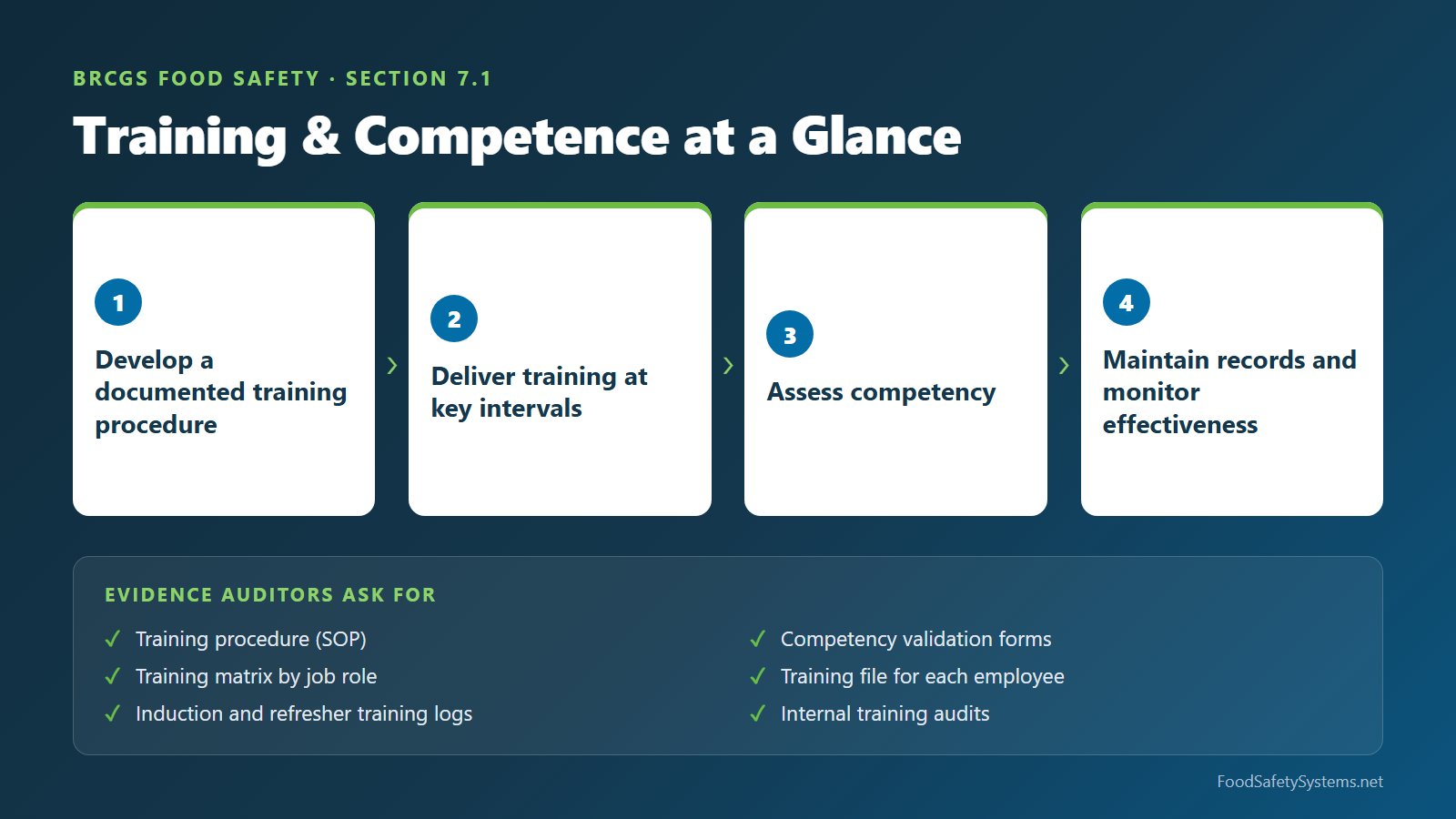
Step by step
Four steps to a documented training procedure
Work through these steps in order. Each one lists what to put in place and the records that prove it works.
Step 1
Develop a documented training procedure
What to put in place
✓ Identify training needs by job function
✓ Set training delivery methods (on-the-job, classroom, online)
✓ Define how competency is assessed
✓ Assign responsibilities for training
Evidence to maintain
✓ Training procedure (SOP)
✓ Training matrix by job role
✓ Records of designated trainers and their qualifications
Step 2
Deliver training at key intervals
What to put in place
✓ At induction, before starting work
✓ When job roles change
✓ When procedures or equipment are updated
✓ At scheduled refresher intervals
Evidence to maintain
✓ Induction training logs
✓ Refresher training calendar
✓ Updated training materials and attendance sheets
Step 3
Assess competency
What to put in place
✓ Written or verbal quizzes
✓ Supervisor observations
✓ Practical demonstrations of tasks
✓ Post-training verification activities
Evidence to maintain
✓ Completed quizzes or observation checklists
✓ Signed competency validation forms
✓ Records of retraining where gaps are found
Step 4
Maintain training records and monitor effectiveness
What to put in place
✓ Document, sign and date all training
✓ Include the trainer's and trainee's names
✓ Keep records available for audit and review them for gaps
Evidence to maintain
✓ Central training log
✓ Training file for each employee
✓ Internal training audits and summaries
Avoid nonconformities
Common training audit findings and how to fix them
Incomplete or missing training records
Fix: standardize training forms and digital logs.
No formal training plan by job role
Fix: create a role-based training matrix.
Staff unaware of food safety responsibilities
Fix: increase refresher and job-specific training.
Training not assessed for effectiveness
Fix: use post-training quizzes and supervisor sign-off checklists.
Audit day
Auditor verification checklist
During a BRCGS audit, expect to show:
✓ Your documented training procedure and matrix
✓ Employee training and competency records
✓ Evidence of refresher training and job-specific updates
✓ Competency assessments and improvement actions
The benefit
Why training and competence matter
A strong training system:
✓ Makes sure employees are qualified to protect food safety and quality
✓ Reduces the risk of operator errors and nonconformities
✓ Strengthens audit readiness and team confidence
✓ Supports a culture of learning and accountability
Implementation roadmap
From training SOP to continuous improvement
Phase 1
Build your training system
✓ Create a training SOP and assign responsibility
✓ Develop role-specific training plans
Phase 2
Train and validate
✓ Run formal induction and ongoing training
✓ Assess understanding through testing and observation
Phase 3
Monitor and improve
✓ Review training records regularly
✓ Carry out internal audits of training effectiveness
Phase 4
Retain and review
✓ Keep detailed training logs
✓ Update plans when products, roles or procedures change
FAQ
Documented training procedure questions
What should a documented training procedure include?
How training needs are identified by job function, the delivery methods (on-the-job, classroom, online), how competency is assessed and who is responsible for training.
When do staff need training?
At induction before starting work, when job roles change, when procedures or equipment are updated, and at scheduled refresher intervals.
What must a training record show?
It must be documented, signed and dated, include the trainer's and trainee's names, and be available for audit and reviewed for gaps.
Related guides
More BRCGS personnel guides
Personnel Hygiene Training
Build a hygiene training program and keep the evidence.
Read the guide →
Personal Hygiene Policies
Write, train, enforce and review your hygiene policy.
Read the guide →
Visitor and Contractor Controls
Entry procedures, hygiene briefings and access limits.
Read the guide →
Get your documented training procedure audit-ready
We provide training SOP templates, competency assessment forms, role-based training matrices and digital training logbooks and refresher trackers.
Food Safety Systems is an independent consulting provider and is not affiliated with, endorsed by or certified by BRCGS or the British Retail Consortium. BRCGS® is a registered trademark of the British Retail Consortium Trading Ltd. For official requirements, visit www.brcgs.com. Read our disclaimer.