
BRCGS Food Safety Issue 9 · Sections 1.1 & 3.11
Recall and Incident Management: Managing Food Safety Incidents & Product Recalls
Effective recall and incident management lets you handle food safety incidents and product recalls quickly, transparently and with full leadership oversight. This guide covers what BRCGS expects, five steps to build your program and the evidence auditors check.
Requirement overview
What BRCGS Sections 1.1 and 3.11 require
BRCGS Food Safety Issue 9 requires the site's senior management to make sure the company is informed of, and complies with, all relevant food safety legislation, and that systems are in place to manage incidents and to withdraw or recall products where necessary.
Senior management is directly responsible for making sure these systems work. Incidents and recalls must be handled swiftly, transparently and with full leadership oversight to protect consumers.
Key compliance objectives
✓ Establish and support a documented incident and recall program
✓ Make sure traceability and communication systems work
✓ Lead incident response and decision-making
✓ Review, test and continually improve recall systems
Step by step
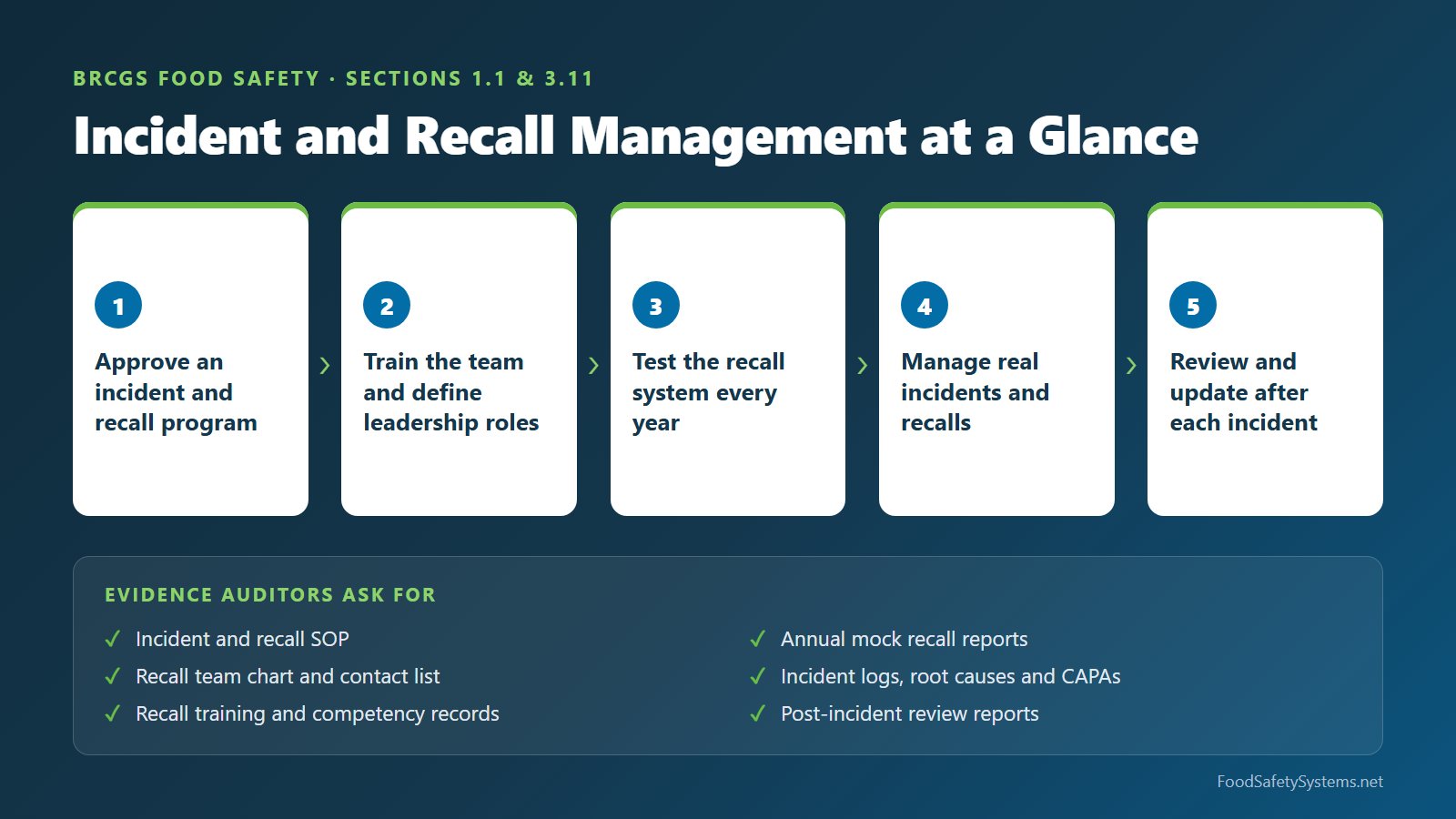
Five steps to a recall and incident management program
Work through these steps in order. Each one lists what to put in place and the records that prove it works.
Step 1
Develop and approve an incident and recall program
What to put in place
✓ Written procedure covering notification, investigation and response steps
✓ Defined recall team with assigned roles and contact details
✓ Links to regulatory, customer and internal reporting obligations
Evidence to maintain
✓ Documented food safety incident and recall SOP
✓ Signed recall program and organizational chart
✓ Emergency contact list and escalation plan
Step 2
Train the team and define leadership roles
What to put in place
✓ Senior management assigns clear authority to manage and start recalls
✓ Senior management makes sure all responsible parties are trained and competent
✓ Senior management takes part in decisions and public-facing responses
Evidence to maintain
✓ Recall training logs
✓ Competency assessments for recall team members
✓ Records of senior management participation
Step 3
Test the recall system every year
What to put in place
✓ Run at least one documented mock recall per year
✓ Validate product traceability and communication timelines
✓ Evaluate response coordination and leadership involvement
Evidence to maintain
✓ Mock recall reports and evaluation forms
✓ Corrective and preventive action plans
✓ Recall procedures updated from test results
Step 4
Manage real incidents and recalls effectively
What to put in place
✓ Activate the recall team immediately
✓ Notify regulatory authorities and affected customers
✓ Retrieve product and communicate transparently
✓ Investigate the root cause and prevent recurrence
Evidence to maintain
✓ Logs of real incidents, root causes and CAPAs
✓ Communication records with customers and regulators
Step 5
Review and update systems after each incident
What to put in place
✓ Hold a formal post-incident review
✓ Assign actions and revise SOPs
✓ Share learnings across teams
Evidence to maintain
✓ Post-incident review reports
✓ Updated procedures and training records
✓ Leadership meeting notes or review sign-offs
Avoid nonconformities
Common incident and recall audit findings and how to fix them
No documented recall procedure
Fix: develop and approve a comprehensive recall program.
Inadequate recall training
Fix: schedule regular training and mock recall drills.
Senior management not involved in testing
Fix: require leadership to join the annual mock recall and reviews.
Incomplete incident records
Fix: use standardized logs and include all corrective actions.
Audit day
Auditor verification checklist
Auditors will expect:
✓ A written, approved recall and incident management program
✓ Evidence of senior management participation
✓ Annual mock recall documentation
✓ Logs of real incidents, root causes and CAPAs
✓ Communication records with customers and regulators
The benefit
Why incident and recall management matters
A tested program does more than pass the audit:
✓ Protects consumer safety and brand reputation
✓ Prepares your company for an effective crisis response
✓ Meets BRCGS certification and legal compliance expectations
✓ Builds trust with retailers, regulators and auditors
Implementation roadmap
From a written SOP to a tested, improving program
Phase 1
Build your program
✓ Assign the recall team and write the incident and recall SOP
✓ Approve it and distribute it across departments
Phase 2
Train and validate
✓ Train all relevant staff
✓ Run annual mock recalls with the full team
Phase 3
Operate and monitor
✓ Keep real-time incident logs
✓ Track traceability and communication performance
Phase 4
Review and improve
✓ Hold post-event reviews
✓ Update documents and retrain as needed
FAQ
Recall and incident management questions
How often should we run a mock recall?
Run at least one documented mock recall per year. Use it to validate product traceability and communication timelines, and to evaluate response coordination and leadership involvement.
What role does senior management play in a recall?
Senior management assigns clear authority to manage and start recalls, makes sure the team is trained and competent, and takes part in decisions and public-facing responses.
What should happen after an incident?
Hold a formal post-incident review, assign actions, revise SOPs and share learnings across teams. Keep the review reports, updated procedures and leadership sign-offs.
Related guides
More senior management commitment guides
Strengthen your recall and incident management program
We offer incident and recall SOP templates, mock recall checklists and training slides, CAPA tracking logs and traceability forms, and staff training and management review guides.
Food Safety Systems is an independent consulting provider and is not affiliated with, endorsed by or certified by BRCGS or the British Retail Consortium. BRCGS® is a registered trademark of the British Retail Consortium Trading Ltd. For official requirements, visit www.brcgs.com. Read our disclaimer.