BRCGS Food Safety Issue 9 · Section 4.12
BRCGS Waste Management System: Section 4.12 Guide
A waste management system keeps waste from compromising product safety, hygiene or quality. This guide shows what BRCGS Section 4.12 expects, the four steps to segregate, remove and store waste, and the evidence auditors ask to see.
Requirement overview
What BRCGS Section 4.12 requires
BRCGS Food Safety Section 4.12 requires that waste is managed in a way that does not compromise product safety, hygiene or quality. Waste must be handled efficiently, removed regularly and stored in designated areas to prevent contamination, pest attraction or risks to product integrity.
Section 4.12 expects waste to be removed from food handling areas as soon as appropriate, in a way that does not compromise food safety.
An effective waste management system supports hygiene, pest control and overall food safety compliance, all core expectations in BRCGS audits.
Key compliance objectives
✓ Prevent contamination through proper segregation and disposal of waste
✓ Ensure waste removal does not disrupt food handling operations
✓ Protect raw materials, packaging and finished products from exposure
✓ Maintain documented procedures and staff training
Step by step
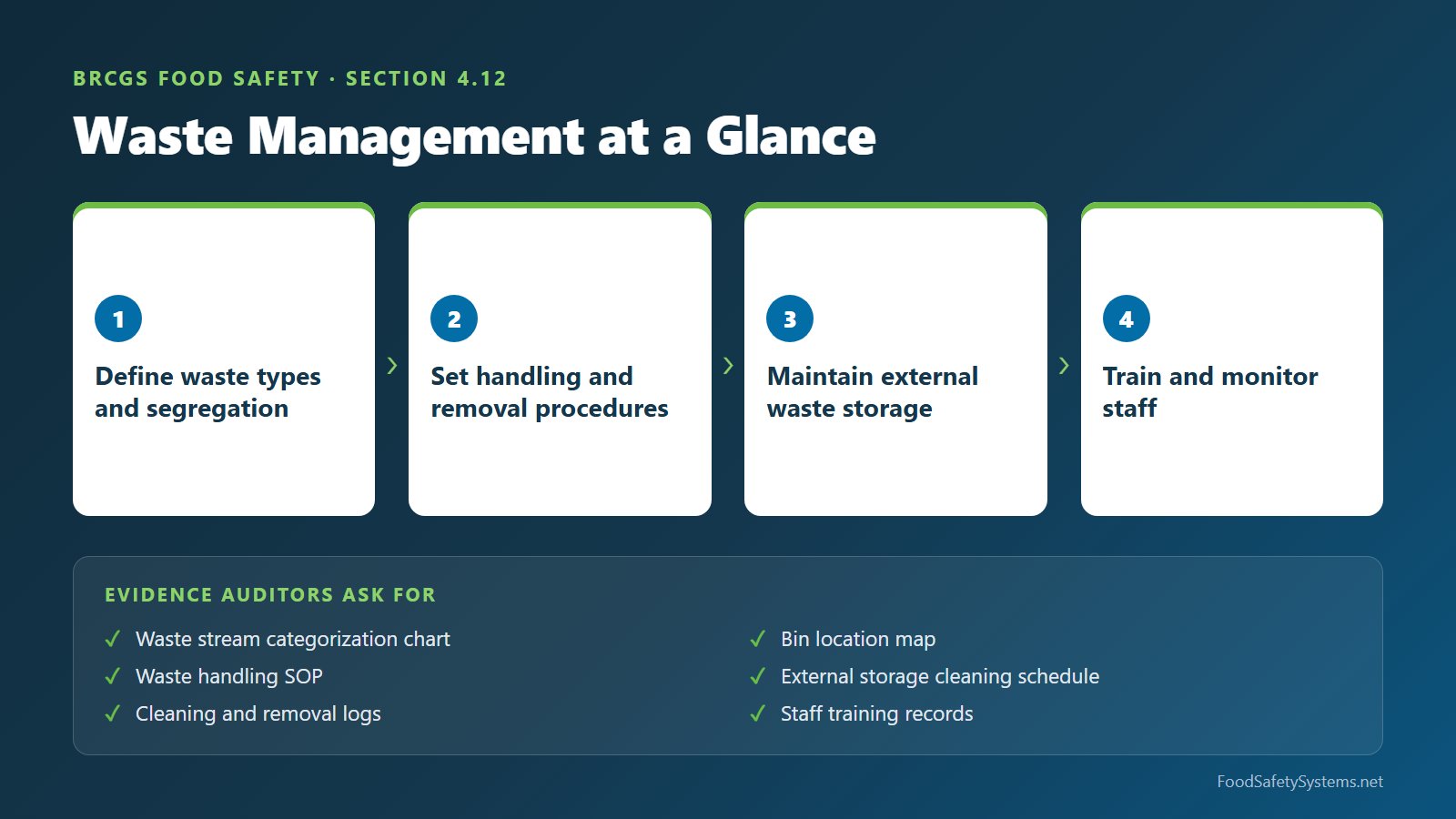
Four steps to a compliant waste management system
Work through these steps in order. Each one lists what to put in place and the records that prove it works.
Step 1
Define waste types and segregation methods
What to put in place
✓ Food waste
✓ Packaging waste
✓ Hazardous or chemical waste, such as cleaning agents
✓ General refuse
Evidence to maintain
✓ Waste stream categorization chart
✓ Color-coded bins or containers for segregation
✓ Training materials on segregation rules
Step 2
Establish waste handling and removal procedures
What to put in place
✓ Remove waste promptly from production areas
✓ Set schedules for waste removal and cleaning
✓ Use sealed, leak-proof and clearly labeled containers
Evidence to maintain
✓ Waste handling SOP
✓ Cleaning and removal logs
✓ Bin location map with responsibility assignments
Step 3
Maintain external waste storage areas
What to put in place
✓ Secure, clean and pest-resistant
✓ Located away from food storage and processing areas
✓ Managed to prevent odor, leakage or overflow
Evidence to maintain
✓ Facility layout showing the waste zone
✓ External storage cleaning schedule
✓ Pest control monitoring logs
Step 4
Train and monitor staff
What to put in place
✓ Waste identification and segregation
✓ Bin cleaning and replacement frequency
✓ Spill response and contamination prevention
Evidence to maintain
✓ Completed training records
✓ Observational audits or spot checks
✓ Incident logs or corrective action reports
Avoid nonconformities
Common waste management audit findings and how to fix them
Overflowing or open waste bins
Fix: use covered containers and remove waste more often.
No segregation of food and non-food waste
Fix: use color-coded containers and clear signage.
Waste stored too close to production
Fix: redesign the site layout and designate external waste zones.
No cleaning or pest control of waste areas
Fix: schedule and document bin cleaning and pest checks.
Audit day
Auditor verification checklist
During a BRCGS audit, expect to show:
✓ Waste management SOP and waste flow diagram
✓ Bin labels, color coding and location plan
✓ Cleaning and removal logs
✓ Pest control reports for waste zones
✓ Evidence of staff training and responsibilities
The benefit
Why waste management matters
A well-run system does more than pass the audit:
✓ Prevents cross-contamination and pest attraction
✓ Supports a hygienic, organized and audit-ready site
✓ Supports compliance with BRCGS Section 4.12
✓ Protects product safety and brand integrity
Implementation roadmap
From waste categories to continuous improvement
Phase 1
Build your waste management program
✓ Identify and categorize all waste types
✓ Set site-specific waste zones and container systems
Phase 2
Train and enforce
✓ Instruct staff on proper segregation and removal
✓ Post signs and use visual color-coding
Phase 3
Monitor and clean
✓ Remove waste on schedule
✓ Clean bins and storage areas regularly
Phase 4
Improve continuously
✓ Review incident logs for pest or hygiene issues
✓ Adjust waste routes and schedules as needed
FAQ
Waste management system questions
How often should waste be removed?
BRCGS Section 4.12 expects waste to be removed from food handling areas as soon as appropriate. Set removal schedules, keep removal logs and use covered containers so bins never overflow.
What makes an external waste area compliant?
It should be secure, clean and pest-resistant, located away from food storage and processing, and managed to prevent odor, leakage and overflow, with a cleaning schedule and pest monitoring logs.
What waste records do BRCGS auditors check?
Typically the waste management SOP and flow diagram, bin labels, color coding and location plan, cleaning and removal logs, pest control reports for waste zones and staff training records.
Related guides
More BRCGS site standards guides
Pest Control Program
Keep waste areas from attracting pests with a risk-based program.
Read the guide →
Layout, Product Flow & Segregation
Plan waste routes that stay clear of product.
Read the guide →
Cleaning & Sanitation
Documented cleaning procedures, including bins and storage areas.
Read the guide →
Get your waste management system audit-ready
We provide waste management SOP templates, site signage kits (bin labels and color codes), staff training guides for waste segregation and audit checklists for waste and sanitation controls.
Food Safety Systems is an independent consulting provider and is not affiliated with, endorsed by or certified by BRCGS or the British Retail Consortium. BRCGS® is a registered trademark of the British Retail Consortium Trading Ltd. For official requirements, visit www.brcgs.com. Read our disclaimer.