
BRCGS Food Safety Issue 9 · Section 4.11
Risk-Based Environmental Monitoring: BRCGS Section 4.11 Guide
Risk-based environmental monitoring verifies that your hygiene procedures keep pathogens and allergens under control. This guide shows what BRCGS Section 4.11 expects, the four steps to build your program, and the evidence auditors ask to see.
Requirement overview
What BRCGS Section 4.11 requires
BRCGS Food Safety Section 4.11 requires sites to run a risk-based environmental monitoring program that verifies how well hygiene procedures minimize the risk of contamination, particularly from pathogens and allergens.
The program covers pathogens or appropriate indicator organisms and includes written procedures, sampling and testing procedures, action limits and corrective actions.
An effective program monitors food contact and non-contact surfaces in critical areas and confirms sanitation effectiveness, especially in high-care, high-risk and ambient high-care zones.
Key compliance objectives
✓ Validate sanitation effectiveness in critical hygiene zones
✓ Detect potential pathogen or allergen risks early
✓ Ensure timely corrective action and continuous monitoring
✓ Provide evidence of compliance in internal and external audits
Step by step
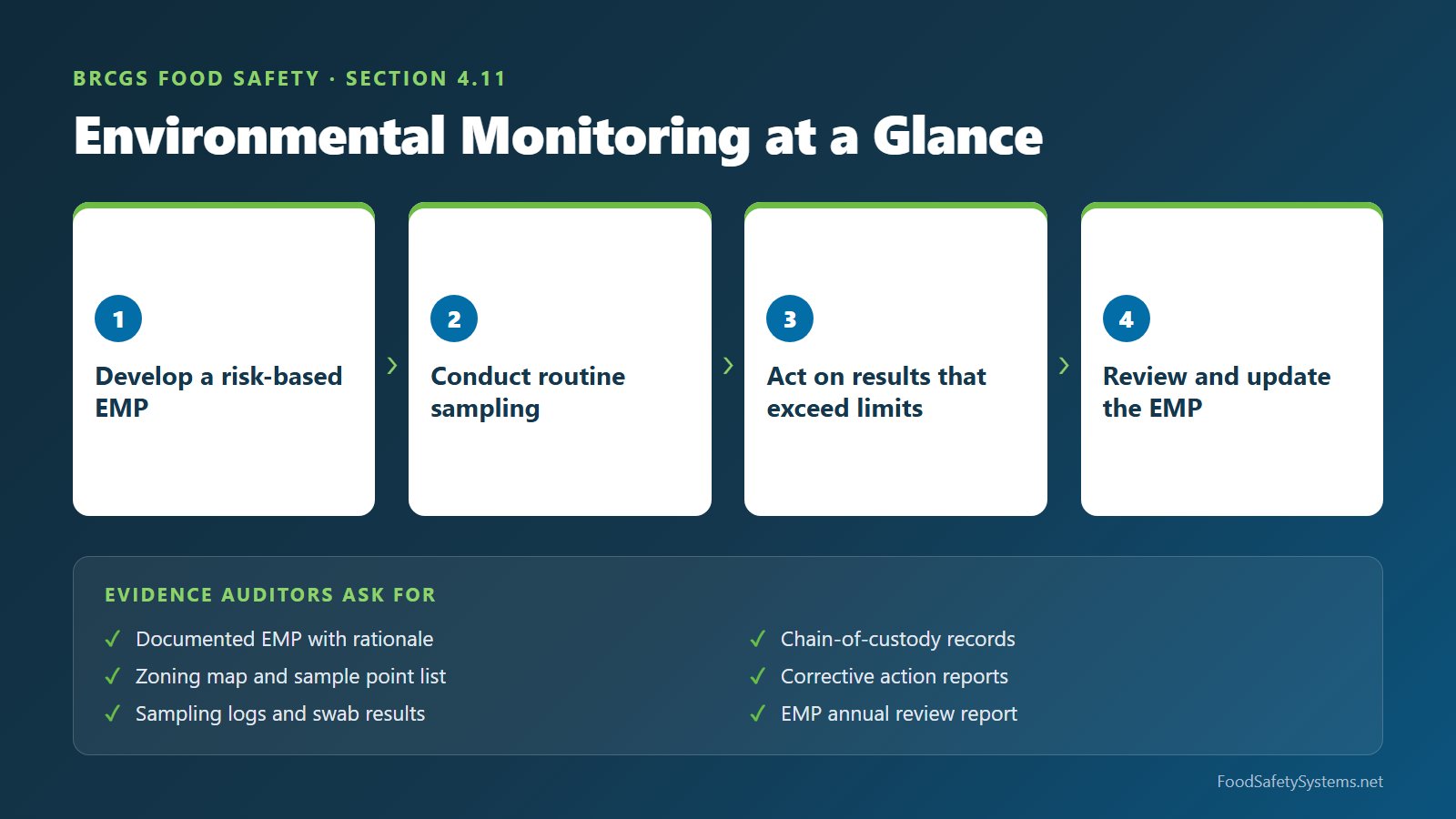
Four steps to a risk-based environmental monitoring program
Work through these steps in order. Each one lists what to put in place and the records that prove it works.
Step 1
Develop an environmental monitoring program (EMP)
What to put in place
✓ Risk assessment of zones (low-risk, high-care and so on)
✓ Target organisms, such as Listeria, Salmonella and Enterobacteriaceae
✓ Sampling locations, frequency and rationale
✓ Responsibilities and action limits
Evidence to maintain
✓ Documented EMP with rationale
✓ Zoning map and sample point list
✓ Sampling schedule and organism targets
Step 2
Conduct routine sampling
What to put in place
✓ Swab both food contact and non-contact surfaces
✓ Rotate sampling points to avoid predictable patterns
✓ Follow sterile techniques and trained protocols
✓ Use accredited third-party labs if applicable
Evidence to maintain
✓ Sampling logs and swab results
✓ Chain-of-custody records for lab submissions
✓ Training records for sampling staff
Step 3
Interpret results and act on deviations
What to put in place
✓ Start an immediate investigation and root cause analysis when results exceed limits
✓ Re-clean, resample and review procedures
✓ Escalate based on the risk zone and organism detected
Evidence to maintain
✓ Test result trend logs
✓ Corrective action reports
✓ Cleaning verification records
Step 4
Review and update the EMP regularly
What to put in place
✓ Review after product changes, line expansions or layout changes
✓ Review after sanitation validation failures or positive pathogen findings
✓ Analyze data trends periodically
Evidence to maintain
✓ EMP annual review report
✓ Updated swabbing plan and frequency log
✓ Verification of new high-risk areas or equipment zones
Avoid nonconformities
Common environmental monitoring audit findings and how to fix them
No EMP in place
Fix: develop a documented, risk-based environmental monitoring program.
No target organisms defined
Fix: identify specific pathogens or indicators based on product and zone.
Infrequent or inconsistent sampling
Fix: set a defined frequency and rotate sampling points systematically.
No corrective actions after positive tests
Fix: establish a CAPA protocol and documentation requirement.
Audit day
Auditor verification checklist
During an audit, be prepared to provide:
✓ Your written environmental monitoring procedure
✓ Sampling schedules and rationale
✓ Swabbing records, test results and trend analysis
✓ Corrective actions for any failed results
✓ The annual review of program effectiveness
The benefit
Why environmental monitoring matters
A well-run EMP does more than pass the audit:
✓ Identifies contamination risks before they affect product safety
✓ Supports sanitation validation and verification
✓ Strengthens audit readiness and regulatory compliance
✓ Protects consumer health and brand trust
Implementation roadmap
From zone risk assessment to annual review
Phase 1
Build your EMP
✓ Run a hygiene zone risk assessment
✓ Set the sampling plan and organism targets
Phase 2
Train and execute
✓ Train sanitation and QA staff on correct sampling
✓ Swab as scheduled and submit samples promptly
Phase 3
Review and respond
✓ Monitor results and trends over time
✓ Take corrective action and revise cleaning procedures
Phase 4
Validate and improve
✓ Review the EMP annually or when processes change
✓ Update zones, frequencies and targets as needed
FAQ
Environmental monitoring questions
What should a risk-based environmental monitoring program include?
A zone risk assessment, target organisms (such as Listeria, Salmonella or Enterobacteriaceae), sampling locations, frequency and rationale, responsibilities, action limits and corrective actions, all in written procedures.
What happens when a result exceeds the limit?
Start an investigation and root cause analysis straight away, re-clean and resample, review the procedures, and escalate based on the risk zone and the organism detected.
When should the EMP be reviewed?
At least annually, and after product changes, line expansions, layout changes, sanitation validation failures or positive pathogen findings.
Related guides
More BRCGS site standards guides
Cleaning & Sanitation
Documented cleaning procedures your monitoring program verifies.
Read the guide →
Layout, Product Flow & Segregation
Hygiene zoning and controlled movement between zones.
Read the guide →
Environmental Monitoring Add-On
The optional BRCGS module for microbial environmental testing.
Read the guide →
Get your risk-based environmental monitoring program audit-ready
We provide environmental monitoring program templates, sample swab point zone maps, corrective action tracking forms and staff training guides for environmental sampling.
Food Safety Systems is an independent consulting provider and is not affiliated with, endorsed by or certified by BRCGS or the British Retail Consortium. BRCGS® is a registered trademark of the British Retail Consortium Trading Ltd. For official requirements, visit www.brcgs.com. Read our disclaimer.