BRCGS Food Safety Issue 9 · Sections 4.1 & 4.4
External and Internal Site Condition: BRCGS Sections 4.1 and 4.4 Guide
The external and internal site condition decides whether your buildings keep contamination and pests out. This guide shows what BRCGS Sections 4.1 and 4.4 expect, the four steps to keep the site audit-ready, and the evidence auditors ask to see.
Requirement overview
What BRCGS Sections 4.1 and 4.4 require
BRCGS Food Safety Sections 4.1 and 4.4 require that the internal and external condition of the site is designed, maintained and managed to minimize the risk of contamination and support food safety, legality and product quality.
Section 4.1 requires external areas to be kept in good order, with measures to prevent pest access where necessary. Section 4.4 requires the internal condition of manufacturing, storage and product handling areas to be suitable for their purpose and maintained to prevent contamination and make cleaning easy.
Good site maintenance, inside and out, is essential for preventing physical, chemical, microbiological and pest-related hazards.
Key compliance objectives
✓ Keep internal production and storage areas clean, hygienic and damage-free
✓ Prevent pest harborage and entry from the external surroundings
✓ Support hygienic design and access for cleaning
✓ Ensure structural integrity and prevent contamination risks
Step by step
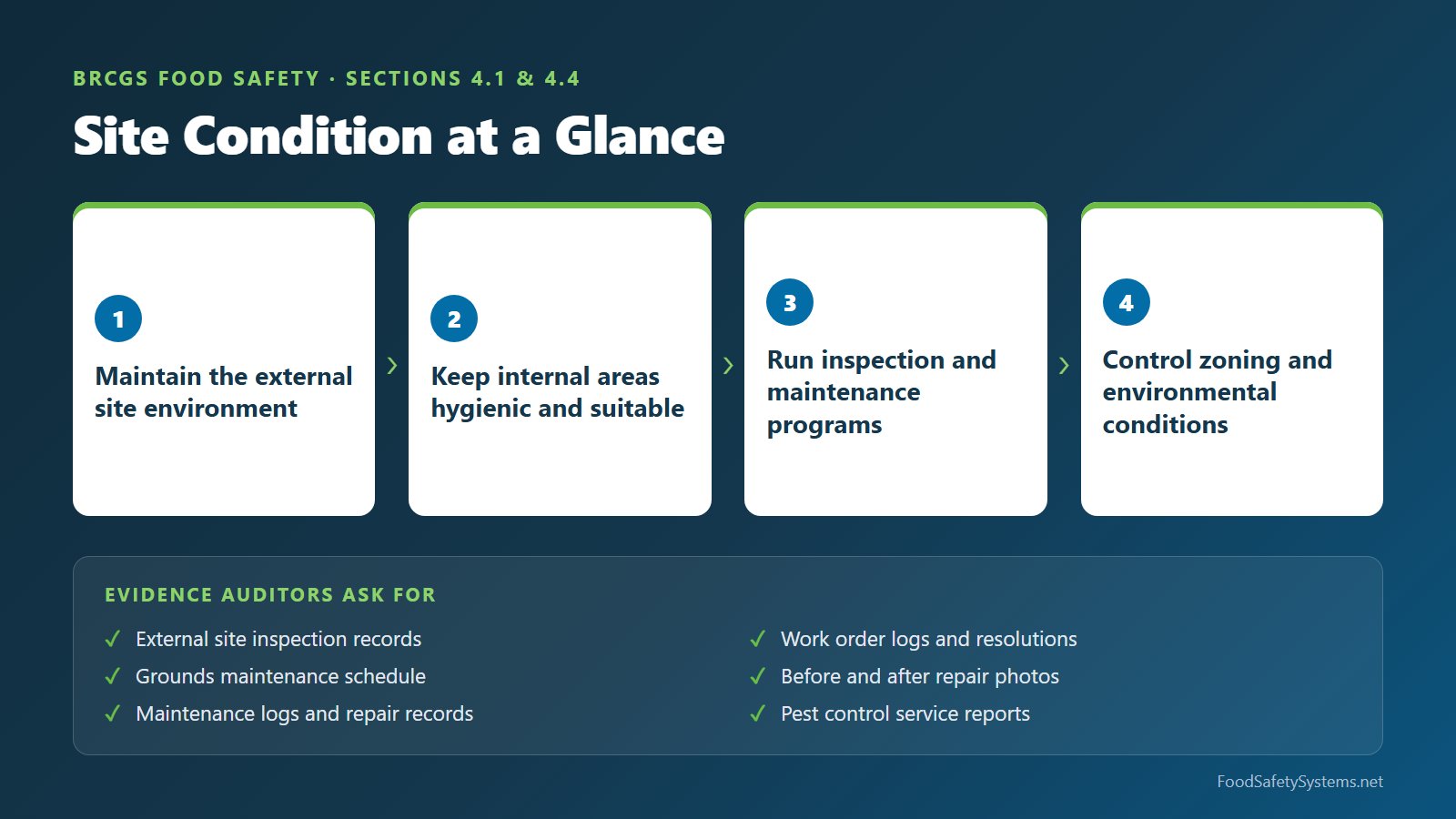
Four steps to keep the external and internal site condition audit-ready
Work through these steps in order. Each one lists what to put in place and the records that prove it works.
Step 1
Maintain the external site environment
What to put in place
✓ Monitor grounds and landscaping, waste disposal areas, drainage and standing water, perimeter fencing and building exteriors
✓ Clean routinely and control vegetation
✓ Contain waste properly and remove it on schedule
✓ Pest-proof external entry points
Evidence to maintain
✓ External site inspection records
✓ Pest control service reports
✓ Grounds maintenance schedule
Step 2
Ensure internal areas are hygienic and suitable
What to put in place
✓ Assess walls, floors, ceilings and drains; doors, windows and overhead structures; lighting, ventilation and condensation control
✓ Keep surfaces sealed and damage-free
✓ No flaking paint, exposed insulation or open gaps
✓ Fixtures that prevent water accumulation and dust build-up
Evidence to maintain
✓ Maintenance logs and repair records
✓ Hygienic zoning and building layout plans
✓ Internal housekeeping inspection forms
Step 3
Implement inspection and maintenance programs
What to put in place
✓ Scheduled preventive maintenance for structures and fixtures
✓ Prompt repair of identified defects
✓ Tracking of open and closed work orders
Evidence to maintain
✓ Facility maintenance SOP
✓ Work order logs and resolution records
✓ Before and after photos or records of repairs
Step 4
Control zoning and environmental conditions
What to put in place
✓ Segregate low-risk, high-risk and high-care areas
✓ Control airflow and entry between zones
✓ Control temperature, humidity and lighting
Evidence to maintain
✓ Hygienic zoning and building layout plans
✓ Photos or reports showing zoning and structural compliance
Avoid nonconformities
Common site condition issues and how to fix them
Flaking paint, exposed insulation or open gaps
Fix: repair defects promptly, track each work order to closure and keep before and after records.
Standing water and poorly maintained grounds
Fix: include drainage, grounds and vegetation in routine external inspections and the grounds maintenance schedule.
Pest entry points on the building exterior
Fix: pest-proof external entry points and keep pest control service reports and site maps.
Damage that is seen but never followed up
Fix: assign inspection and follow-up responsibilities and log every issue and its resolution.
Audit day
Auditor verification checklist
During a BRCGS audit, expect to show:
✓ Inspection records for internal and external site conditions
✓ Maintenance logs and documented repairs
✓ Pest control service reports and site maps
✓ Photos or reports showing zoning and structural compliance
The benefit
Why site condition matters
A well-kept site does more than pass the audit:
✓ Prevents contamination from structural or environmental sources
✓ Reduces pest risks and improves compliance with hygiene standards
✓ Supports smooth audit outcomes and certification retention
✓ Promotes a clean, safe and professional production environment
Implementation roadmap
From site maintenance SOPs to continuous improvement
Phase 1
Build and maintain your site
✓ Set site maintenance SOPs for internal and external areas
✓ Assign responsibilities for inspections and follow-ups
Phase 2
Train and inspect
✓ Train staff on facility hygiene standards and damage reporting
✓ Run regular site walkthroughs and document observations
Phase 3
Monitor and act
✓ Log identified issues and their resolutions
✓ Track pest control effectiveness and structural integrity
Phase 4
Improve continuously
✓ Review findings in management meetings
✓ Invest in upgrades and infrastructure improvements when needed
FAQ
Site condition questions
What do BRCGS Sections 4.1 and 4.4 cover?
Section 4.1 covers the external areas of the site, including pest access. Section 4.4 covers the internal condition of manufacturing, storage and product handling areas, which must suit their purpose, prevent contamination and be easy to clean.
Which external areas should we inspect?
Grounds and landscaping, waste disposal areas, drainage and standing water, perimeter fencing and building exteriors, including any external entry points pests could use.
What site condition records do auditors check?
Internal and external inspection records, maintenance logs and documented repairs, pest control service reports and site maps, and photos or reports showing zoning and structural compliance.
Related guides
More BRCGS site standards guides
Layout, Product Flow & Segregation
Design zoning and the flow of people, materials and waste.
Read the guide →
Maintenance & Repair
Planned and reactive maintenance for equipment and building fabric.
Read the guide →
Pest Control Program
Keep pests out with a risk-based, documented program.
Read the guide →
Get your external and internal site condition audit-ready
We provide internal and external facility inspection templates, preventive maintenance schedules, zoning control diagrams and documentation tools, and training guides for hygiene and facilities teams.
Food Safety Systems is an independent consulting provider and is not affiliated with, endorsed by or certified by BRCGS or the British Retail Consortium. BRCGS® is a registered trademark of the British Retail Consortium Trading Ltd. For official requirements, visit www.brcgs.com. Read our disclaimer.