BRCGS Food Safety Issue 9 · Section 1.1
Food Safety and Quality Objectives: Set, Share and Review Them
Clear food safety and quality objectives give your site measurable targets for safety, legality and product quality. This guide covers what BRCGS Section 1.1 expects, four steps to set and manage your objectives and the evidence auditors ask for.
Requirement overview
What BRCGS Section 1.1 requires for objectives
Section 1.1 of BRCGS Food Safety Issue 9 requires the site's senior management to set clear objectives to maintain and improve the safety, legality and quality of the products it makes.
Senior management should define measurable, realistic and time-bound objectives that drive continual improvement. The objectives must be communicated, monitored and reviewed regularly so the whole site is engaged and accountable.
Key compliance objectives
✓ Set measurable food safety and quality targets
✓ Align objectives with the food safety policy and business goals
✓ Communicate objectives clearly to relevant staff
✓ Review progress and adjust goals regularly
Step by step
Four steps to effective food safety and quality objectives
Work through these steps in order. Each one lists what to put in place and the records that prove it works.
Step 1
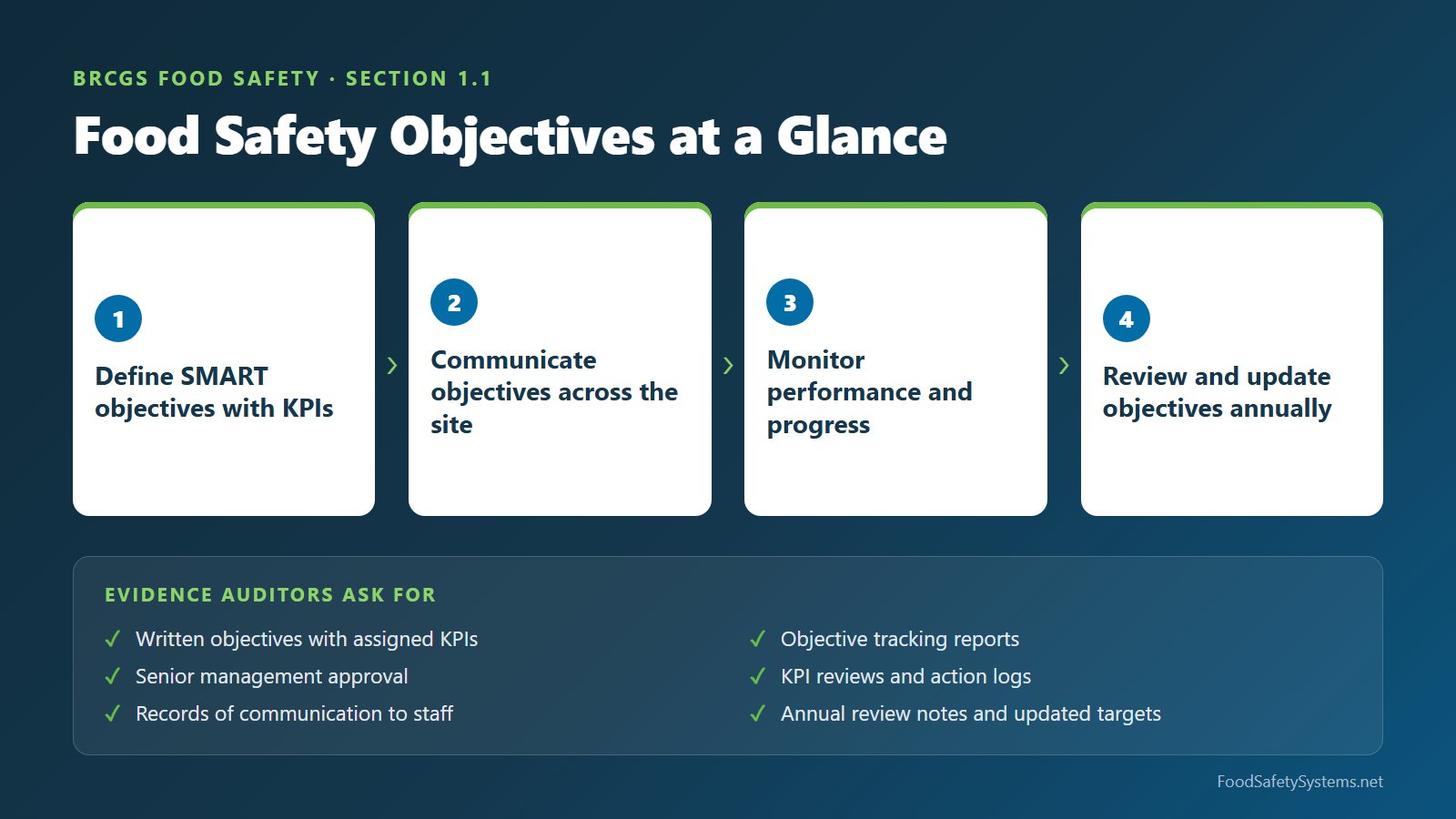
Define SMART objectives
What to put in place
✓ Specific to site risks, product types and customer expectations
✓ Measurable through KPIs and trend analysis
✓ Achievable and aligned with available resources
✓ Relevant to food safety and quality performance
✓ Time-bound, with clear review deadlines
Evidence to maintain
✓ Written objectives with assigned KPIs
✓ Documentation linking objectives to the food safety policy
✓ Objectives approval signed by senior management
Step 2
Communicate objectives across the site
What to put in place
✓ Staff meetings and briefings
✓ Dashboards or visual boards in production areas
✓ Internal emails or memos from management
Evidence to maintain
✓ Communication records such as meeting minutes and announcements
✓ Awareness training or orientation slides
✓ Staff acknowledgements or quiz results (optional)
Step 3
Monitor performance and progress
What to put in place
✓ Monthly or quarterly data reviews
✓ Non-conformance trends and root cause summaries
✓ Internal audits, quality checks or customer feedback
Evidence to maintain
✓ Objective tracking reports or dashboards
✓ Completed KPI reviews and action logs
✓ Corrective and preventive action plans (CAPAs), where applicable
Step 4
Review and update objectives annually
What to put in place
✓ Evaluate objective outcomes
✓ Gather feedback from team leads and QA staff
✓ Align with new risks, products or regulatory updates
Evidence to maintain
✓ Annual review meeting notes
✓ Revised list of objectives with updated targets
✓ Records of any changes to strategy or focus
Avoid nonconformities
Common objectives audit findings and how to fix them
No documented food safety objectives
Fix: create and formalize SMART objectives aligned with company policy.
Objectives not communicated to staff
Fix: use meetings, visuals and email to share key goals.
No review or measurement process
Fix: set up routine KPI tracking and annual reviews.
Objectives not linked to actual outcomes
Fix: use relevant metrics tied to safety, quality or legal compliance.
Audit day
Auditor verification checklist
During an audit, be ready to provide:
✓ Written food safety and quality objectives with assigned KPIs
✓ Records of communication to staff
✓ Monitoring reports and evidence of progress
✓ Annual review documentation and updated targets
The benefit
Why clear objectives matter
Well-set objectives do more than pass the audit:
✓ Drive measurable improvement in food safety and product quality
✓ Align team actions with regulatory and customer expectations
✓ Support audit readiness with performance-based evidence
✓ Reinforce accountability at every level of the organization
Implementation roadmap
From first targets to continual improvement
Phase 1
Build your program
✓ Set SMART objectives with stakeholder input
✓ Link goals to your food safety policy and business strategy
Phase 2
Train and communicate
✓ Share objectives in team meetings and onboarding
✓ Reinforce awareness during internal reviews
Phase 3
Track and evaluate
✓ Monitor progress with dashboards and trend reports
✓ Adjust based on site performance and feedback
Phase 4
Improve continuously
✓ Hold formal annual reviews
✓ Update goals to reflect new risks, learnings and standards
FAQ
Food safety and quality objectives questions
What does BRCGS Section 1.1 say about objectives?
It requires senior management to set clear objectives to maintain and improve the safety, legality and quality of products. The objectives should be measurable, communicated, monitored and reviewed regularly.
What makes a good food safety objective?
A SMART one: specific to your site risks and products, measurable through KPIs, achievable with your resources, relevant to food safety and quality performance, and time-bound with clear review deadlines.
How often should objectives be reviewed?
Track progress through monthly or quarterly data reviews, and hold a formal review every year to evaluate outcomes and update targets for new risks, products or regulatory changes.
Related guides
More senior management commitment guides
Set food safety and quality objectives auditors can verify
We provide objective-setting templates and KPI dashboards, internal communication toolkits, monitoring forms and review checklists, and audit-ready documentation binders.
Food Safety Systems is an independent consulting provider and is not affiliated with, endorsed by or certified by BRCGS or the British Retail Consortium. BRCGS® is a registered trademark of the British Retail Consortium Trading Ltd. For official requirements, visit www.brcgs.com. Read our disclaimer.