BRCGS Food Safety Issue 9 · Section 3.6
Specification Control and Access for Raw Materials, Packaging and Finished Product
Specification control and access keep raw material, packaging and finished product specifications accurate, approved and available where they are used. This guide shows what BRCGS Section 3.6 expects, four steps and the evidence auditors ask to see.
Requirement overview
What Section 3.6 requires from your specifications
BRCGS Food Safety Issue 9 requires accurate, approved specifications for raw materials, packaging and finished products. They must support product safety, legality and quality, and be accessible, controlled and reviewed regularly.
Section 3.6 requires that specifications are accurate, legible and unambiguous, formally approved and controlled, and available for raw materials (including packaging) and finished products.
Clear, current specifications help prevent non-conformities, protect against food safety risks and support traceability, consistency and regulatory compliance.
Key compliance objectives
✓ Keep accurate, approved specifications for all materials and products
✓ Support product safety, legal compliance and customer expectations
✓ Make specifications available and controlled at the point of use
✓ Review and update specifications regularly or when changes occur
What to cover
Specification categories and required details
Raw materials
Ingredients, additives, allergens and processing aids.
Packaging
Contact materials, barrier properties and food-grade verification.
Finished products
Nutritional data, shelf life, storage and usage instructions.
Required details
Name and code; physical, chemical and microbiological standards; allergen and origin declarations; acceptance criteria, tolerances and test methods.
Step by step
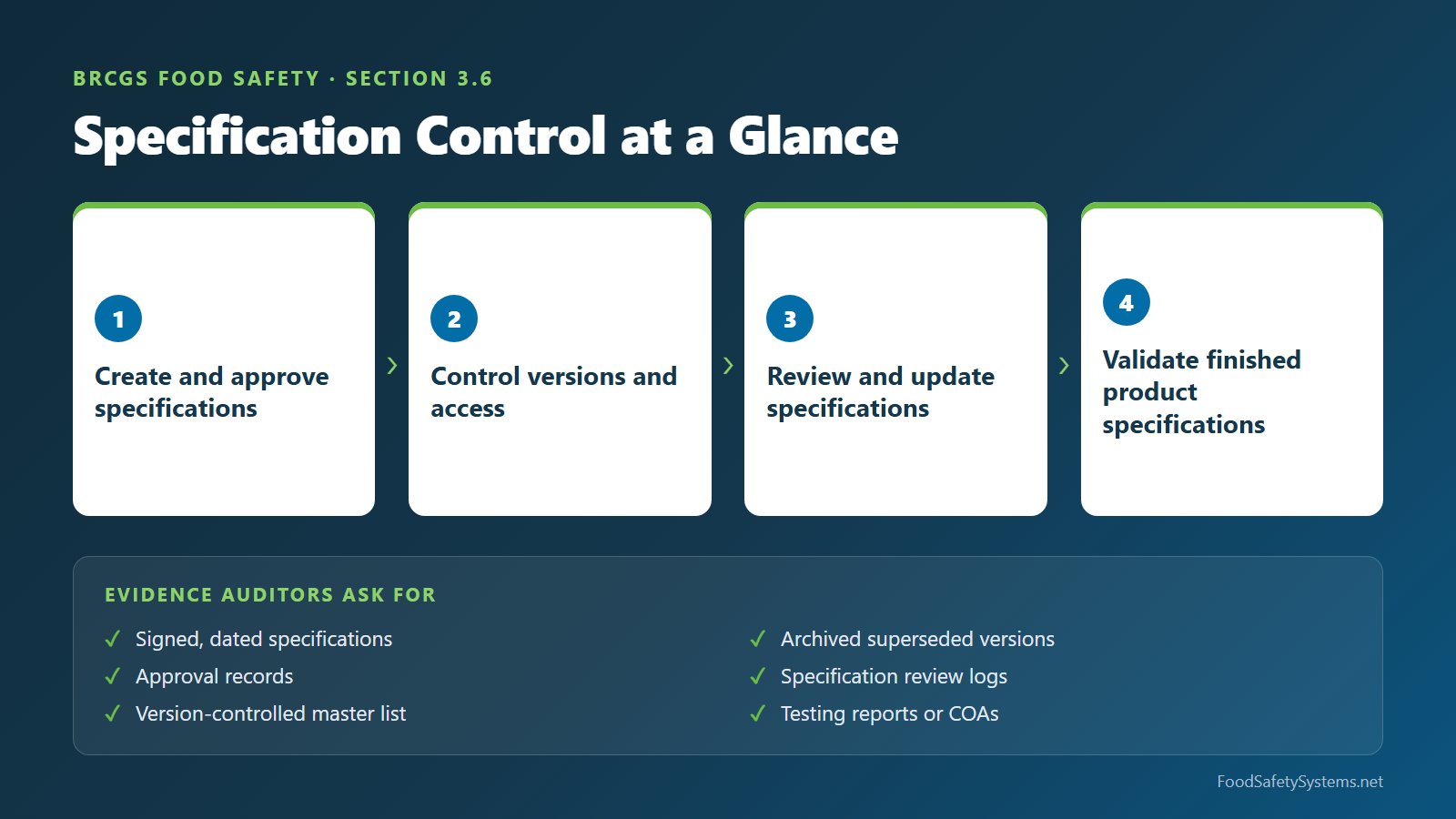
Four steps to specification control and access
Work through these steps in order. Each one lists what to put in place and the records that prove it works.
Step 1
Create and approve specifications
What to put in place
✓ Cover every raw material, packaging item and finished product
✓ Include all required details for each category
✓ Get approval from authorized personnel
Evidence to maintain
✓ Signed and dated specification documents
✓ Approval records from authorized personnel
✓ Supporting supplier documents or COAs
Step 2
Implement specification control and access
What to put in place
✓ A version-controlled specification master list
✓ Controlled distribution and access at relevant locations
✓ Secure storage of previous versions
Evidence to maintain
✓ Document control logs or registers
✓ Read-and-understood records, if applicable
✓ Superseded versions archived and marked
Step 3
Review and update specifications regularly
What to put in place
✓ Product or supplier changes
✓ Non-conformances or audit findings
✓ Regulatory or customer specification changes
Evidence to maintain
✓ Specification review logs with revision history
✓ Change control forms and approval trails
✓ Communication logs with suppliers or customers
Step 4
Validate finished product specifications
What to put in place
✓ Product conformance testing
✓ Label review and nutritional verification
✓ Microbiological or shelf-life analysis
Evidence to maintain
✓ Testing reports or certificates of analysis
✓ Product review forms
✓ Finished product release documentation
Avoid nonconformities
Common audit findings and how to fix them
Missing or outdated specifications
Fix: keep a complete, up-to-date specification master file.
Unapproved or draft versions in use
Fix: put approval and version control workflows in place.
Incomplete or vague specification details
Fix: standardize the specification format and include all required fields.
No documented review process
Fix: schedule and document regular review cycles.
Audit day
Auditor verification checklist
During a BRCGS audit, expect to show:
✓ Specifications for all raw materials, packaging and finished products
✓ Approval and review records with version history
✓ Evidence of control over specification access and updates
✓ Sample testing and conformance records for finished goods
The benefit
Why specification control matters
Well-controlled specifications:
✓ Prevent the use of non-conforming or unsafe materials
✓ Set clear expectations for suppliers and internal teams
✓ Support traceability, legality and customer satisfaction
✓ Reduce audit risk and improve product consistency
Implementation roadmap
From specification library to continuous improvement
Phase 1
Build your specification library
✓ Standardize templates for raw materials, packaging and finished products
✓ Assign approval roles and keep a master register
Phase 2
Train and implement
✓ Make sure QA, procurement and production staff can access and use specifications
✓ Check new materials against specifications on receipt
Phase 3
Monitor and review
✓ Review all specifications periodically
✓ Track specification changes and supplier updates
Phase 4
Improve continuously
✓ Use non-conformance or complaint data to refine specifications
✓ Keep pace with customer, legal and food safety requirements
FAQ
Specification control questions
Which specifications does BRCGS Section 3.6 cover?
Raw materials (including packaging) and finished products. They must be accurate, legible, unambiguous, formally approved and controlled.
What does specification control and access look like in practice?
A version-controlled master list, controlled distribution and access where specifications are used, and secure archiving of superseded versions, marked as such.
When should specifications be reviewed?
Regularly, and whenever there are product or supplier changes, non-conformances or audit findings, or regulatory or customer specification changes.
Related guides
More BRCGS management system guides
Supplier and Raw Material Approval
Approve and monitor raw material and packaging suppliers.
Read the guide →
Document Control & Record-Keeping
Keep procedures, specifications and records current and controlled.
Read the guide →
Traceability Systems
Link product lots to raw materials, packaging and processing records.
Read the guide →
Get your specification control and access audit-ready
We provide specification templates for raw materials, packaging and finished goods, master list and version control trackers, supplier verification forms and validation checklists, and product conformance and shelf-life verification tools.
Food Safety Systems is an independent consulting provider and is not affiliated with, endorsed by or certified by BRCGS or the British Retail Consortium. BRCGS® is a registered trademark of the British Retail Consortium Trading Ltd. For official requirements, visit www.brcgs.com. Read our disclaimer.