BRCGS Food Safety Issue 9 · Section 3.11
Incident Management and BRCGS Withdrawal and Recall Procedure
An incident management system and a documented withdrawal and recall procedure let you act fast when product safety, legality or quality is at risk. This guide shows what BRCGS Section 3.11 expects, five steps and the evidence auditors ask to see.
Requirement overview
What Section 3.11 requires for incidents, withdrawal and recall
BRCGS Food Safety Issue 9 requires certified sites to have documented procedures for managing incidents that may affect product safety, legality or quality, including full product withdrawal and recall systems.
Section 3.11 requires a documented incident management procedure covering incidents and potential emergency situations that affect food safety, legality or quality. It also requires a documented product withdrawal and recall procedure.
These procedures must support rapid decisions, effective traceability and prompt stakeholder communication, with detailed records that support corrective actions and show compliance.
Key compliance objectives
✓ Respond quickly and effectively to food safety incidents
✓ Carry out traceability, withdrawal and recall procedures
✓ Communicate with customers, regulators and stakeholders
✓ Keep thorough documentation and corrective action records
Step by step
Five steps to a working withdrawal and recall procedure
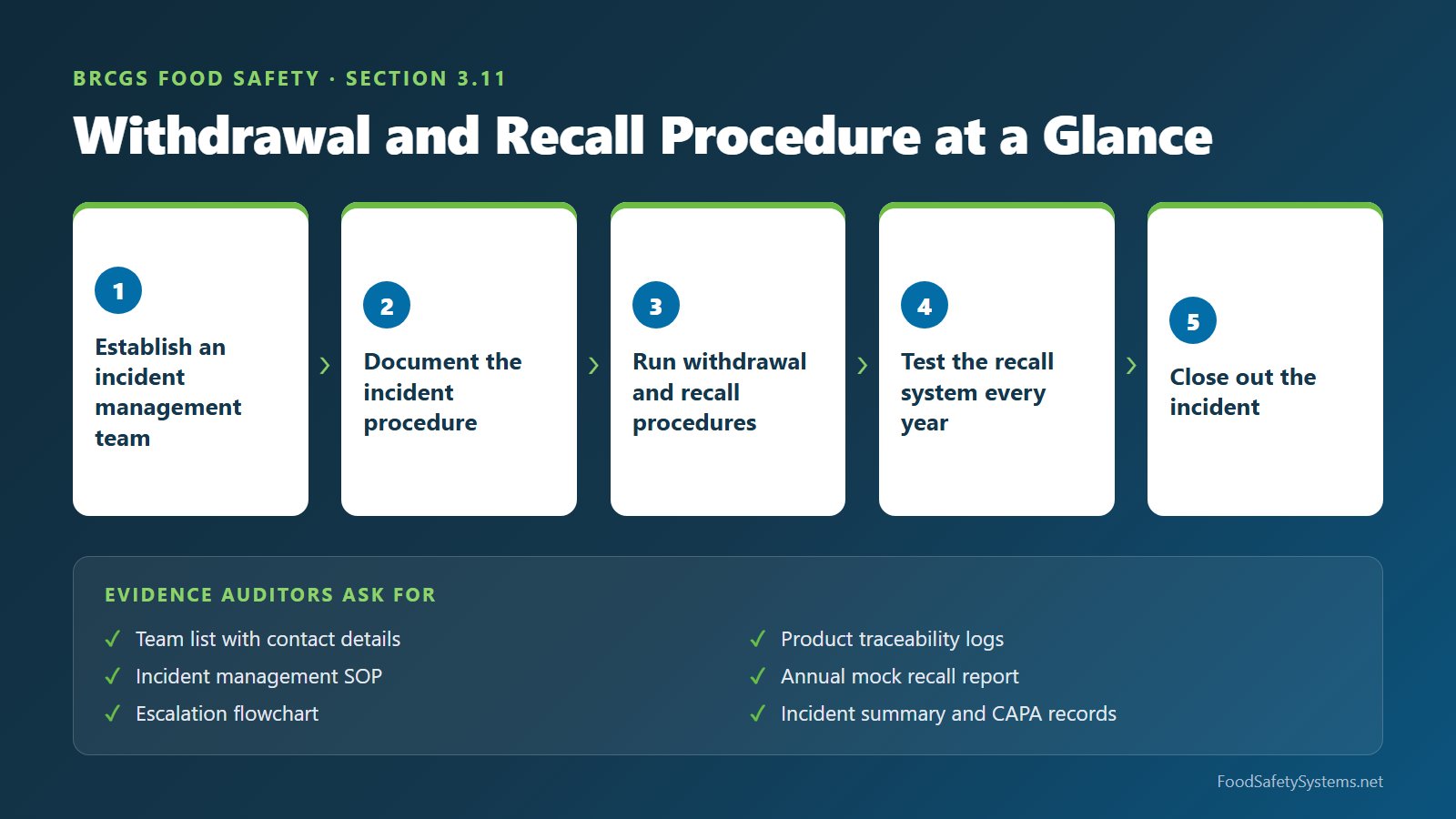
Work through these steps in order. Each one lists what to put in place and the records that prove it works.
Step 1
Establish an incident management team
What to put in place
✓ Incident or recall coordinator
✓ QA or food safety lead
✓ Communications officer
✓ Regulatory liaison
Evidence to maintain
✓ Incident management team list with contact details
✓ Role descriptions and decision-making authority
✓ Training records for team members
Step 2
Create a documented incident handling procedure
What to put in place
✓ Incident classification criteria, such as safety, legality or PR risk
✓ A decision tree for escalation and withdrawal or recall triggers
✓ Internal and external notification protocols
Evidence to maintain
✓ Incident management SOP
✓ Internal escalation flowchart
✓ Regulatory reporting contact list
Step 3
Implement product withdrawal and recall procedures
What to put in place
✓ Identify and locate affected products
✓ Retrieve and segregate products
✓ Notify customers, distributors and authorities
✓ Record actions, responses and communications
Evidence to maintain
✓ Product traceability logs
✓ Mock or real recall reports
✓ Stakeholder communication templates
Step 4
Test and review the recall system every year
What to put in place
✓ At least one mock recall per year
✓ Traceability to the final distribution point
✓ Full documentation of time, accuracy and team performance
Evidence to maintain
✓ Annual mock recall report with approval signature
✓ Evaluation form with gaps and actions
✓ SOP updates and team retraining records
Step 5
Document and close out the incident
What to put in place
✓ Root cause analysis and impact assessment
✓ Corrective and preventive action plans (CAPAs)
✓ Final report to senior management
Evidence to maintain
✓ Incident summary report
✓ CAPA documentation with completion tracking
✓ Management review sign-off
Avoid nonconformities
Common audit findings and how to fix them
No annual mock recall
Fix: schedule and log an annual test recall with full documentation.
Incomplete incident procedures
Fix: update SOPs to cover escalation, communication and CAPAs.
No record of stakeholder contact
Fix: keep logs of calls, emails and regulatory notifications.
Recall not aligned with traceability test
Fix: cross-check traceability data against the recall steps.
Audit day
Auditor verification checklist
During a BRCGS audit, expect to present:
✓ Documented incident management and recall procedures
✓ Team roles, responsibilities and training records
✓ The annual mock recall report and traceability test results
✓ Records of any real recalls or withdrawals, with CAPAs
The benefit
Why recall readiness matters
A tested incident and recall system:
✓ Reduces risk to consumers and brand reputation
✓ Supports a rapid, compliant response in emergencies
✓ Improves audit readiness and customer confidence
✓ Shows strong traceability and crisis communication
Implementation roadmap
From incident team to continuous improvement
Phase 1
Build your program
✓ Assign and train an incident management team
✓ Develop SOPs for incident handling and product recall
Phase 2
Train and test
✓ Run annual mock recalls and traceability checks
✓ Train staff on incident communication protocols
Phase 3
Operate and monitor
✓ Keep incident logs and stakeholder contact records
✓ Track actions and timelines during real or mock recalls
Phase 4
Improve continuously
✓ Carry out root cause reviews
✓ Update procedures after every test or real incident
FAQ
Withdrawal and recall procedure questions
Who should be on the incident management team?
Typically an incident or recall coordinator, a QA or food safety lead, a communications officer and a regulatory liaison, each with a defined role, decision-making authority and training records.
How often should we test the recall procedure?
Run at least one mock recall per year, trace to the final distribution point, and document the time taken, accuracy and team performance.
What closes out an incident?
A root cause analysis and impact assessment, CAPA plans with completion tracking, and a final report to senior management with management review sign-off.
Related guides
More BRCGS management system guides
Traceability Systems
Link product lots to raw materials, packaging and processing records.
Read the guide →
Complaint Handling
Log complaints, find root causes and review trends.
Read the guide →
Corrective & Preventive Actions (CAPA)
Contain, investigate and prevent non-conformities from recurring.
Read the guide →
Get your withdrawal and recall procedure audit-ready
We provide incident management and recall SOP templates, mock recall scenario guides and evaluation forms, traceability log templates and customer contact logs, and team training guides and internal audit checklists.
Food Safety Systems is an independent consulting provider and is not affiliated with, endorsed by or certified by BRCGS or the British Retail Consortium. BRCGS® is a registered trademark of the British Retail Consortium Trading Ltd. For official requirements, visit www.brcgs.com. Read our disclaimer.