BRCGS Food Safety Issue 9 · Section 3.7
Corrective and Preventive Actions (CAPA): BRCGS Section 3.7 Guide
Corrective and preventive actions turn every non-conformity into a fix that sticks. This guide shows what BRCGS Section 3.7 expects, five steps from identification to verification and the evidence auditors ask to see.
Requirement overview
What Section 3.7 requires for corrective and preventive actions
Section 3.7 requires a documented corrective and preventive action process: when a problem is found, identify the root cause and take action to correct it and prevent it from happening again. (Handling the non-conforming product itself is covered under Section 3.8.)
Section 3.7 requires a documented procedure for handling non-conforming products or processes, including root cause analysis and actions to prevent recurrence.
A proactive CAPA process supports compliance and audit readiness, and also drives continuous improvement and reduces risk across operations.
Key compliance objectives
✓ Identify and isolate non-conforming products or processes
✓ Carry out thorough root cause analysis
✓ Implement corrective and preventive actions to avoid recurrence
✓ Monitor effectiveness and document every CAPA step
Step by step
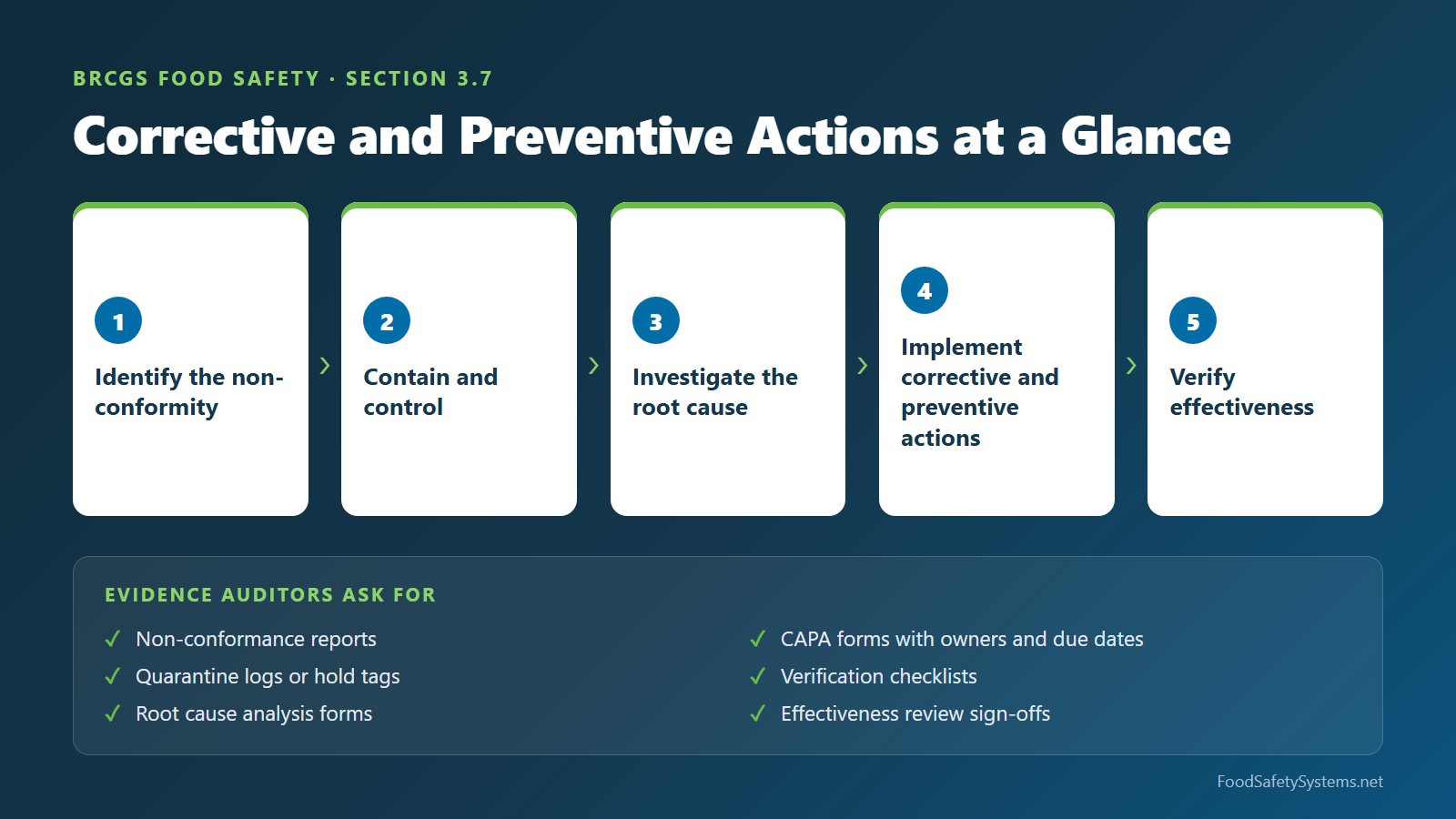
Five steps to an effective CAPA process
Work through these steps in order. Each one lists what to put in place and the records that prove it works.
Step 1
Identify the non-conformity
What to put in place
✓ Deviations from process control limits
✓ Customer complaints or returns
✓ Audit or inspection findings
✓ Failed verification or test results
Evidence to maintain
✓ Non-conformance reports
✓ Photos, test results or logs
✓ Initial impact assessment
Step 2
Contain and control
What to put in place
✓ Quarantine the affected product or area
✓ Notify relevant departments or customers
✓ Stop production if necessary
Evidence to maintain
✓ Quarantine logs or hold tags
✓ Notification records
✓ Batch or product traceability
Step 3
Investigate the root cause
What to put in place
✓ 5 Whys
✓ Fishbone (Ishikawa) diagram
✓ Cause and effect matrix
Evidence to maintain
✓ Completed root cause analysis forms
✓ Investigation meeting notes
✓ Input from cross-functional teams
Step 4
Implement corrective and preventive actions
What to put in place
✓ Corrective action: an immediate fix for the issue
✓ Preventive action: a systemic fix to prevent recurrence
Evidence to maintain
✓ CAPA form with actions, owners and due dates
✓ Updated SOPs or training records
✓ Photos or logs of completed fixes
Step 5
Verify effectiveness
What to put in place
✓ Follow-up audits or inspections
✓ Trend analysis and performance reviews
✓ Staff interviews or retesting
Evidence to maintain
✓ Verification checklists
✓ Effectiveness review sign-offs
✓ Re-training records, if applicable
Avoid nonconformities
Common CAPA audit findings and how to fix them
No root cause identified
Fix: use structured tools such as 5 Whys and involve the relevant staff.
Only corrective action taken
Fix: add preventive steps that address systemic risks.
No follow-up or effectiveness check
Fix: document verification and review after each CAPA is completed.
Incomplete documentation or signatures
Fix: use standard CAPA templates with assigned responsibilities.
Audit day
Auditor verification checklist
During a BRCGS audit, be prepared to show:
✓ Your documented CAPA procedure
✓ Recent non-conformance reports with root cause analysis
✓ Evidence of containment, corrective and preventive actions
✓ Records showing verification of effectiveness and follow-up
The benefit
Why CAPA matters
A disciplined CAPA process:
✓ Gives a structured response to quality and safety failures
✓ Drives continual improvement of your food safety system
✓ Reduces recurrence of errors or hazards
✓ Reinforces accountability and audit readiness
Implementation roadmap
From CAPA procedure to continuous improvement
Phase 1
Build your system
✓ Develop a CAPA SOP aligned with BRCGS Section 3.7
✓ Assign CAPA coordinators and define roles
Phase 2
Train and apply
✓ Train staff to recognize, report and document non-conformities
✓ Use structured tools to analyze root causes
Phase 3
Monitor and audit
✓ Track open CAPAs and verify closure effectiveness
✓ Review trends and recurring issues in management reviews
Phase 4
Improve continuously
✓ Update procedures, training or controls based on CAPA results
✓ Share lessons across teams to reduce future risk
FAQ
Corrective and preventive action questions
What is the difference between corrective and preventive action?
Corrective action is the immediate fix for the issue. Preventive action is the systemic fix that stops it from happening again. Auditors expect to see both.
Which root cause tools can we use?
Common options are 5 Whys, a fishbone (Ishikawa) diagram and a cause and effect matrix. Record the analysis on a root cause form with input from cross-functional teams.
How do we prove a CAPA worked?
Verify it with follow-up audits or inspections, trend analysis, staff interviews or retesting, and keep verification checklists and effectiveness review sign-offs.
Related guides
More BRCGS management system guides
Get your corrective and preventive actions audit-ready
We provide CAPA form templates and logbooks, root cause analysis tools (5 Whys, fishbone diagrams), CAPA process SOPs aligned with BRCGS, and internal audit forms for effectiveness verification.
Food Safety Systems is an independent consulting provider and is not affiliated with, endorsed by or certified by BRCGS or the British Retail Consortium. BRCGS® is a registered trademark of the British Retail Consortium Trading Ltd. For official requirements, visit www.brcgs.com. Read our disclaimer.