
BRCGS Food Safety Issue 9 · Section 3.10
BRCGS Complaint Handling Procedure: Section 3.10 Guide
A documented complaint handling procedure lets you log every complaint, find root causes, act and spot trends. This guide shows what BRCGS Section 3.10 expects, five steps to put it in place and the evidence auditors ask to see.
Requirement overview
What Section 3.10 requires from a complaint handling procedure
BRCGS Food Safety Issue 9, Section 3.10, requires a documented system for managing complaints, including recording, investigating and reporting complaints relevant to food safety, legality and quality.
Complaint data must be analyzed for trends. Where a complaint type increases significantly, or a complaint is serious (for example about product safety or legality), the root cause must be established and appropriate corrective action taken.
Effective complaint handling improves product quality, strengthens consumer trust and supports audit readiness.
Key compliance objectives
✓ Capture and log all complaints about food safety, legality or quality
✓ Investigate complaints with root cause analysis
✓ Apply corrective and preventive actions (CAPA)
✓ Review complaint trends for systemic issues
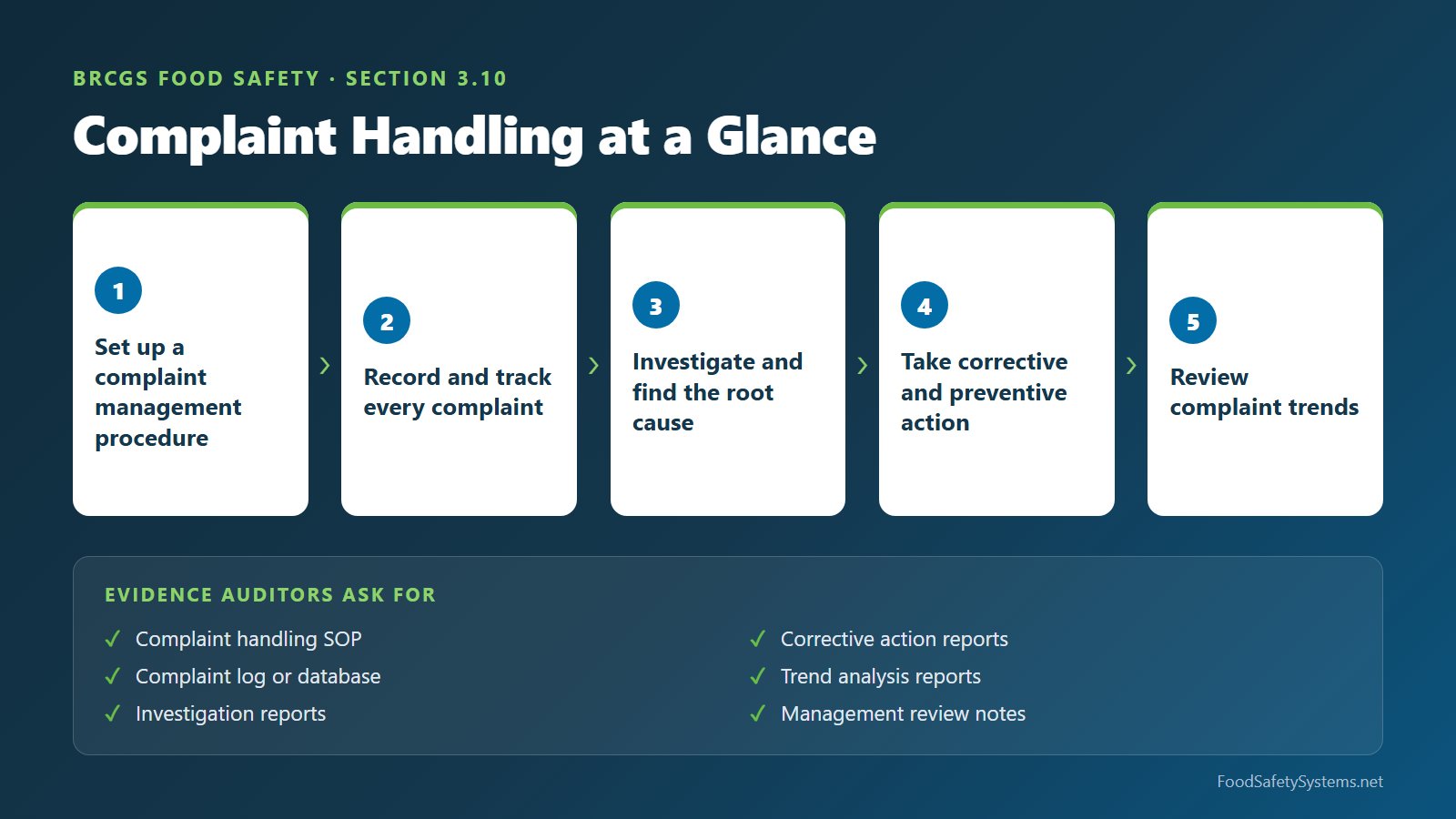
Step by step
Five steps to a working complaint handling system
Work through these steps in order. Each one lists what to put in place and the records that prove it works.
Step 1
Establish a complaint management procedure
What to put in place
✓ Clear complaint categories, such as safety, labeling and contamination
✓ A process for intake, logging, investigation and resolution
✓ Designated roles for review and response
Evidence to maintain
✓ Complaint handling SOP
✓ A contact point for complaint reporting
✓ Complaint form or intake record
Step 2
Record and track all complaints
What to put in place
✓ Date, product, lot or batch number and a description of the issue
✓ Customer details, if available
✓ Classification: food safety, legal or quality
Evidence to maintain
✓ Complaint log or database
✓ Records showing investigation status
✓ Photos or product samples, if applicable
Step 3
Investigate and analyze the root cause
What to put in place
✓ Verify product details and traceability
✓ Review batch records, production logs or supplier inputs
✓ Root cause analysis, such as 5 Whys or a fishbone diagram
Evidence to maintain
✓ Investigation report
✓ Root cause findings
✓ Supporting traceability documents
Step 4
Take corrective and preventive actions
What to put in place
✓ Actions proportionate to complaint severity
✓ Reviewed by appropriate personnel
✓ Documented with a completion timeline and verification
Evidence to maintain
✓ Corrective action reports
✓ Preventive action logs
✓ Sign-off and effectiveness verification
Step 5
Monitor and analyze complaint trends
What to put in place
✓ Monthly or quarterly trend reviews
✓ Identify recurring issues or complaint spikes
✓ Present results to senior management in review meetings
Evidence to maintain
✓ Trend analysis reports
✓ Charts or dashboards
✓ Management review meeting notes
Avoid nonconformities
Common audit findings and how to fix them
Complaint not investigated
Fix: document an investigation for every valid complaint.
No root cause or CAPA
Fix: run a structured root cause analysis and track CAPA to completion.
No trend analysis
Fix: schedule regular trend reviews and keep summaries.
Poor record-keeping or missing data
Fix: standardize intake forms and complaint logs.
Audit day
Auditor verification checklist
During a BRCGS audit, be prepared to provide:
✓ Your documented complaint handling procedure
✓ A complaint log with investigation notes and classifications
✓ Evidence of corrective and preventive actions taken
✓ Trend analysis reports and management review inputs
The benefit
Why complaint handling matters
A well-run complaint system:
✓ Strengthens customer satisfaction and confidence
✓ Reveals weaknesses in your FSQMS or supply chain
✓ Shows commitment to continuous improvement
✓ Supports audit compliance under BRCGS Section 3.10
Implementation roadmap
From first SOP to continuous improvement
Phase 1
Build your complaint program
✓ Draft a complaint handling SOP
✓ Assign roles for intake, review and investigation
Phase 2
Train and implement
✓ Train staff to recognize and report complaints
✓ Use standard forms and tracking systems
Phase 3
Investigate and act
✓ Perform root cause analysis and document CAPA
✓ Classify complaints and prioritize food safety issues
Phase 4
Review and improve
✓ Analyze complaint trends regularly
✓ Use the findings to prevent recurrence
FAQ
Complaint handling procedure questions
What should a complaint record include?
The date, product, lot or batch number, a description of the issue, customer details if available, and a classification as food safety, legal or quality.
When does BRCGS expect a root cause investigation?
Section 3.10 requires the root cause to be established and corrective action taken where a complaint type increases significantly or a complaint is serious, for example about product safety or legality.
How often should complaint trends be reviewed?
Monthly or quarterly reviews work well. Look for recurring issues or spikes, and present the results to senior management in review meetings.
Related guides
More BRCGS management system guides
Corrective & Preventive Actions (CAPA)
Contain, investigate and prevent non-conformities from recurring.
Read the guide →
Management of Non-Conforming Products
Identify, segregate and decide what happens to affected product.
Read the guide →
Incident Management & Recall
Plan incident handling and your product withdrawal and recall procedure.
Read the guide →
Get your complaint handling procedure audit-ready
We provide complaint handling SOP templates, standardized intake and investigation forms, root cause analysis worksheets, and complaint tracking dashboards and trend templates.
Food Safety Systems is an independent consulting provider and is not affiliated with, endorsed by or certified by BRCGS or the British Retail Consortium. BRCGS® is a registered trademark of the British Retail Consortium Trading Ltd. For official requirements, visit www.brcgs.com. Read our disclaimer.