BRCGS Food Safety Issue 9 · Section 9
Traded Product Traceability and Recall Readiness: BRCGS Section 9 Guide
Traded product traceability and recall readiness mean handling goods made off site with the same control as your own products. This guide shows what BRCGS Section 9 expects, four steps to put it in place and the evidence auditors ask to see.
Requirement overview
What Section 9 requires for traded product traceability
BRCGS Food Safety Issue 9, Section 9, requires that the company ensures suppliers of traded products are approved and that the products are traceable.
Where the site is responsible for the recall of traded products, it must have procedures in place to manage such events effectively, including a documented recall plan.
Sites that handle traded products (made off site but stored, sold or distributed by the certified facility) need full traceability and recall readiness, just as they would for in-house products.
Key compliance objectives
✓ Trace traded products one step forward and one step back
✓ Maintain up-to-date supplier approval documentation
✓ Be prepared to run a full recall of traded products
✓ Document all tests, communications and corrective actions
Step by step
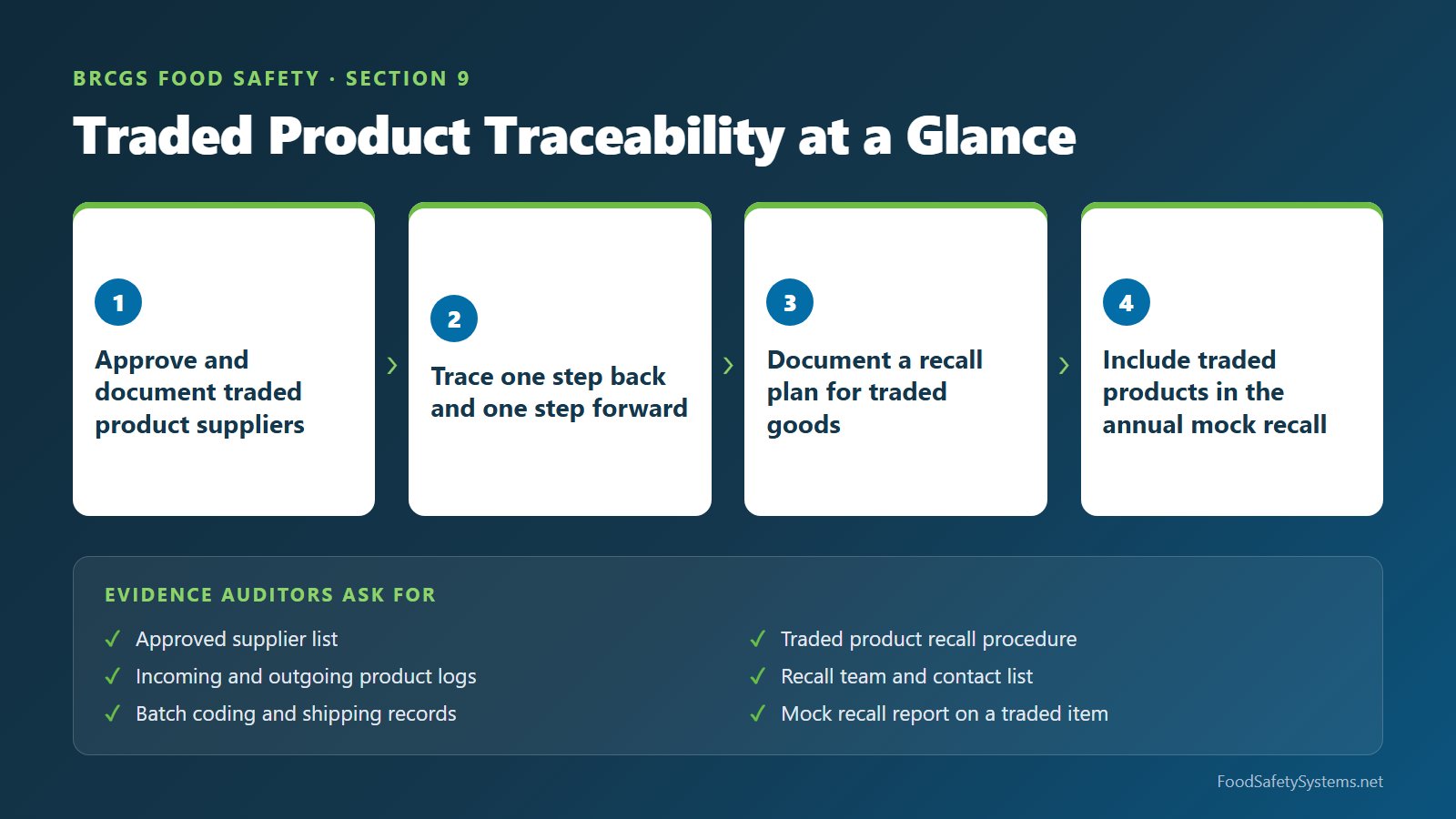
Four steps to traceability and recall readiness
Work through these steps in order. Each one lists what to put in place and the records that prove it works.
Step 1
Establish supplier approval and documentation
What to put in place
✓ Suppliers meet the site's food safety expectations
✓ Documentation includes certificates (such as GFSI), specifications and supply chain records
✓ A risk assessment for each traded product source
Evidence to maintain
✓ Approved supplier list
✓ Supplier certificates and specifications
✓ Product traceability agreements or contracts
Step 2
Maintain traded product traceability
What to put in place
✓ The full chain: supplier, storage, distribution, customer
✓ Batch or lot coding for the whole product journey
✓ Clear identification of traded versus in-house products
Evidence to maintain
✓ Incoming and outgoing product logs
✓ Batch coding and shipping documentation
✓ Cross-reference to supplier and customer data
Step 3
Document recall procedures for traded products
What to put in place
✓ Specific procedures for handling recalls of traded goods
✓ Roles and responsibilities, including communication with the supplier or manufacturer
✓ Access to current distribution records and mock recall testing
Evidence to maintain
✓ Traded product recall procedure
✓ Recall team structure and contact list
✓ Distribution matrix and recall flow diagram
Step 4
Run an annual mock recall that includes traded products
What to put in place
✓ Test the speed and accuracy of tracing a traded product
✓ Test external communication with suppliers and customers
✓ Check the team's familiarity with recall roles and the process
Evidence to maintain
✓ Mock recall scenario report involving a traded item
✓ Trace logs showing one-up, one-down verification
✓ Evaluation forms and corrective actions
Avoid nonconformities
Common audit findings and how to fix them
No recall procedure for traded products
Fix: add traded products to the recall SOP and define roles and communication.
Traceability only tracked internally
Fix: include supplier and distribution-level tracking in the trace system.
Suppliers not properly vetted
Fix: carry out documented supplier approval and ongoing verification.
Mock recalls exclude traded products
Fix: build traded SKUs into the annual recall test.
Audit day
Auditor verification checklist
During a BRCGS audit, expect to present:
✓ Approved supplier list and risk assessments
✓ Traded product traceability records, in and out
✓ A recall plan that includes traded goods
✓ Evidence of a mock recall involving a traded product
✓ Records of communication with suppliers and customers
The benefit
Why recall readiness matters
Being ready for a traded product recall:
✓ Supports regulatory and BRCGS compliance
✓ Shows control over outsourced and distributed goods
✓ Protects consumers and brand reputation
✓ Builds supply chain transparency and accountability
Implementation roadmap
From supplier control to tested recall plans
Phase 1
Build supplier control
✓ Approve and document all traded product suppliers
✓ Define food safety expectations and traceability requirements
Phase 2
Create the traceability system
✓ Assign codes to traded products
✓ Keep forward and backward tracking logs
Phase 3
Develop recall readiness
✓ Bring traded products into the site-wide recall SOP
✓ Name a recall coordinator for traded product incidents
Phase 4
Test and improve
✓ Include traded products in mock recall drills
✓ Review lessons learned and update documents
FAQ
Traded product traceability questions
How far must traded product traceability reach?
One step back and one step forward: from the supplier through storage and distribution to the customer, with batch or lot coding along the whole journey.
Do traded products need their own recall plan?
Where the site is responsible for recalling traded products, Section 9 requires procedures to manage it, including a documented recall plan. Many sites add traded products to their site-wide recall SOP.
Should mock recalls include traded products?
Yes. Include a traded item in the annual mock recall to test tracing speed and accuracy, communication with suppliers and customers, and the team's knowledge of their roles.
Related guides
More BRCGS traded products guides
Supplier Approval & Monitoring
Approve and monitor traded product suppliers with a risk-based procedure.
Read the guide →
Approval & Verification of Traded Products
Risk assessments, supplier approval criteria and ongoing verification.
Read the guide →
Specifications for Traded Products
Keep traded product specifications complete, signed and reviewed.
Read the guide →
Get your traded product traceability audit-ready
We provide traded product recall SOP templates, traceability tracking logs, mock recall testing scenarios for third-party goods, and supplier approval and risk assessment templates.
Food Safety Systems is an independent consulting provider and is not affiliated with, endorsed by or certified by BRCGS or the British Retail Consortium. BRCGS® is a registered trademark of the British Retail Consortium Trading Ltd. For official requirements, visit www.brcgs.com. Read our disclaimer.