BRCGS Food Safety Issue 9 · Section 9
Approval and Verification of Traded Products: BRCGS Section 9 Guide
Approval and verification of traded products gives food made by other companies the same level of control as your own. This guide shows what BRCGS Section 9 expects, four steps to put it in place and the evidence auditors ask to see.
Requirement overview
What Section 9 requires for verification of traded products
BRCGS Food Safety Issue 9, Section 9, applies when a certified site trades food products made by other companies but sold under the site's name or handled through its processes, such as warehousing, labeling or distribution.
Section 9 requires that the company ensures traded food products comply with all relevant safety, legal and quality requirements, and that there are documented procedures for supplier approval, risk assessment and verification of traded products.
In practice, traded products need the same level of control as items produced in-house, through formal supplier approval and verification.
Key compliance objectives
✓ Approve traded product suppliers through documented procedures
✓ Carry out food safety and legal compliance checks
✓ Maintain traceability and verification documentation
✓ Ensure consistent quality and risk control of all traded products
Step by step
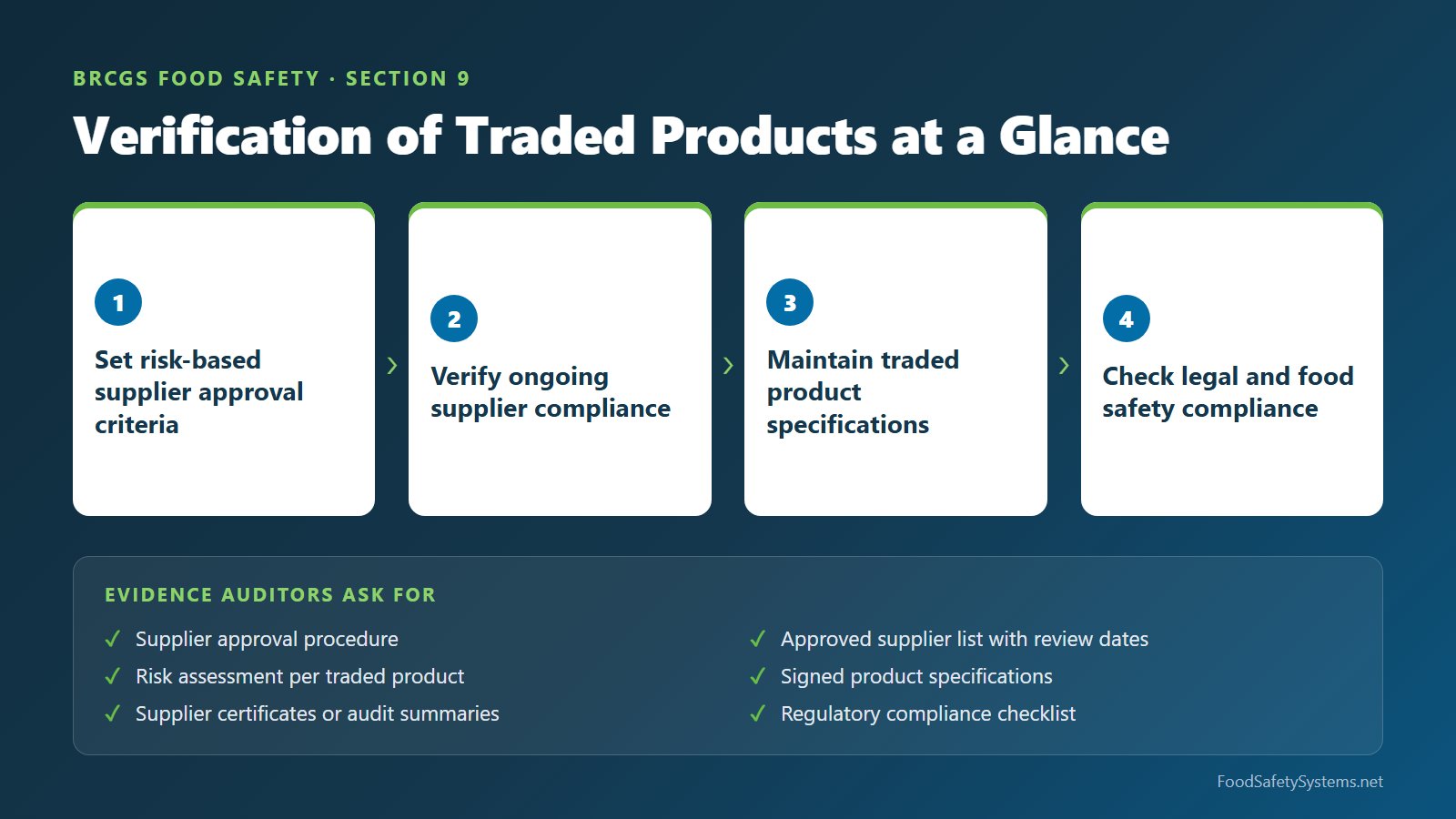
Four steps to approve and verify traded products
Work through these steps in order. Each one lists what to put in place and the records that prove it works.
Step 1
Establish supplier approval criteria
What to put in place
✓ Risk assessment of each traded product
✓ Supplier food safety certification, such as a GFSI-recognized scheme
✓ Review of HACCP plans, COAs and product specifications
Evidence to maintain
✓ Supplier approval procedure
✓ Risk assessment form for each traded product
✓ Supplier certification or audit summary
Step 2
Verify ongoing supplier compliance
What to put in place
✓ Supplier performance reviews and issue logs
✓ Random product sampling or third-party testing
✓ A documented reassessment schedule, for example annually
Evidence to maintain
✓ Supplier monitoring records
✓ Retest results, complaints or incident logs
✓ Approved supplier list with review dates
Step 3
Maintain traded product specifications
What to put in place
✓ Ingredient and allergen details
✓ Packaging requirements
✓ Storage and shelf life parameters
✓ Labeling and country-of-origin declarations
Evidence to maintain
✓ Signed product specifications from the supplier
✓ Label and allergen check against BRCGS requirements
✓ Product conformance records
Step 4
Ensure legal and food safety compliance
What to put in place
✓ Country-specific regulatory requirements
✓ Import and export documentation, if applicable
✓ Any known or emerging product risks
Evidence to maintain
✓ Regulatory compliance checklist
✓ Country of destination requirements log
✓ Food fraud vulnerability assessment, if applicable
Avoid nonconformities
Common audit findings and how to fix them
No documented supplier approval
Fix: implement and follow a formal supplier approval process.
No risk assessment for traded goods
Fix: carry out and keep risk evaluations for every traded product.
Outdated or missing product specifications
Fix: make sure specifications are reviewed, signed and regularly updated.
Inadequate verification
Fix: monitor supplier performance and keep the approved supplier list up to date.
Audit day
Auditor verification checklist
During a BRCGS audit, expect to present:
✓ Documented supplier approval and verification procedures
✓ Completed risk assessments for each traded product
✓ Approved supplier certifications or audit records
✓ Traded product specifications and compliance records
✓ Evidence of ongoing review and verification
The benefit
Why approval and verification matter
Your company is responsible for every product sold under its name:
✓ Keeps every product under your name safe
✓ Protects your brand from reputational and legal risk
✓ Strengthens traceability and food safety controls
✓ Shows full compliance with BRCGS Section 9
Implementation roadmap
From first inventory to continuous improvement
Phase 1
Build your program
✓ Identify all traded products
✓ Develop a supplier approval and product verification SOP
Phase 2
Train and apply
✓ Train procurement and QA teams on risk assessment
✓ Maintain supplier files and approved product lists
Phase 3
Monitor and audit
✓ Run periodic supplier reviews and product checks
✓ Keep specifications and certifications current
Phase 4
Improve continuously
✓ Update risk assessments as new hazards or regulatory changes arise
✓ Replace or re-approve suppliers based on performance
FAQ
Traded product approval questions
When does BRCGS Section 9 apply?
When a certified site trades food products made by other companies but sold under the site's name or handled through its processes, such as warehousing, labeling or distribution.
What should supplier approval for traded products be based on?
A risk assessment of each traded product, the supplier's food safety certification (for example a GFSI-recognized scheme), and a review of HACCP plans, COAs and product specifications.
How do we verify traded products after approval?
Through supplier performance reviews and issue logs, random product sampling or third-party testing, and a documented reassessment schedule, for example annually.
Related guides
More BRCGS traded products guides
Supplier Approval & Monitoring
Approve and monitor traded product suppliers with a risk-based procedure.
Read the guide →
Specifications for Traded Products
Keep traded product specifications complete, signed and reviewed.
Read the guide →
Traceability & Recall Readiness
Trace traded products one step back and forward, and plan for recalls.
Read the guide →
Get your verification of traded products audit-ready
We provide supplier approval and risk assessment templates, traded product specification forms, verification checklists and compliance logs, and internal training tools for QA and procurement teams.
Food Safety Systems is an independent consulting provider and is not affiliated with, endorsed by or certified by BRCGS or the British Retail Consortium. BRCGS® is a registered trademark of the British Retail Consortium Trading Ltd. For official requirements, visit www.brcgs.com. Read our disclaimer.