BRCGS Food Safety Issue 9 · Section 8
Air Handling: Controlled Air Movement in Production Risk Zones
Controlled air movement and filtration prevent airborne cross-contamination between High Risk, High Care and Ambient High Care zones. This guide covers what BRCGS Section 8 expects, three steps to put it in place and the evidence auditors ask to see.
Requirement overview
What BRCGS Section 8 requires for air handling
BRCGS Food Safety Issue 9 defines zoned production areas (High Risk, High Care and Ambient High Care) that need controlled air movement and filtration to prevent cross-contamination between zones.
Section 8 requires air handling systems designed to prevent airborne contamination, for example through filtered air, positive air pressure, airflow direction and segregation.
Good air control minimizes microbial and particulate transfer and keeps sensitive processing areas hygienic.
Key compliance objectives
✓ Prevent airborne cross-contamination between zones
✓ Maintain air quality through filtration and directional airflow
✓ Verify air pressure differentials in High Risk and High Care areas
✓ Align air handling with risk-based environmental controls
Step by step
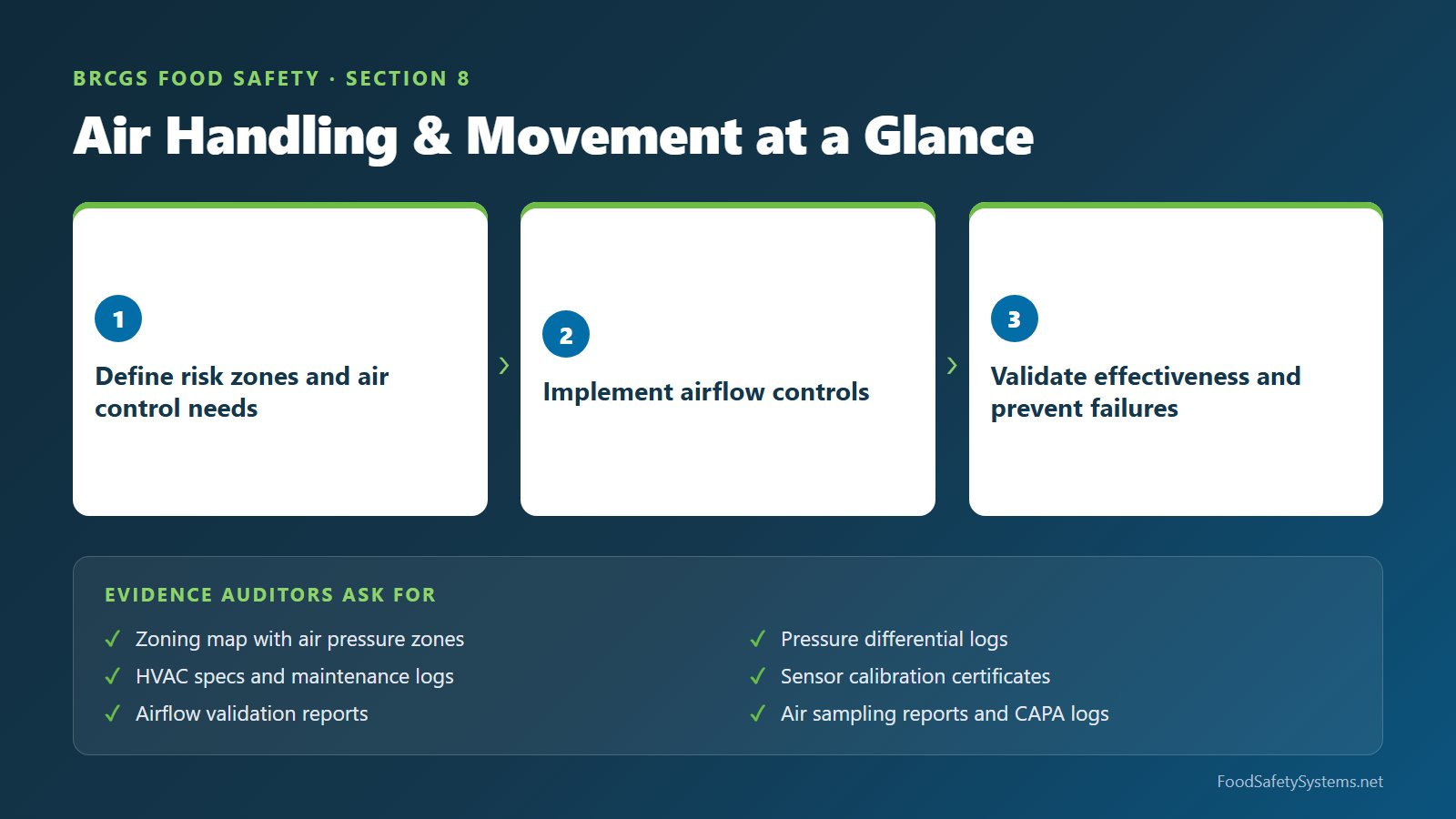
Three steps to controlled air movement
Work through these steps in order. Each one lists what to put in place and the records that prove it works.
Step 1
Define risk zones and air control requirements
What to put in place
✓ High Risk: chilled RTE products after cooking
✓ High Care: RTE products that bypass a kill step
✓ Ambient High Care: RTE products stored ambient and vulnerable to cross-contamination
✓ Positive air pressure, especially in High Risk and High Care
✓ HEPA or equivalent filtration
✓ Independent air handling units (AHUs) to avoid recirculated contamination
Evidence to maintain
✓ Site zoning map with air pressure zones
✓ HVAC specifications and maintenance logs
✓ Zoning validation or risk assessment
Step 2
Implement airflow controls
What to put in place
✓ Airflow direction from clean to less clean areas
✓ Pressure differential monitoring equipment
✓ Automatic shut-off or alarms for airflow failure
Evidence to maintain
✓ Airflow validation reports
✓ Pressure differential logs
✓ Sensor calibration certificates
Step 3
Validate effectiveness and prevent failures
What to put in place
✓ Visual checks of airflow direction, for example with smoke pens
✓ Periodic microbiological air sampling, especially in High Risk areas
✓ Trend analysis of air-related deviations
Evidence to maintain
✓ Air sampling reports
✓ Corrective and preventive action logs
✓ Validation protocols and outcomes
Avoid nonconformities
Common air handling audit findings and how to fix them
No airflow validation or direction test
Fix: run smoke tests or differential pressure assessments routinely.
Filters not changed as scheduled
Fix: put a documented filter maintenance schedule in place.
Shared HVAC across zones
Fix: use separate air handling for High Risk and High Care areas, or install filters.
Missing pressure monitoring records
Fix: log air pressure daily and include it in internal checks.
Audit day
Auditor verification checklist
During a BRCGS audit, expect to present:
✓ HVAC and airflow design diagrams
✓ Documented air zone pressure differentials
✓ Maintenance and filter change logs
✓ Air sampling or airflow validation reports
✓ Records of air handling nonconformities and CAPAs
The benefit
Why controlled air movement matters
Good air handling:
✓ Controls airborne risks in high-sensitivity production areas
✓ Protects product safety, especially for RTE products
✓ Reduces contamination risks and potential recalls
Implementation roadmap
From airflow assessment to continuous improvement
Phase 1
Build your control system
✓ Identify all risk zones and assess airflow needs
✓ Specify and install air handling units with suitable filters
Phase 2
Operate and maintain
✓ Monitor airflow direction and zone pressure daily
✓ Replace filters and calibrate systems regularly
Phase 3
Validate and audit
✓ Carry out air sampling and airflow direction testing
✓ Review performance against the zoning risk assessment
Phase 4
Improve continuously
✓ Update maintenance and airflow SOPs
✓ Record and correct deviations
FAQ
Controlled air movement questions
Which way should air flow between zones?
From clean to less clean areas, supported by positive air pressure (especially in High Risk and High Care zones), pressure differential monitoring and alarms or automatic shut-off if airflow fails.
Can High Risk and High Care zones share an HVAC system?
Shared HVAC across zones is a common audit finding. The recommended fix is separate air handling for High Risk and High Care areas, or installing filters.
How do we validate our air handling?
Check airflow direction visually (for example with smoke pens), carry out periodic microbiological air sampling, trend air-related deviations, and keep air sampling reports, CAPA logs and validation records.
Related guides
More BRCGS production risk zone guides
Production Risk Zones & Segregation
Classify zones and apply physical and procedural segregation.
Read the guide →
Equipment & Facility Design for Risk Zones
Facility layout and hygienic equipment that suit each zone.
Read the guide →
Production Risk Zones & Hygiene Controls
Hygiene controls for each zone and rules for moving between them.
Read the guide →
Get controlled air movement audit-ready
We provide air handling SOPs and zoning maps, air sampling protocols and log templates, HVAC maintenance checklists and risk-based zoning assessment templates.
Food Safety Systems is an independent consulting provider and is not affiliated with, endorsed by or certified by BRCGS or the British Retail Consortium. BRCGS® is a registered trademark of the British Retail Consortium Trading Ltd. For official requirements, visit www.brcgs.com. Read our disclaimer.