BRCGS Food Safety Issue 9 · Section 8
Production Risk Zones: Physical and Procedural Segregation Guide
Physical and procedural segregation keeps High Risk, High Care and Ambient High Care zones apart and protects ready-to-eat products from cross-contamination. This guide covers what BRCGS Section 8 expects, four steps to put it in place and the evidence auditors ask to see.
Requirement overview
What BRCGS Section 8 requires for risk zone segregation
BRCGS Food Safety Issue 9 defines production risk zones by the risk of product contamination. Sites must identify, segregate and manage High Risk, High Care and Ambient High Care areas to prevent cross-contamination and protect product integrity.
Section 8 requires that production in these areas is managed to prevent contamination, and that premises and process flows are designed, built and maintained to segregate manufacturing zones and minimize contamination risk.
Correct zone classification and segregation are essential for hygiene control, especially for ready-to-eat (RTE) and high-sensitivity products.
Key compliance objectives
✓ Identify and validate risk zones based on product and process risk
✓ Implement physical and procedural segregation measures
✓ Control the movement of personnel, equipment and air
✓ Maintain zoning maps, cleaning protocols and verification records
Step by step
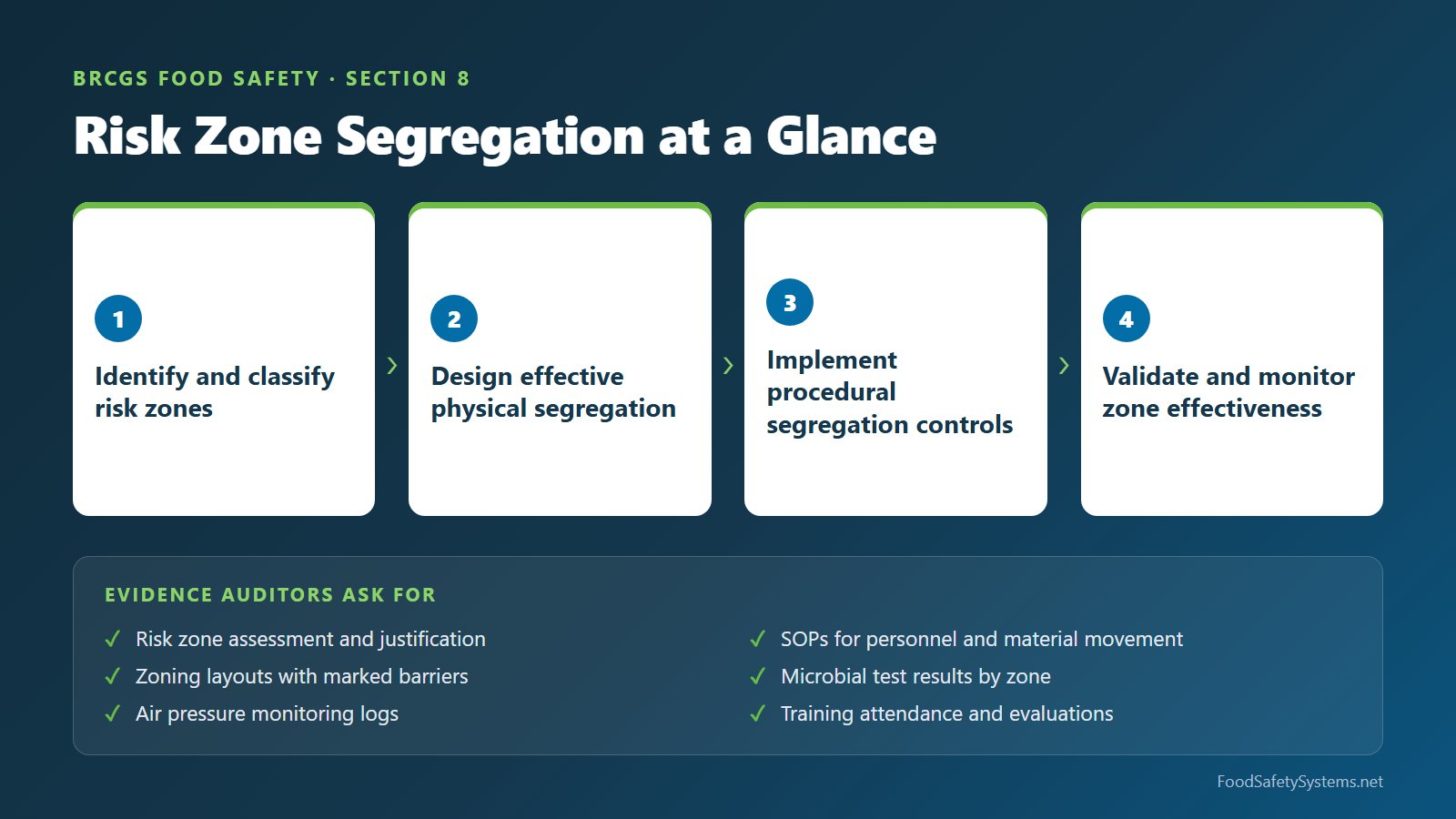
Four steps to physical and procedural segregation
Work through these steps in order. Each one lists what to put in place and the records that prove it works.
Step 1
Identify and classify risk zones
What to put in place
✓ High Risk: RTE products with high exposure risk (for example, cooked meats)
✓ High Care: RTE products that need protection from recontamination (for example, sandwiches)
✓ Ambient High Care: shelf-stable products that need strict hygiene (for example, flow-wrapped snacks)
Evidence to maintain
✓ Risk zone assessment documentation
✓ Product classification and process flow diagrams
✓ Justification for the risk level of each area
Step 2
Design effective physical segregation
What to put in place
✓ Separate rooms, walls, barriers or airlocks
✓ Positive air pressure in High Risk areas
✓ Controlled drainage flow from clean to dirty zones
Evidence to maintain
✓ Facility zoning layouts with marked barriers
✓ Air pressure monitoring logs
✓ Maintenance records for doors, filters and seals
Step 3
Implement procedural segregation controls
What to put in place
✓ Staff zoning with color-coded uniforms
✓ Dedicated tools, utensils and PPE for each zone
✓ Entry controls such as handwashing, boot wash and change areas
Evidence to maintain
✓ SOPs for personnel and material movement
✓ Zone-specific equipment logs
✓ Uniform and hygiene compliance checks
Step 4
Validate and monitor zone effectiveness
What to put in place
✓ Environmental swabbing, for example for Listeria and other pathogens
✓ Internal audits and inspections
✓ Staff training assessments on zone protocols
Evidence to maintain
✓ Microbial test results by zone
✓ Audit checklists and CAPAs
✓ Training attendance and evaluations
Avoid nonconformities
Common segregation audit findings and how to fix them
Undefined or inconsistent zoning
Fix: carry out a risk assessment and create zoning maps.
Cross-use of utensils or PPE across zones
Fix: introduce color-coded equipment and strict segregation policies.
Airflow issues in High Risk areas
Fix: install pressure controls and maintain HVAC filters.
No validation of hygiene effectiveness
Fix: start routine environmental monitoring in each zone.
Audit day
Auditor verification checklist
During a BRCGS audit, expect to present:
✓ Facility zoning risk assessment and classification rationale
✓ Segregation layout plans, physical and procedural
✓ Environmental test results for High Risk and High Care areas
✓ Evidence of staff training and zone-specific procedures
✓ Internal audit results and continuous improvement logs
The benefit
Why zone segregation matters
Effective segregation:
✓ Protects RTE and sensitive products from recontamination
✓ Shows full control of hygiene and facility design
✓ Meets BRCGS zoning expectations for high-risk processing
Implementation roadmap
From zone mapping to continuous improvement
Phase 1
Build your program
✓ Identify risk-based production zones
✓ Develop zoning diagrams and control procedures
Phase 2
Train and implement
✓ Train staff on zone protocols, flows and hygiene expectations
✓ Enforce zoning through uniforms, access controls and signage
Phase 3
Monitor and verify
✓ Carry out routine environmental monitoring
✓ Run zoning audits and risk reassessments
Phase 4
Improve continuously
✓ Update zone controls after layout, process or product changes
✓ Respond to audit findings and contamination trends
FAQ
Risk zone segregation questions
What is the difference between physical and procedural segregation?
Physical segregation uses the building itself: separate rooms, walls, barriers or airlocks, positive air pressure in High Risk areas and drainage that flows from clean to dirty zones. Procedural segregation uses rules: color-coded uniforms, dedicated tools and PPE per zone and entry controls such as handwashing, boot wash and change areas.
How do we justify our zone classifications?
Keep a risk zone assessment, product classification and process flow diagrams, and a written justification for the risk level of each area.
How do we prove segregation is working?
Use environmental swabbing (for example for Listeria), internal audits and inspections, and staff training assessments, and keep microbial results by zone, audit checklists with CAPAs and training evaluations.
Related guides
More BRCGS production risk zone guides
Production Risk Zones & Hygiene Controls
Hygiene controls for each zone and rules for moving between them.
Read the guide →
Equipment & Facility Design for Risk Zones
Facility layout and hygienic equipment that suit each zone.
Read the guide →
Air Handling & Movement
Positive pressure, filtration and airflow direction between zones.
Read the guide →
Put physical and procedural segregation in place
We provide zoning risk assessment templates, sample layout maps for risk segregation, environmental monitoring protocols and training guides for personnel hygiene and area control.
Food Safety Systems is an independent consulting provider and is not affiliated with, endorsed by or certified by BRCGS or the British Retail Consortium. BRCGS® is a registered trademark of the British Retail Consortium Trading Ltd. For official requirements, visit www.brcgs.com. Read our disclaimer.