BRCGS Food Safety Issue 9 · Section 1.1
Building a Food Safety Culture Plan: Establish and Maintain Your Culture
A food safety culture plan, set and led by senior management, turns food safety into everyday behavior at every level. This guide covers what BRCGS Section 1.1 expects, five steps to build and maintain your culture and the evidence auditors review.
Requirement overview
What BRCGS Section 1.1 requires for food safety culture
Section 1.1 of BRCGS Food Safety Issue 9 requires the site's senior management to define and maintain a clear plan for developing and continually improving a food safety and quality culture.
A food safety culture must be deliberately built, supported by leadership and continually improved. BRCGS expects documented strategies and active involvement from senior management to promote the behaviors and values that support food safety at every level.
Key compliance objectives
✓ Show leadership and accountability in food safety
✓ Engage staff at all levels in food safety behaviors
✓ Monitor and evaluate culture-building activities
✓ Keep documentation and records for audit readiness
Step by step
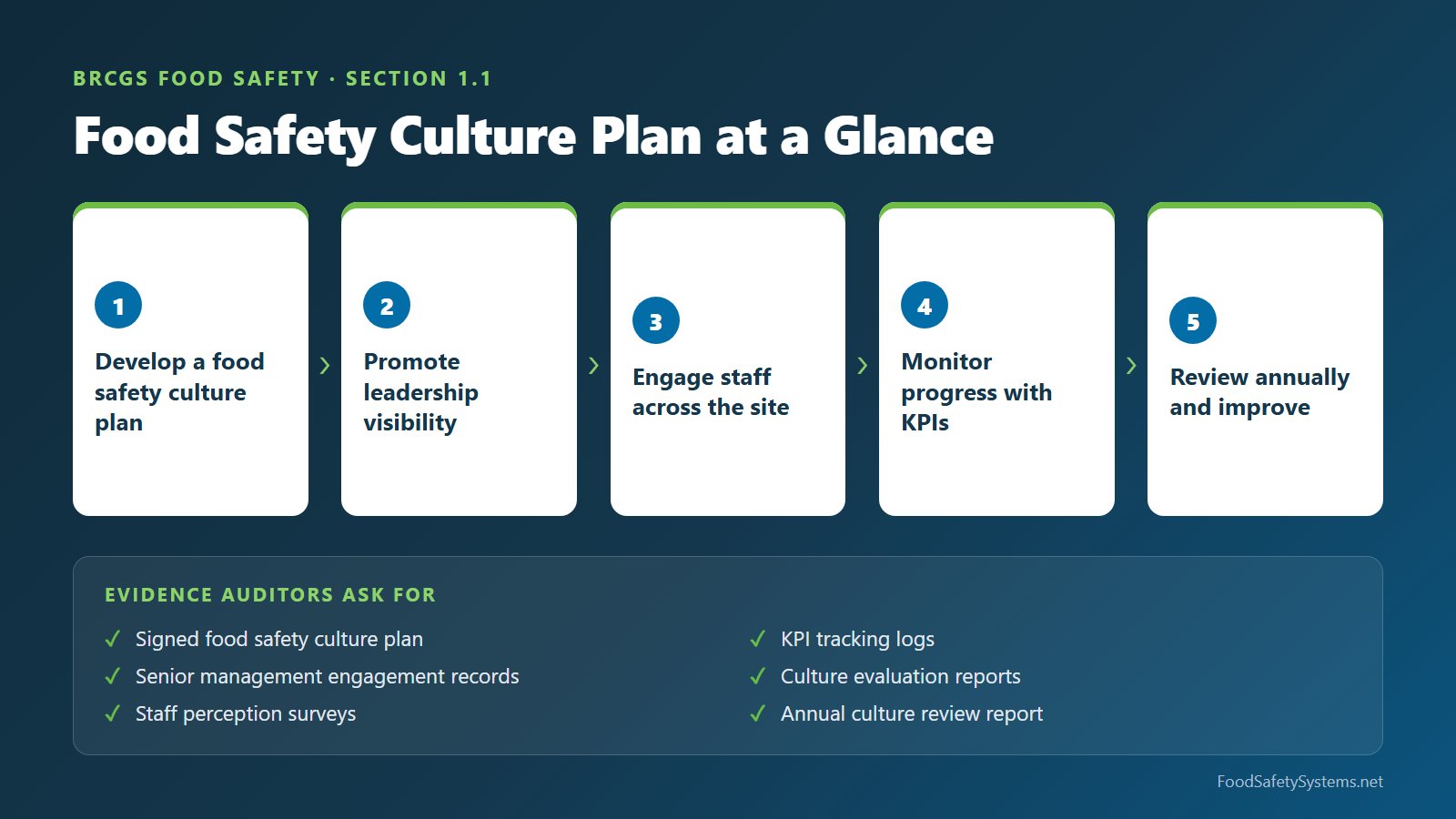
Five steps to a food safety culture plan that works
Work through these steps in order. Each one lists what to put in place and the records that prove it works.
Step 1
Develop a food safety culture plan
What to put in place
✓ Vision and goals aligned with the company mission and BRCGS expectations
✓ Actions to embed food safety into daily operations
✓ Assigned roles, responsibilities and budget
Evidence to maintain
✓ Documented food safety culture strategy
✓ Plan signed by senior leadership
✓ Resource allocation or activity calendar
Step 2
Promote leadership visibility
What to put in place
✓ Senior managers lead by example in food safety practices
✓ Senior managers take part in meetings, briefings and audits
✓ Senior managers communicate culture goals and expectations
Evidence to maintain
✓ Memos, announcements and meeting attendance logs
✓ Records of site visits, walkthroughs or town halls
✓ Internal newsletters or culture campaigns
Step 3
Engage staff across the organization
What to put in place
✓ Surveys, interviews and suggestion boxes
✓ Recognition programs for food safety behavior
✓ Staff-led improvement initiatives
Evidence to maintain
✓ Completed staff perception surveys
✓ Recognition program documentation
✓ Team meeting notes and improvement action logs
Step 4
Monitor progress and measure effectiveness
What to put in place
✓ Training participation rates and assessments
✓ Audit findings tied to behaviors or procedures
✓ Incident reporting frequency and staff feedback
Evidence to maintain
✓ Dashboard or tracking logs for KPIs
✓ Food safety culture evaluation reports
✓ Internal audit records and summaries
Step 5
Review annually and drive improvement
What to put in place
✓ Analyze performance against goals
✓ Identify barriers and areas for reinforcement
✓ Update the food safety culture strategy
Evidence to maintain
✓ Annual food safety culture review reports
✓ Revised plans and updated training records
✓ Assigned corrective actions with completion timelines
Avoid nonconformities
Common food safety culture audit findings and how to fix them
No documented food safety culture plan
Fix: develop and implement a written, approved strategy.
Minimal leadership involvement
Fix: increase visible participation in culture and food safety events.
Weak staff engagement
Fix: use surveys, team-led activities and communication campaigns.
No review or metrics
Fix: track participation, audit data and behavior-linked indicators.
Audit day
Auditor verification checklist
Expect auditors to review:
✓ Your documented and approved food safety culture plan
✓ Records of senior management engagement
✓ Survey results or staff feedback mechanisms
✓ Evidence of monitoring, evaluation and improvement actions
The benefit
Why food safety culture matters
A strong culture does more than pass the audit:
✓ Embeds food safety in daily operations
✓ Empowers employees to speak up and take responsibility
✓ Shows leadership commitment during audits
✓ Builds a resilient, audit-ready team focused on food safety
Implementation roadmap
From a written plan to an annual review cycle
Phase 1
Build your program
✓ Develop and document a food safety culture strategy
✓ Assign leadership roles and provide resources
Phase 2
Train and engage
✓ Communicate culture goals across departments
✓ Recognize and reward safe behaviors
Phase 3
Monitor and evaluate
✓ Collect culture data: surveys, KPIs and training metrics
✓ Involve management in tracking and feedback
Phase 4
Review and improve
✓ Update plans annually
✓ Apply learnings from audits and staff input
FAQ
Food safety culture plan questions
What does BRCGS Section 1.1 require for food safety culture?
It requires senior management to define and maintain a clear plan for developing and continually improving a food safety and quality culture, with documented strategies and active leadership involvement.
What should a food safety culture plan include?
A vision and goals aligned with your mission and BRCGS expectations, actions to embed food safety into daily operations, and assigned roles, responsibilities and budget. The plan should be signed by senior leadership.
How do we measure food safety culture?
Track metrics such as training participation and assessments, audit findings tied to behaviors, incident reporting frequency and staff feedback, then review results against your goals every year.
Related guides
More senior management commitment guides
Effective Communication
Communicate food safety and quality information to all staff.
Read the guide →
Management Review
Review system performance and culture insights at planned intervals.
Read the guide →
Provision of Resources
Allocate the people, budget and tools your culture plan needs.
Read the guide →
Build or strengthen your food safety culture plan
We provide editable food safety culture plan templates, employee survey tools and recognition ideas, leadership tracking logs, and KPI dashboards and review templates.
Food Safety Systems is an independent consulting provider and is not affiliated with, endorsed by or certified by BRCGS or the British Retail Consortium. BRCGS® is a registered trademark of the British Retail Consortium Trading Ltd. For official requirements, visit www.brcgs.com. Read our disclaimer.