
BRCGS Food Safety Issue 9 · Section 1.1
Effective Communication Processes for Food Safety & Quality
Effective communication processes make sure every employee receives, understands and acts on food safety and quality messages. This guide covers what BRCGS Section 1.1 expects, five steps to build your process and the evidence auditors ask to see.
Requirement overview
What BRCGS Section 1.1 requires for communication
Section 1.1 of BRCGS Food Safety Issue 9 requires the company to have a demonstrable and effective system for communicating food safety and quality information to all staff.
Under BRCGS, senior management is responsible for making sure communication delivers timely and relevant food safety and quality messages throughout the organization.
To build a strong food safety culture, communication must be intentional, consistent and understood by every employee.
Key compliance objectives
✓ Set up structured communication channels for food safety
✓ Make sure messages reach all staff levels and roles
✓ Verify understanding and collect feedback
✓ Document all communication activities and results
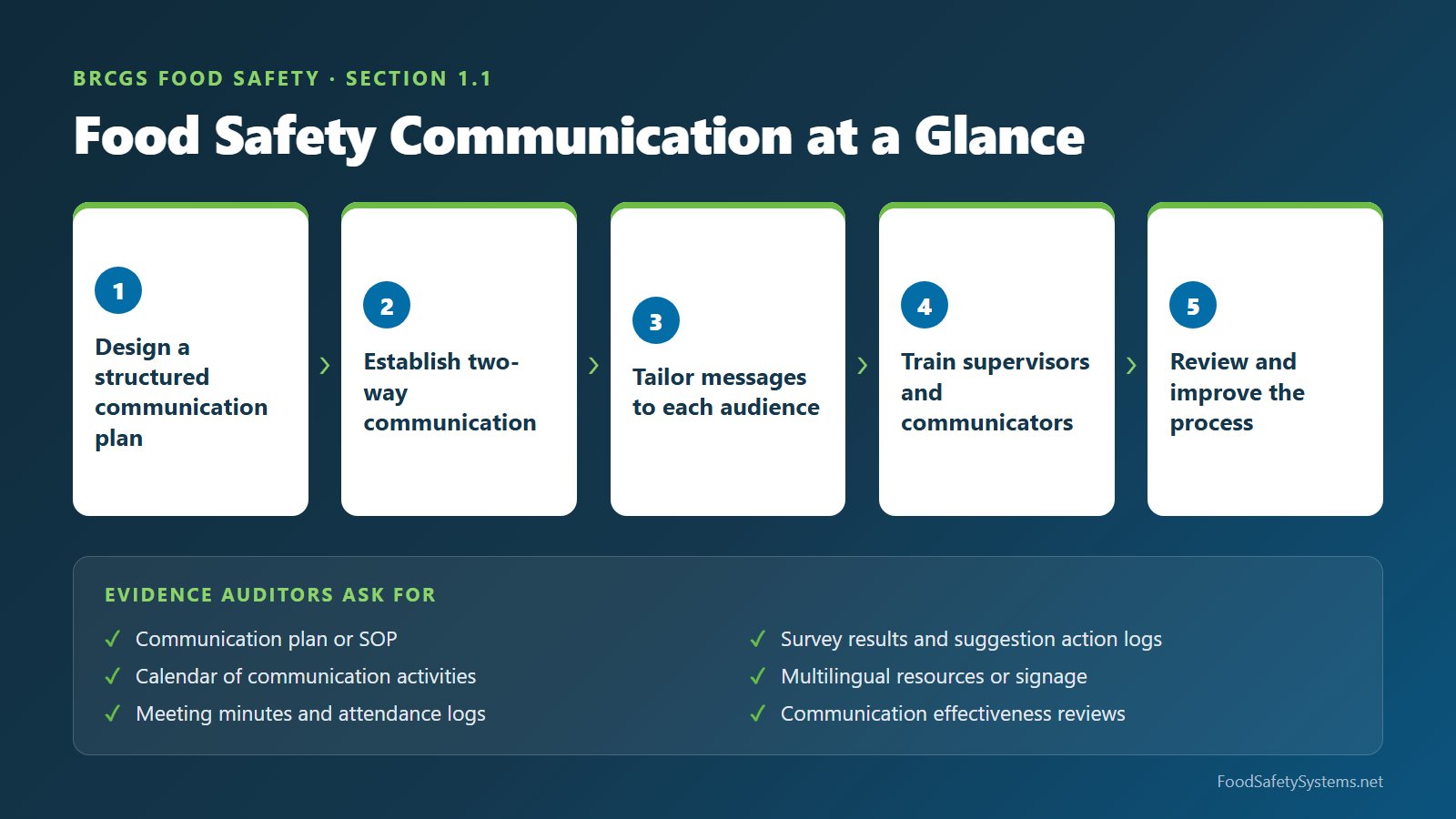
Step by step
Five steps to effective communication processes
Work through these steps in order. Each one lists what to put in place and the records that prove it works.
Step 1
Design a structured communication plan
What to put in place
✓ Purpose, target audience and frequency
✓ Message types: policy updates, recalls, audit preparation, performance feedback
✓ Methods: digital (email, intranet), physical (posters, bulletin boards) and verbal (meetings, toolbox talks)
Evidence to maintain
✓ Communication plan or SOP
✓ Calendar of recurring communication activities
✓ Defined roles for communicators and approvers
Step 2
Establish two-way communication
What to put in place
✓ Regular team meetings or shift huddles
✓ Employee feedback sessions and suggestion boxes
✓ Anonymous surveys on food safety awareness
Evidence to maintain
✓ Meeting minutes and attendance logs
✓ Survey results and response summaries
✓ Action logs based on staff suggestions
Step 3
Tailor communication to audience needs
What to put in place
✓ Use visual aids and translated materials where needed
✓ Match the format to the role, such as visual cues for production staff and detailed SOPs for QA
✓ Reinforce messages with examples and repetition
Evidence to maintain
✓ Multilingual resources or signage
✓ Department-specific memos or training handouts
✓ Communication effectiveness reviews
Step 4
Train supervisors and communicators
What to put in place
✓ Communication expectations from leadership
✓ How to cascade messages effectively
✓ How to gather and report staff feedback
Evidence to maintain
✓ Training attendance logs and materials
✓ Communication protocols or scripts
✓ Staff evaluations or feedback forms
Step 5
Review and improve communication processes
What to put in place
✓ Monitor message clarity, delivery consistency and employee understanding
✓ Collect communication-related audit findings or complaints
✓ Update processes based on feedback and performance
Evidence to maintain
✓ Internal audit or self-assessment reports
✓ Revised communication SOPs or plans
✓ Record of improvements and action items
Avoid nonconformities
Common communication audit findings and how to fix them
No structured communication plan
Fix: develop a documented communication strategy and assign roles.
One-way, top-down-only communication
Fix: put systems in place for staff feedback and open dialogue.
Messages not understood by staff
Fix: tailor content for clarity and provide multilingual access.
No evidence of communication activities
Fix: log communications, keep minutes and document responses.
Audit day
Auditor verification checklist
Expect auditors to ask for:
✓ A documented communication process or SOP
✓ Evidence of company-wide communication activities
✓ Proof that all staff received and understood key messages
✓ Feedback logs, surveys or communication effectiveness reports
The benefit
Why communication matters
Good communication does more than pass the audit:
✓ Builds trust and transparency in the food safety system
✓ Supports a timely response to hazards or audits
✓ Aligns all employees with quality and safety objectives
✓ Shows leadership commitment during certification audits
Implementation roadmap
From a written plan to continuous improvement
Phase 1
Build your system
✓ Write a communication plan or SOP
✓ Define audiences, channels, frequency and roles
Phase 2
Engage and deliver
✓ Use multiple channels and formats suited to each staff level
✓ Promote two-way interaction for feedback
Phase 3
Monitor and improve
✓ Review communication effectiveness regularly
✓ Adjust based on employee feedback, audits or results
FAQ
Food safety communication questions
What does BRCGS Section 1.1 require for communication?
It requires a demonstrable and effective system for communicating food safety and quality information to all staff, with senior management responsible for making sure messages are timely and relevant.
Is top-down communication enough?
No. One-way, top-down-only communication is a common audit finding. Add two-way channels such as shift huddles, feedback sessions, suggestion boxes and anonymous surveys, and log the actions you take on staff suggestions.
How do we prove staff understood key messages?
Keep meeting minutes and attendance logs, survey results, feedback logs and communication effectiveness reviews. Auditors look for proof that all staff received and understood key messages.
Related guides
More senior management commitment guides
Food Safety Culture
Build and maintain a food safety culture plan led by senior management.
Read the guide →
Food Safety and Quality Objectives
Set SMART objectives and communicate them across your site.
Read the guide →
Organizational Structure
Define reporting lines and communicate them to all relevant staff.
Read the guide →
Build effective communication processes for your site
We provide communication SOP templates, communication logbooks and schedules, supervisor communication training materials, and food safety awareness posters and feedback tools.
Food Safety Systems is an independent consulting provider and is not affiliated with, endorsed by or certified by BRCGS or the British Retail Consortium. BRCGS® is a registered trademark of the British Retail Consortium Trading Ltd. For official requirements, visit www.brcgs.com. Read our disclaimer.