BRCGS Global Standard for Storage & Distribution
Temperature Control Measures for BRCGS Storage & Distribution
Effective temperature control measures keep temperature-sensitive products safe from receipt to dispatch. This guide explains what the BRCGS Global Standard for Storage & Distribution expects, the five steps to put controls in place, and the records auditors ask to see.
Requirement overview
What the standard requires for temperature control
The BRCGS Global Standard for Storage & Distribution requires that all temperature-sensitive products are kept within specified temperature ranges throughout receipt, storage, handling and dispatch. These controls must be monitored, recorded and verified to protect product safety and quality.
The standard requires procedures that ensure all products are stored and transported at temperatures appropriate to the product.
Poor temperature control can lead to microbial growth, product spoilage, or failure to meet regulatory and customer requirements.
Key compliance objectives
✓ Keep storage and transport temperatures within acceptable ranges
✓ Use calibrated equipment for continuous or manual monitoring
✓ Document and review all temperature logs and deviations
✓ Protect product integrity and safety throughout the supply chain
Step by step
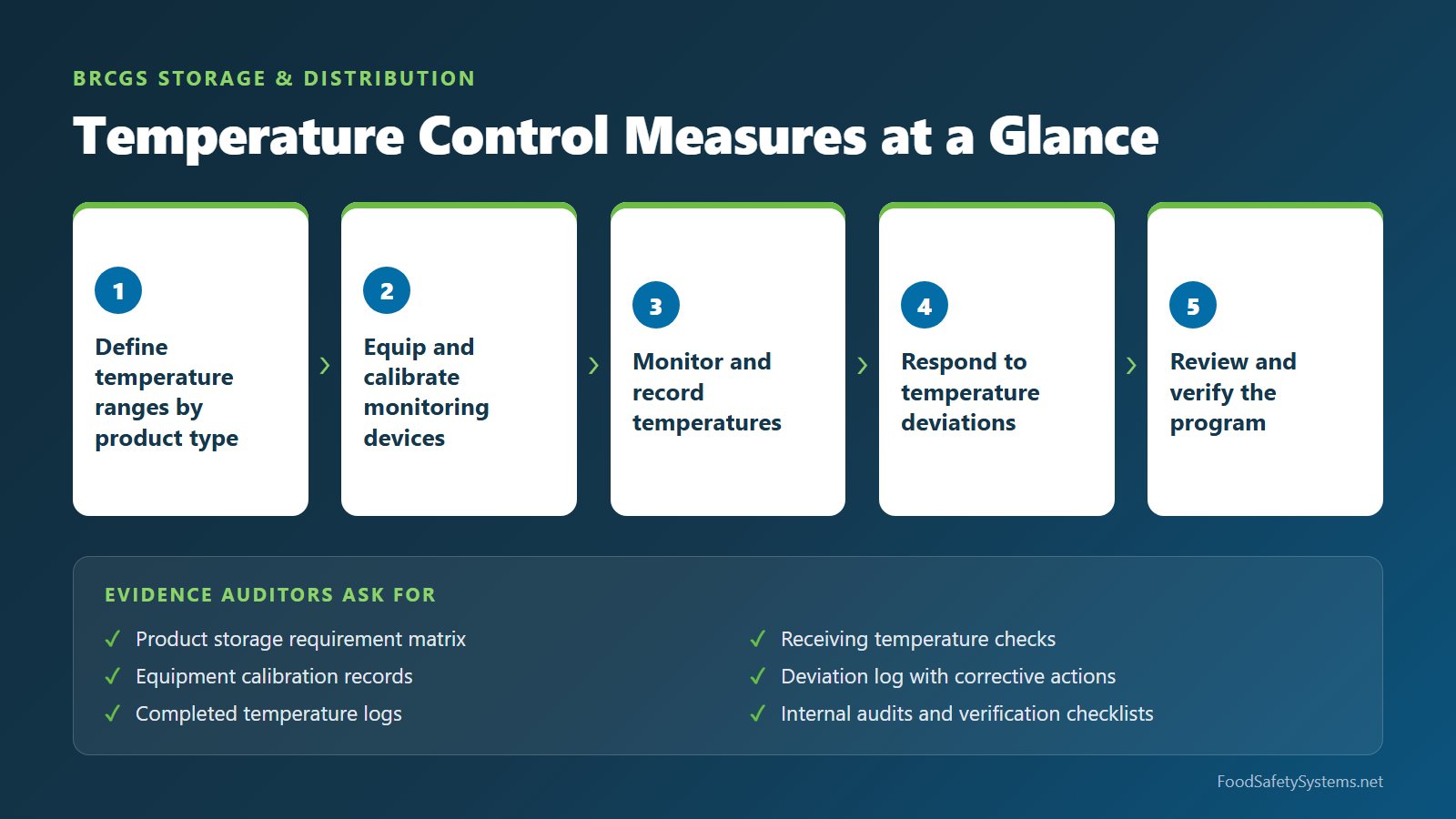
Five steps to effective temperature control measures
Work through these steps in order. Each one lists what to put in place and the records that prove it works.
Step 1
Define temperature requirements by product type
What to put in place
✓ Identify and list the products that need temperature control
✓ Set acceptable temperature ranges (for example frozen ≤ -18°C, chilled 0-5°C)
✓ Document product-specific requirements clearly
Evidence to maintain
✓ Product storage requirement matrix
✓ Supplier or customer specifications
✓ Regulatory temperature standards
Step 2
Equip and calibrate monitoring devices
What to put in place
✓ Continuous digital monitoring (data loggers, sensors)
✓ Manual checks with calibrated thermometers
✓ Alarms for out-of-range events
Evidence to maintain
✓ Equipment calibration records
✓ Maintenance logs for temperature devices
✓ Sensor location validation records
Step 3
Monitor and record temperatures
What to put in place
✓ Continuous (automated) or scheduled (manual) monitoring based on product sensitivity
✓ Temperature checks at receiving, storage, picking and dispatch
✓ Immediate response to temperature deviations
Evidence to maintain
✓ Completed temperature logs (manual or electronic)
✓ Records of receiving temperature checks
✓ Out-of-specification alerts and corrective actions
Step 4
Respond to temperature deviations
What to put in place
✓ Quarantine the affected product
✓ Find the root cause and check the equipment
✓ Notify QA or a supervisor to decide on disposition
Evidence to maintain
✓ Deviation log with root cause and corrective actions
✓ Product disposition records
✓ Preventive action reports
Step 5
Run internal reviews and verification
What to put in place
✓ Monthly review of temperature logs and deviation reports
✓ Random spot checks by the QA team
Evidence to maintain
✓ Internal audit reports
✓ Verification checklists
✓ Minutes of cold chain review meetings
Avoid nonconformities
Common temperature control audit findings and how to fix them
No documented temperature specifications
Fix: create product-specific storage requirement sheets.
Incomplete or missing logs
Fix: standardize monitoring forms and make sure they are completed on time.
Uncalibrated equipment
Fix: put a scheduled calibration and verification process in place.
No corrective action for deviations
Fix: require documented CAPA and review it in management meetings.
Audit day
Auditor verification checklist
During a BRCGS Storage & Distribution audit, expect to present:
✓ Product temperature requirement documentation
✓ Calibration certificates for monitoring devices
✓ Completed and reviewed temperature logs
✓ Evidence of corrective and preventive actions
✓ SOPs for temperature control and deviation handling
The benefit
Why temperature control matters
Good temperature control does more than pass the audit:
✓ Supports compliance with the BRCGS Global Standard for Storage & Distribution and legal requirements
✓ Prevents spoilage, food safety risks and customer complaints
✓ Builds trust in the integrity of your cold chain
✓ Improves audit readiness and operational accountability
Implementation roadmap
From product requirements to continuous improvement
Phase 1
Build your program
✓ Identify temperature-sensitive products
✓ Document temperature requirements by product group
Phase 2
Train and equip
✓ Calibrate monitoring tools and alarms
✓ Train warehouse, receiving and dispatch staff
Phase 3
Monitor and respond
✓ Keep temperature logs and checklists
✓ Investigate deviations and take corrective action
Phase 4
Review and improve
✓ Run periodic internal reviews
✓ Adjust procedures as equipment or product lines change
FAQ
Temperature control measures questions
What does BRCGS Storage & Distribution require for temperature control?
It requires that temperature-sensitive products stay within specified ranges through receipt, storage, handling and dispatch, with procedures that keep all products at temperatures appropriate to the product, and controls that are monitored, recorded and verified.
How often should temperatures be monitored?
Continuously with automated systems, or on a manual schedule set by product sensitivity. Check temperatures at receiving, storage, picking and dispatch, and respond immediately to any deviation.
What should happen when a temperature goes out of range?
Quarantine the affected product, investigate the root cause and check the equipment, and notify QA or a supervisor to decide on disposition. Record the deviation, the corrective and preventive actions, and the product disposition.
Related guides
More BRCGS Storage & Distribution guides
Warehousing Hygiene & Maintenance
Cleaning, maintenance and inspections that keep storage areas fit for food.
Read the guide →
Transport & Delivery Conditions
Set product-specific transport conditions and check deliveries on arrival.
Read the guide →
Cross-Docking Traceability & Control
Keep short-stay products identified, traceable and protected.
Read the guide →
Get your temperature control measures audit-ready
We provide temperature monitoring SOP templates, deviation response forms and CAPA logs, calibration tracking tools and cold chain verification checklists.
Food Safety Systems is an independent consulting provider and is not affiliated with, endorsed by or certified by BRCGS or the British Retail Consortium. BRCGS® is a registered trademark of the British Retail Consortium Trading Ltd. For official requirements, visit www.brcgs.com. Read our disclaimer.