BRCGS Food Safety Issue 9 · Sections 5.6 & 5.7
BRCGS Product Release Criteria: Sections 5.6 & 5.7 Guide
Clear product release criteria, named release authority and complete records make sure only conforming product leaves your site. This guide shows what BRCGS Sections 5.6 and 5.7 expect, the four steps to put it in place, and the evidence auditors ask to see.
Requirement overview
What BRCGS requires for product release
BRCGS requires that all finished products are held under control until inspection, testing and verification confirm they meet defined food safety and quality criteria. Product must not be released without approval from authorized personnel.
Section 5.7 requires that product is released only by authorized personnel, once all release procedures are complete and records are available to show the product meets specification.
Product release is a critical control step in the supply chain: a failure here can let non-compliant or unsafe food reach the market.
Key compliance objectives
✓ Release no product until it meets all specifications
✓ Assign and document release authority to qualified personnel
✓ Keep records of inspection, testing and release approvals
✓ Prevent release of non-conforming or suspect product
Step by step
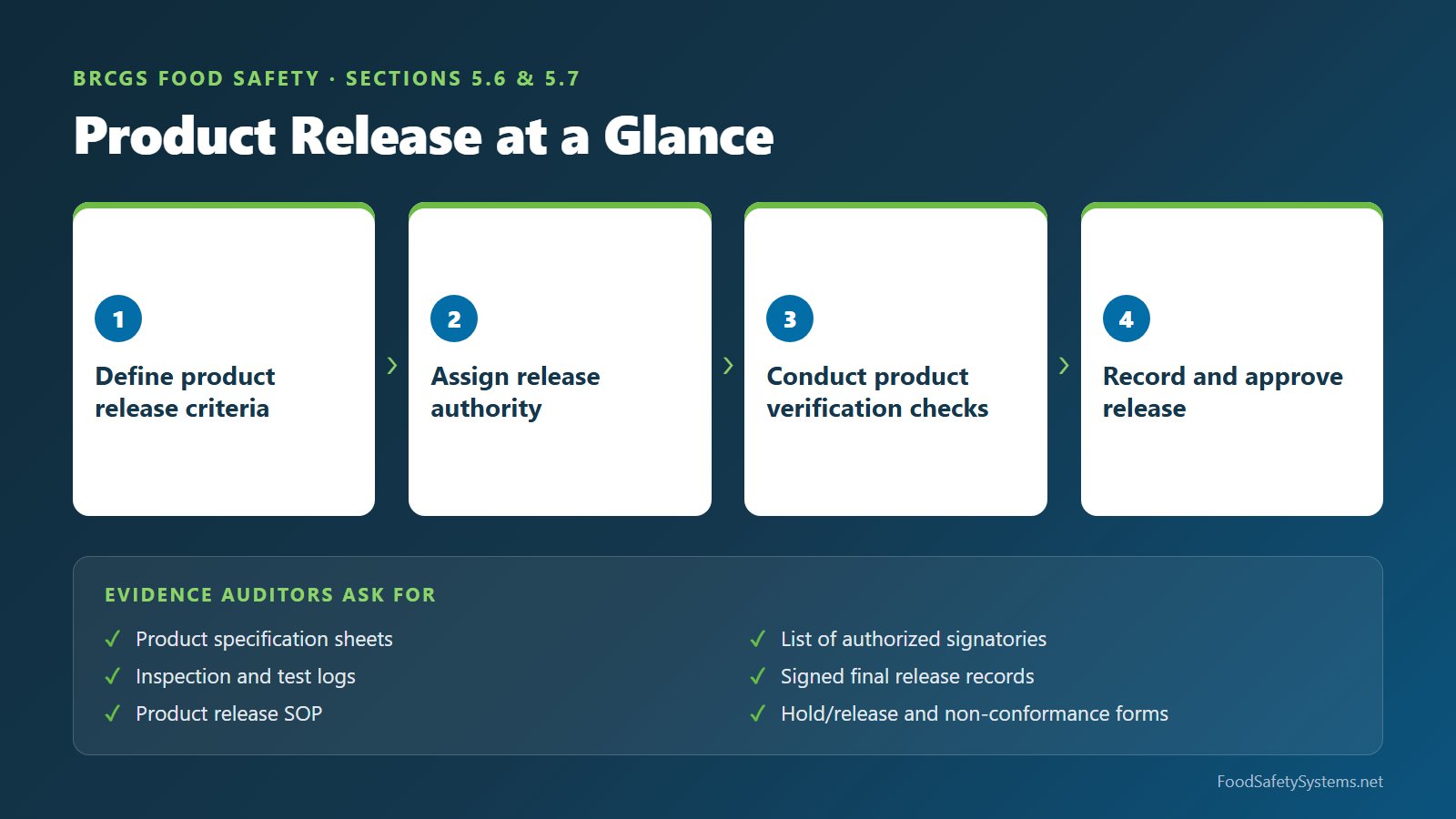
Four steps from product release criteria to signed release
Work through these steps in order. Each one lists what to put in place and the records that prove it works.
Step 1
Define product release criteria
What to put in place
✓ All required inspections and laboratory tests completed
✓ Conformance with finished product specifications (micro, chemical, sensory and others)
✓ Label accuracy, packaging integrity and code dates verified
Evidence to maintain
✓ Product specification sheets
✓ Completed inspection and test logs
✓ Certificates of analysis, if applicable
Step 2
Assign release authority
What to put in place
✓ Authorized roles may include the QA Manager, Site Technical Manager or a designated QA Release Officer
✓ Only trained, authorized individuals can approve release
✓ Keep a list of authorized signatories and their responsibilities
Evidence to maintain
✓ Product release SOP
✓ Authorization and training records
✓ Signature verification list
Step 3
Conduct product verification checks
What to put in place
✓ Sensory checks (appearance, texture, aroma)
✓ Lab test results, such as allergen, pathogen or moisture content
✓ Packaging, date coding and traceability checks
Evidence to maintain
✓ Inspection reports or checklists
✓ QC sampling results
✓ Records of failed or rejected lots and their disposition
Step 4
Record and approve product release
What to put in place
✓ Signed or initialed and dated by an authorized person
✓ Clear reference to batch or lot numbers and test results
✓ Justification for release or hold
Evidence to maintain
✓ Final product release records
✓ Retained samples, if applicable
✓ Non-conformance or hold/release forms
Avoid nonconformities
Common product release audit findings and how to fix them
Products released without approval
Fix: allow only authorized personnel to release product.
Missing or incomplete release records
Fix: use standardized product release forms and train the QA team.
Lab tests pending at the time of release
Fix: introduce a hold-and-release protocol with documented verification.
No evidence of specification checks
Fix: cross-check against product specification sheets and keep the inspection results.
Audit day
Auditor verification checklist
During a BRCGS audit, expect to present:
✓ Your product release procedure (SOP)
✓ A list of authorized release personnel
✓ Product release records with batch or lot traceability
✓ QC inspection and test results that support each release
✓ Records of non-conforming products and their resolution
The benefit
Why release control matters
A controlled release process:
✓ Prevents release of unsafe or non-compliant product
✓ Improves traceability and accountability
✓ Reduces regulatory and brand risk
✓ Strengthens consumer trust and audit readiness
Implementation roadmap
From release SOP to continuous improvement
Phase 1
Build your control framework
✓ Create and approve a product release SOP
✓ Define inspection and testing criteria for each product
Phase 2
Assign and train
✓ Give release authority to qualified personnel
✓ Train QA staff on inspection protocols and documentation
Phase 3
Operate and monitor
✓ Run checks consistently on every production batch
✓ Record all results, approvals and non-conformances
Phase 4
Improve continuously
✓ Review release failures and implement CAPA
✓ Audit the release process to confirm compliance
FAQ
Product release questions
What should product release criteria include?
Completion of all required inspections and laboratory tests, conformance with the finished product specification, and verification of label accuracy, packaging integrity and code dates.
Who can release product under BRCGS?
Only trained, authorized personnel, such as the QA Manager, Site Technical Manager or a designated QA Release Officer. Keep a list of authorized signatories.
What must a product release record show?
The signature or initials of an authorized person and the date, a clear reference to batch or lot numbers and test results, and the justification for release or hold.
Related guides
More BRCGS product control guides
Product Testing & Inspection
The risk-based testing program that feeds release decisions.
Read the guide →
Product Claims & Traceability
Lot coding and traceability linked to release and recall.
Read the guide →
Product Labeling
Label verification and approval before and during production.
Read the guide →
Get your product release criteria audit-ready
We provide product release SOP templates, quality inspection and test result logs, release authority tracking forms and product release audit checklists.
Food Safety Systems is an independent consulting provider and is not affiliated with, endorsed by or certified by BRCGS or the British Retail Consortium. BRCGS® is a registered trademark of the British Retail Consortium Trading Ltd. For official requirements, visit www.brcgs.com. Read our disclaimer.