BRCGS Food Safety Issue 9 · Sections 5.4 & 3.9
BRCGS Product Claims and Traceability: Sections 5.4 & 3.9 Guide
Product claims must be substantiated and legal, and every ingredient, pack and finished lot must be traceable. This guide shows what BRCGS Sections 5.4 and 3.9 expect, the four steps to put them in place, and the evidence auditors ask to see.
Requirement overview
What BRCGS requires for product claims and traceability
BRCGS Food Safety Issue 9 requires that all product claims are substantiated and compliant with regulations, and that a robust traceability system is maintained for ingredient, packaging and finished product movements.
Section 5.4 requires that, where a product is labeled or claimed as suitable for specific groups of consumers or as meeting certain conditions (for example allergen-free, gluten-free or organic), the basis for the claim is documented and substantiated.
Section 3.9 requires a system that traces product by unique lot identification from raw material to finished product and back again. Accurate claims protect consumers and brands; traceability lets your site identify and act on food safety risks quickly.
Key compliance objectives
✓ Make sure all on-pack and off-pack claims are truthful and validated
✓ Keep full traceability of ingredients, packaging and finished goods
✓ Enable timely recall, withdrawal and root cause analysis
✓ Provide accurate, legible and accessible traceability records for audits
Claim types
Common product claims that need substantiation
Every claim on or off pack needs supporting documents. These are the claim types sites most often make.
Allergen-free
For example gluten-free or nut-free.
Ethical
For example free range or fair trade.
Nutritional
For example high protein or low sugar.
Regulatory
For example organic or non-GMO.
Step by step
Four steps to compliant claims and traceability
Work through these steps in order. Each one lists what to put in place and the records that prove it works.
Step 1
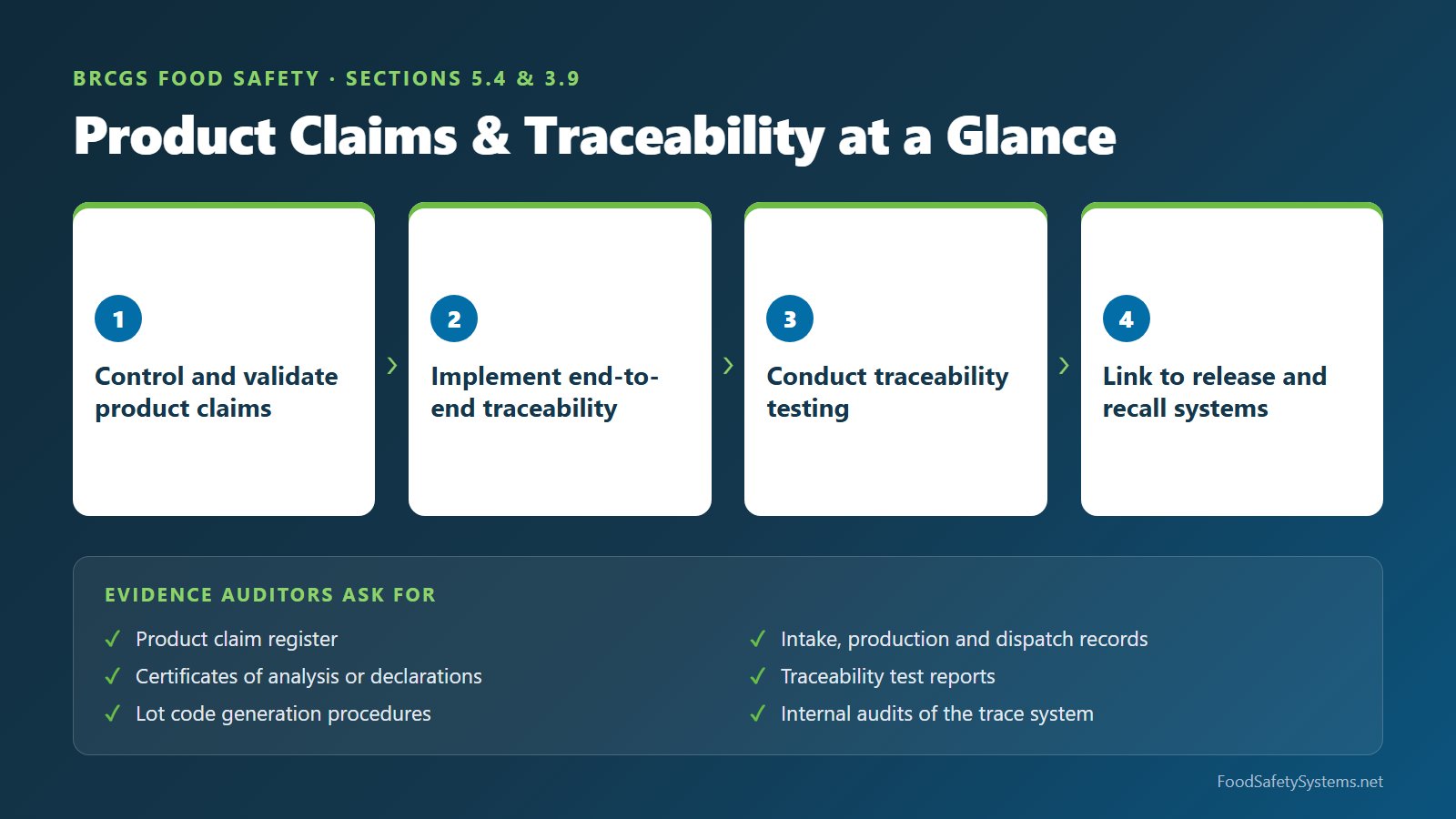
Control and validate product claims
What to put in place
✓ Keep supporting documents and certifications for each claim
✓ Review regulatory guidance (FDA, EU and others) to confirm legal compliance
✓ Validate test data or supplier declarations annually
Evidence to maintain
✓ Product claim register
✓ Certificates of analysis or declarations
✓ Claim approval forms and review records
Step 2
Implement end-to-end traceability
What to put in place
✓ Cover raw materials, ingredients, primary and secondary packaging, WIP and finished products
✓ Track through dispatch and distribution to customer level
✓ Assign unique batch or lot codes and link every material and finished good to them
✓ Map one step forward and one step back in the supply chain
Evidence to maintain
✓ Lot code generation procedures
✓ Material intake logs and production records
✓ Finished goods dispatch records
Step 3
Conduct traceability testing
What to put in place
✓ Test at least annually, or as often as your customer or certification body requires
✓ Select a finished product and trace back to all its components
✓ Trace forward to distribution or customer level
Evidence to maintain
✓ Traceability test reports
✓ Response time tracking
✓ Corrective actions for gaps found
Step 4
Integrate with product release and recall systems
What to put in place
✓ Link traceability to QA release protocols
✓ Align with mock recall, withdrawal and complaint management
✓ Include all private label and branded variations
Evidence to maintain
✓ Product release logs
✓ Complaint and recall cross-references
✓ Internal audit reports on traceability effectiveness
Avoid nonconformities
Common audit findings and how to fix them
Unsupported product claims
Fix: keep claim documentation and certifications up to date.
Incomplete traceability records
Fix: standardize log sheets and tracking software.
Failure to trace within the required time
Fix: run traceability drills and correct documentation errors.
Packaging not linked to finished goods
Fix: include packaging codes in batch tracking and inventory systems.
Audit day
Auditor verification checklist
During a BRCGS audit, be prepared to provide:
✓ Substantiating documents for all marketing and label claims
✓ Traceability logs from raw material to final shipment
✓ Results of traceability tests and internal verification
✓ Evidence of integration with recall and quality systems
The benefit
Why claims and traceability matter
Well-controlled claims and traceability:
✓ Protect your brand from legal and consumer liability
✓ Keep products traceable in a recall or withdrawal
✓ Build customer and auditor confidence
✓ Support marketing with compliant, verifiable claims
Implementation roadmap
From claim register to continuous improvement
Phase 1
Build your program
✓ Create a documented register of all product claims
✓ Develop traceability SOPs from intake to dispatch
Phase 2
Train and validate
✓ Train staff on claim control, trace coding and record-keeping
✓ Run traceability drills under timed conditions
Phase 3
Operate and monitor
✓ Link batch codes across all material stages
✓ Review traceability data and update procedures as needed
Phase 4
Improve continuously
✓ Validate claim sources annually
✓ Improve the speed and accuracy of trace tests through automation or training
FAQ
Product claims and traceability questions
What does BRCGS require for product claims?
Section 5.4 requires that the basis for a claim, such as allergen-free, gluten-free or organic, is documented and substantiated. Keep a claim register, certificates or declarations, and approval and review records.
How often should we test our traceability system?
At least annually, or more often if your customer or certification body requires it. Trace a finished product back to all components and forward to distribution or customer level.
What should a traceability system cover?
Raw materials, ingredients, primary and secondary packaging, work in progress, finished products and dispatch to customer level, all linked by unique batch or lot codes.
Related guides
More BRCGS product control guides
Product Labeling
Verify label content, including claims, before and during production.
Read the guide →
Product Authenticity & Integrity
Food fraud vulnerability assessment and mitigation for raw materials.
Read the guide →
Product Release
Release only conforming product, with batch-level records.
Read the guide →
Get your product claims and traceability audit-ready
We provide product claims verification templates, traceability SOPs and training slides, trace test worksheets and audit checklists, and claim and label approval forms.
Food Safety Systems is an independent consulting provider and is not affiliated with, endorsed by or certified by BRCGS or the British Retail Consortium. BRCGS® is a registered trademark of the British Retail Consortium Trading Ltd. For official requirements, visit www.brcgs.com. Read our disclaimer.