BRCGS Food Safety Issue 9 · Section 5.3
BRCGS Allergen Management System: Section 5.3 Compliance Guide
An allergen management system identifies, manages and controls allergenic materials from the supply chain through production to the finished label. This guide shows what BRCGS Section 5.3 expects, the five steps to put it in place, and the evidence auditors ask to see.
Requirement overview
What BRCGS Section 5.3 requires
BRCGS Food Safety Section 5.3 requires that food businesses have a fully implemented allergen management system to identify, manage and control allergenic materials throughout the supply chain, the production process and finished product labeling.
The system covers risk assessment, handling procedures, prevention of cross-contact and accurate labeling.
Failure to control allergens is one of the most common causes of product recalls and can pose a serious public health risk to allergic consumers.
Key compliance objectives
✓ Identify and assess all allergenic materials on site
✓ Prevent unintended allergen cross-contact
✓ Ensure correct allergen labeling on packaging
✓ Train staff in allergen awareness and control measures
✓ Keep allergen control records for traceability and audit
Step by step
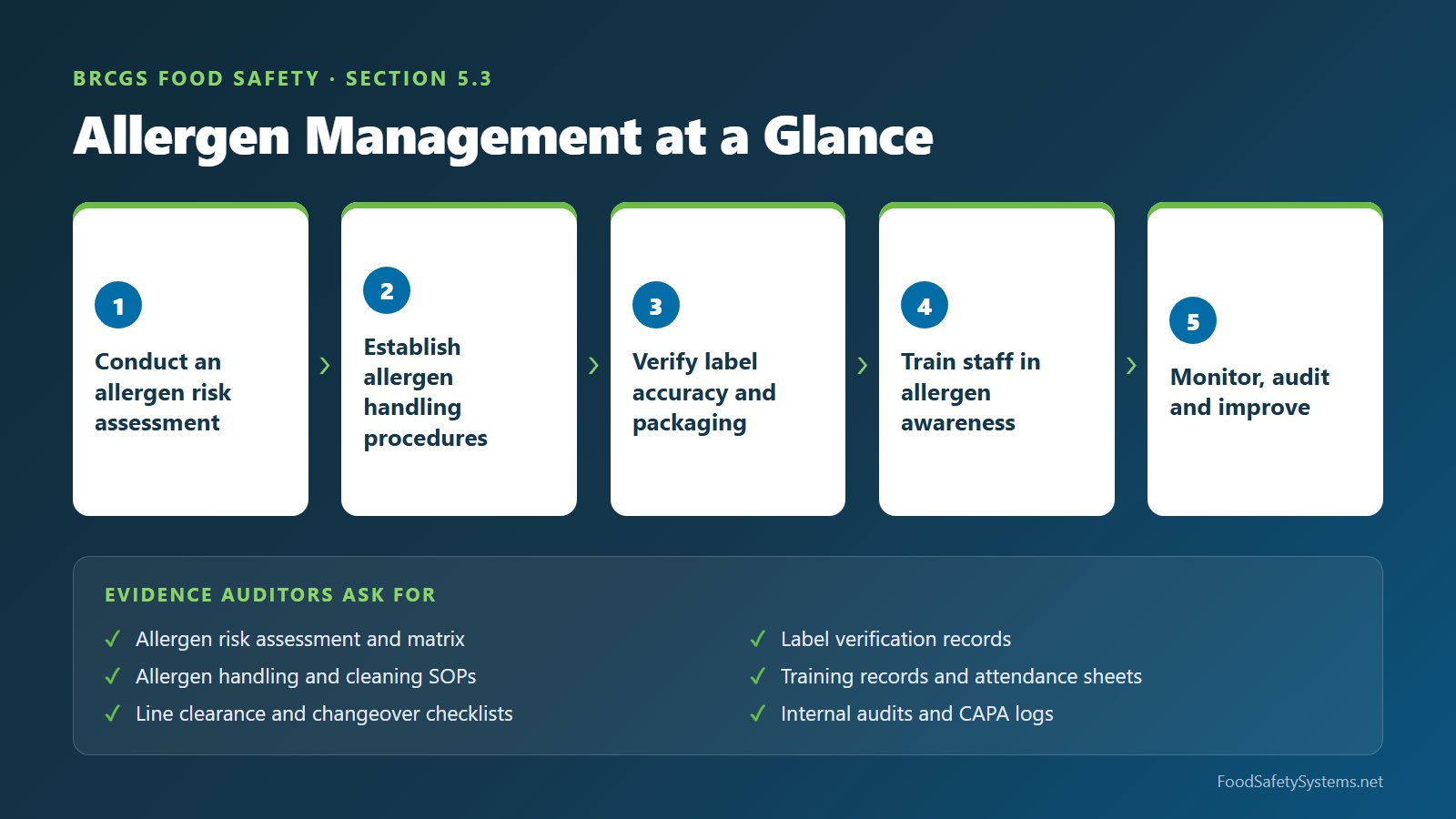
Five steps to an allergen management system
Work through these steps in order. Each one lists what to put in place and the records that prove it works.
Step 1
Conduct an allergen risk assessment
What to put in place
✓ Identify the allergens handled on site, based on local regulations
✓ Evaluate risk at every step: receiving, storage, production, cleaning and labeling
✓ Assess vulnerability to cross-contact and mislabeling
Evidence to maintain
✓ Allergen risk assessment document
✓ Updated allergen matrix and flow diagrams
✓ List of allergenic raw materials with supplier specifications
Step 2
Establish allergen handling procedures
What to put in place
✓ Segregated storage of allergenic ingredients
✓ Dedicated equipment or cleaning protocols for changeovers
✓ Scheduling to minimize risk, such as allergen-to-non-allergen sequencing
Evidence to maintain
✓ SOPs for allergen handling and cleaning
✓ Line clearance and changeover checklists
✓ Visual or color-coded identification systems
Step 3
Verify label accuracy and packaging controls
What to put in place
✓ Check every label against the finished product formulation
✓ Implement label approval and verification procedures
✓ Make sure the correct packaging is used every time
Evidence to maintain
✓ Label verification records
✓ Final pack checks and label reconciliation logs
✓ Mock product labels with highlighted allergens
Step 4
Train staff in allergen awareness
What to put in place
✓ The major (big 8) or regionally regulated allergens
✓ Cross-contact risks and control points
✓ Emergency procedures in case of allergen exposure
Evidence to maintain
✓ Allergen training materials and attendance sheets
✓ Post-training evaluations or quizzes
✓ Annual refresher training schedule
Step 5
Monitor, audit and improve
What to put in place
✓ Internal audits of allergen storage and labeling
✓ Periodic review of allergen risk assessments
✓ Investigation and corrective action for allergen-related complaints
Evidence to maintain
✓ Allergen audit results and non-conformance reports
✓ SOPs updated from findings
✓ Corrective and preventive action (CAPA) logs
Avoid nonconformities
Common allergen audit findings and how to fix them
Unsegregated storage of allergens
Fix: use physical barriers, labeling or color-coding to keep allergenic materials apart.
Mislabeling or incorrect allergen information
Fix: review the label approval workflow and the final pack checks.
No allergen risk assessment
Fix: carry out and document an allergen risk assessment for each product line.
Incomplete training records
Fix: schedule regular allergen training and keep attendance logs.
Audit day
Auditor verification checklist
Expect auditors to review:
✓ Allergen risk assessment and matrix
✓ Allergen handling SOPs and changeover checklists
✓ Label verification records and controls
✓ Staff training records on allergen awareness
✓ Internal audits and evidence of continuous improvement
The benefit
Why allergen control matters
A working allergen management system:
✓ Prevents life-threatening reactions in allergic consumers
✓ Reduces the risk of costly allergen-related recalls
✓ Shows strong product control under BRCGS Section 5.3
✓ Reinforces consumer trust and brand credibility
Implementation roadmap
From first assessment to continuous improvement
Phase 1
Build your allergen control program
✓ Identify all allergens handled on site
✓ Conduct and document a risk assessment
✓ Establish allergen handling SOPs
Phase 2
Train and execute
✓ Train all relevant staff on allergen risks and controls
✓ Implement segregation, scheduling and cleaning procedures
Phase 3
Verify and monitor
✓ Run label checks, internal audits and cleaning verification
✓ Track corrective actions for any deviation
Phase 4
Improve continuously
✓ Update controls after complaints, recalls or process changes
✓ Review allergen risk annually or when new products are introduced
FAQ
Allergen management system questions
What does BRCGS Section 5.3 require for allergens?
A fully implemented allergen management system that identifies, manages and controls allergenic materials across the supply chain, production and labeling. It includes risk assessment, handling procedures, cross-contact prevention and accurate labeling.
How often should the allergen risk assessment be reviewed?
Review it periodically, at least annually, and whenever new products are introduced or complaints, recalls or process changes show the controls need updating.
What allergen records do BRCGS auditors check?
Typically the allergen risk assessment and matrix, handling SOPs and changeover checklists, label verification records, staff training records and internal audits showing continuous improvement.
Related guides
More BRCGS product control guides
Product Labeling
Label verification and approval that keeps allergen declarations correct.
Read the guide →
Product Design & Development
Assess allergen and other risks before a new product launches.
Read the guide →
Product Testing & Inspection
Risk-based testing, including allergen verification, before release.
Read the guide →
Get your allergen management system audit-ready
We provide allergen risk assessment templates, allergen matrix and SOP templates, label review forms and training materials, and internal audit checklists for allergen control.
Food Safety Systems is an independent consulting provider and is not affiliated with, endorsed by or certified by BRCGS or the British Retail Consortium. BRCGS® is a registered trademark of the British Retail Consortium Trading Ltd. For official requirements, visit www.brcgs.com. Read our disclaimer.