BRCGS Food Safety Issue 9 · Section 4.14
BRCGS Pest Management Program: Section 4.14 Compliance Guide
A risk-based pest management program keeps pests away from your products, raw materials and packaging. This guide shows what BRCGS Section 4.14 expects, the five steps to put it in place, and the evidence auditors ask to see.
Requirement overview
What BRCGS Section 4.14 requires
BRCGS Food Safety Section 4.14 requires that food sites maintain an effective, risk-based pest management program to prevent pest activity and contamination of products, raw materials or packaging.
The program must be proactive, documented, appropriate to the site, the product and the production risk, and run by a competent person: trained internal staff or a qualified external pest control provider.
Good pest control prevents food safety hazards, protects your brand and keeps you audit-ready.
Key compliance objectives
✓ Prevent pest activity in all areas of the facility
✓ Ensure pest control is managed by competent personnel
✓ Keep complete, current records of all pest control activities
✓ Show a proactive, risk-based approach to pest prevention
Step by step
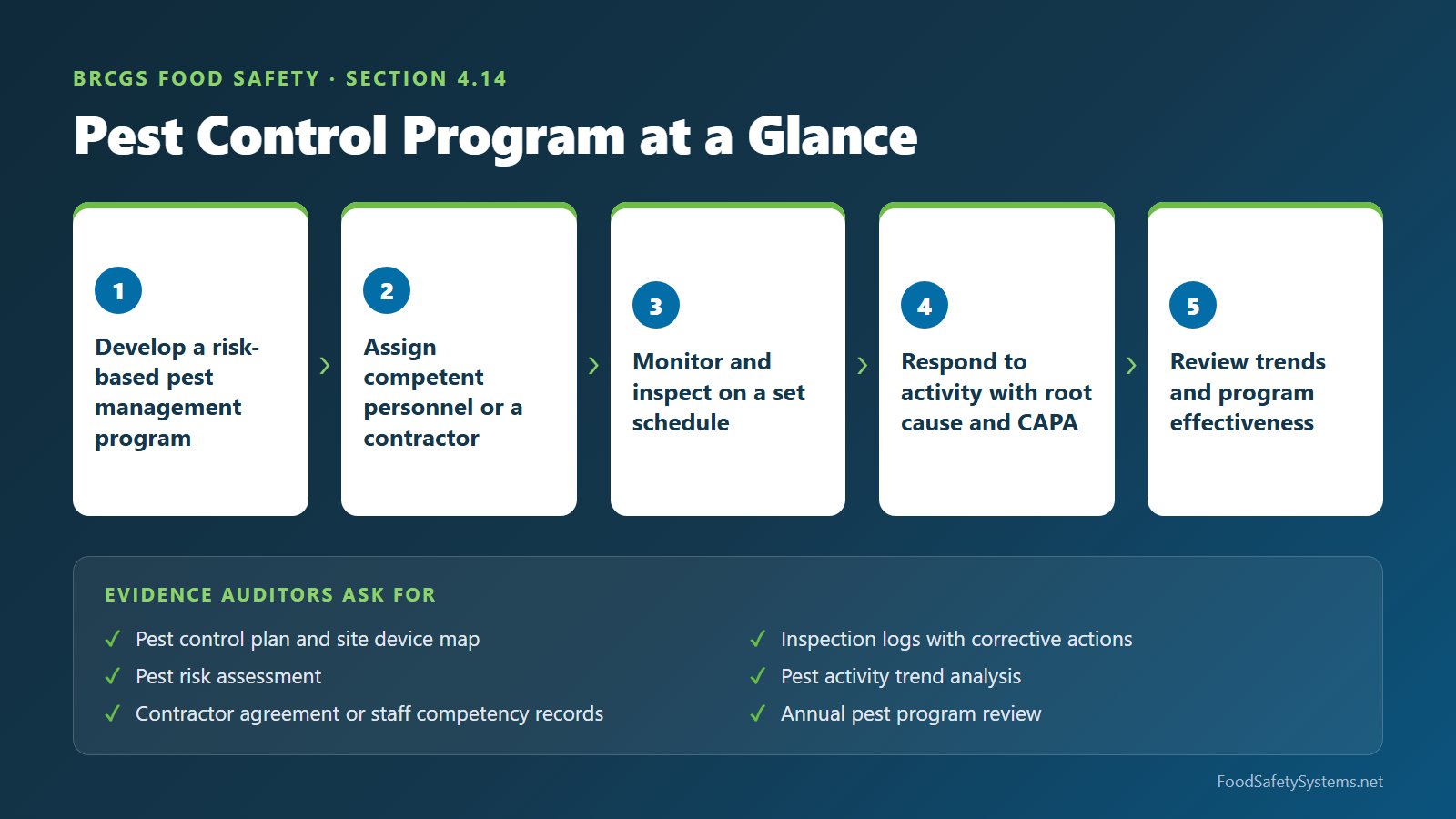
Five steps to a compliant pest management program
Work through these steps in order. Each one lists what to put in place and the records that prove it works.
Step 1
Develop a pest management program
What to put in place
✓ Site risk assessment and pest activity history
✓ Map of pest control devices and monitoring locations
✓ Defined frequencies and target pest species
✓ Emergency procedures for infestations
Evidence to maintain
✓ Pest control plan and site layout map
✓ Pest risk assessment and contractor agreement (if outsourced)
✓ Competency records of pest control personnel
Step 2
Assign responsibility to qualified personnel
What to put in place
✓ Trained internal pest control staff or a certified third-party provider
✓ Defined roles and qualifications
✓ Clear service contracts outlining scope and responsibilities
Evidence to maintain
✓ Training certificates or third-party license
✓ Signed service agreement with scope of work
✓ Contractor contact details and response timelines
Step 3
Conduct regular monitoring and inspections
What to put in place
✓ Routine device checks (bait stations, traps)
✓ Entry points, ceilings, wall cavities and external perimeters
✓ Trending and review of pest activity data
Evidence to maintain
✓ Inspection logs with findings and corrective actions
✓ Site map with device codes and inspection frequencies
✓ Maintenance and cleaning records that reduce pest attraction
Step 4
Respond to pest activity and infestations
What to put in place
✓ Identify the root cause and entry path
✓ Quarantine affected product or areas
✓ Take corrective and preventive action, such as sealing entry points or retraining staff
Evidence to maintain
✓ Pest activity reports and investigation records
✓ CAPA and root cause analysis records
✓ Product disposition records, if applicable
Step 5
Review and validate effectiveness
What to put in place
✓ Monthly service review with your provider
✓ Annual program evaluation
✓ Trending of pest incidents and recurring root causes
Evidence to maintain
✓ Monthly service reports with technician signature
✓ Annual pest program review report
✓ Internal audit findings related to pest control
Avoid nonconformities
Common pest control audit findings and how to fix them
Incomplete or missing pest control logs
Fix: keep signed inspection and service reports consistently, for every visit.
Unqualified personnel managing pests
Fix: use a certified pest control provider or train your in-house staff, and keep the records.
No map of control points or frequencies
Fix: create a detailed site map of devices with a defined inspection schedule.
Lack of trend analysis
Fix: track pest sightings and incidents and review them for patterns.
Audit day
Auditor verification checklist
During a BRCGS audit, expect to provide:
✓ A documented pest management plan
✓ A site map showing pest device locations and risk zones
✓ Service contracts or qualifications of pest control staff
✓ Logs of inspections, findings and corrective actions
✓ Records of trend analysis and program reviews
The benefit
Why a pest management program matters
A well-run program does more than pass the audit:
✓ Prevents contamination of food products and raw materials
✓ Supports regulatory and BRCGS certification compliance
✓ Reduces costly pest-related product losses and recalls
✓ Shows proactive risk management and facility hygiene
Implementation roadmap
From first assessment to continuous improvement
Phase 1
Build your program
✓ Run a site-wide pest risk assessment
✓ Design a mapped, monitored pest control system
Phase 2
Assign and train
✓ Use certified providers or trained internal staff
✓ Define emergency pest response protocols
Phase 3
Monitor and inspect
✓ Schedule and document regular pest control activities
✓ Inspect the building routinely for vulnerabilities
Phase 4
Review and improve
✓ Analyze trends to find recurring issues
✓ Update control points and procedures as risks change
FAQ
Pest management program questions
What does BRCGS Section 4.14 require for pest control?
It requires an effective, risk-based pest management program that is appropriate to the site, the product and the production risk, and that is the responsibility of a competent person or external provider.
Can we run pest control in-house?
Yes, if your internal staff are trained and competent. Keep training records and defined roles. Otherwise use a certified third-party provider under a signed service agreement.
What pest control records do BRCGS auditors check?
Typically the pest management plan, the device site map, contracts or staff qualifications, inspection logs with corrective actions, and records of trend analysis and program reviews.
Related guides
More BRCGS site standards guides
Cleaning & Sanitation
Housekeeping and hygiene controls that also reduce pest attraction.
Read the guide →
Environmental Monitoring
Verify hygiene in production areas with a structured monitoring program.
Read the guide →
Maintenance & Repair
Keep the building fabric sealed and equipment in good repair.
Read the guide →
Get your pest management program audit-ready
We provide pest control SOP templates and inspection forms, risk assessment and mapping templates, CAPA forms for pest-related incidents and internal pest control training guides.
Food Safety Systems is an independent consulting provider and is not affiliated with, endorsed by or certified by BRCGS or the British Retail Consortium. BRCGS® is a registered trademark of the British Retail Consortium Trading Ltd. For official requirements, visit www.brcgs.com. Read our disclaimer.